Investor anxiety increased again Wednesday as a renewed selloff in government bonds pushed Treasury yields higher and raised concerns that expensive borrowing costs could become a larger obstacle for the stock market.
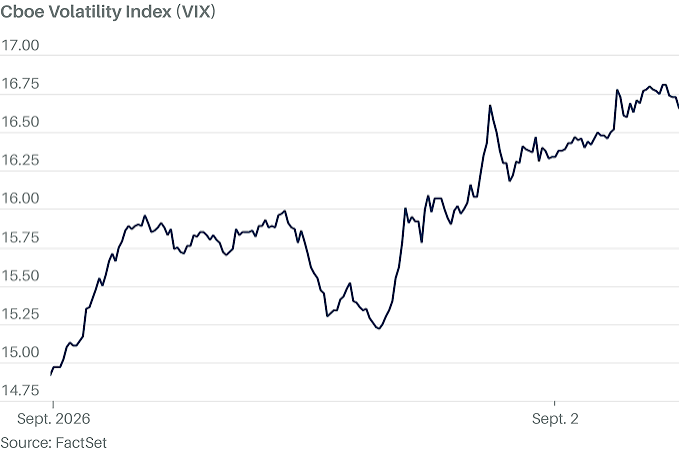
The Cboe Volatility Index, commonly known as the VIX or Wall Street’s fear gauge, climbed to approximately 16.7 during early trading.
The index measures expectations for volatility in the S&P 500 over the coming 30 days based on options-market pricing.
A VIX reading around 16.7 implies that traders are preparing for daily S&P 500 movements of slightly more than 1% on average, although the index does not predict whether those moves will be higher or lower.
Instead, a rising VIX generally indicates that investors are paying more to protect portfolios against larger market swings.
The latest increase came as pressure intensified in the U.S. Treasury market.
The yield on the benchmark 10-year Treasury note moved above 4.8% Wednesday, extending a substantial increase in borrowing costs that developed throughout the summer.
Treasury yields and bond prices move in opposite directions, meaning yields generally rise when investors sell government bonds or demand greater compensation for holding them.
The 10-year yield matters far beyond the bond market.
It influences borrowing costs throughout the U.S. economy and is closely watched when pricing mortgages, corporate debt and other longer-term loans.
It also plays an important role in stock valuations.
When Treasury yields climb, investors can receive larger returns from government debt without taking the same risks associated with owning equities.
That can reduce the relative attractiveness of stocks, particularly companies trading at expensive valuations based on profits expected far into the future.
Several forces have contributed to the rise in yields.
One is energy.
Oil prices have moved sharply higher amid renewed fighting involving the United States and Iran and concerns about possible disruptions to supplies moving through the Middle East.
Higher oil prices can increase gasoline, transportation and production costs across the economy.
Those increases matter to bond investors because they can keep inflation elevated.
If inflation remains stubbornly high, the Federal Reserve may have to maintain restrictive interest rates longer than markets previously expected or potentially raise rates further.
Investors have recently increased their expectations for tighter monetary policy as energy prices rise and inflation risks return to the foreground.
That has added pressure to Treasury prices and pushed yields higher.
The growing federal deficit is another concern.
Large government deficits require the Treasury Department to borrow significant amounts of money by issuing bonds and other securities.
A greater supply of government debt can place upward pressure on yields if investors require higher returns to absorb that borrowing.
Concerns surrounding the long-term trajectory of U.S. government finances have therefore become another important part of the bond-market debate.
Together, rising oil prices, fiscal concerns and the possibility of higher interest rates have helped push borrowing costs upward over the summer.
The result is increasingly being felt in equities.
Stocks have already entered September under pressure as investors reconsider how much they are willing to pay for companies when relatively safe government bonds offer increasingly attractive yields.
That uncertainty is now appearing in the VIX.
A level of 16.7 is not normally associated with extreme market panic.
The VIX can climb dramatically higher during genuine financial crises or sudden market crashes.
But its latest increase shows that investors are becoming less comfortable with the unusually calm trading conditions that characterized portions of the earlier market rally.
The rise also suggests traders believe the S&P 500 could experience larger day-to-day movements as markets react to changes in oil prices, Treasury yields, inflation data and Federal Reserve expectations.
Bond-market conditions may therefore be one of the most important factors determining what happens next for stocks.
If Treasury yields continue moving higher, expensive technology and other growth-oriented stocks could face additional valuation pressure.
Companies could also encounter higher financing costs when raising debt or refinancing existing obligations.
Consumers would feel the impact through borrowing costs as well, especially in housing and other interest-rate-sensitive areas of the economy.
A reversal in yields could provide relief.
Cooling oil prices, weaker inflation readings, improving federal fiscal expectations or economic data that reduce the likelihood of further Federal Reserve tightening could encourage investors to return to Treasuries, pushing yields lower.
That could make stocks comparatively more attractive again and reduce demand for volatility protection.
For now, however, markets remain caught between elevated equity valuations and an increasingly difficult interest-rate environment.
The VIX’s move toward 17 shows that investors are not necessarily expecting a major market collapse, but they are becoming more prepared for turbulence.
With the 10-year Treasury yield above 4.8%, energy prices elevated and uncertainty surrounding both inflation and future Fed decisions, the bond market is once again becoming a major source of anxiety for Wall Street.
The immediate concern is no longer simply whether stocks can continue rising.
It is whether the market can absorb another increase in borrowing costs without triggering a much larger reassessment of stock valuations.