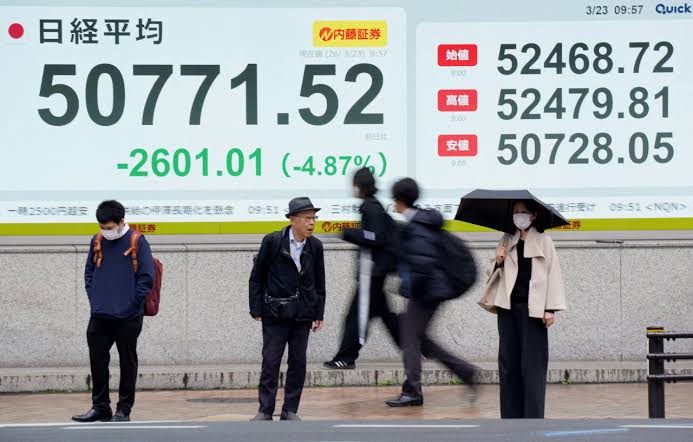
Asian stocks moved broadly lower Thursday as oil held above $100 a barrel and U.S. Treasury yields remained near multiyear highs, reviving the inflation-and-interest-rate concerns that have become one of the biggest risks to global equity markets.
Technology shares were among the weakest areas as investors reacted to the combination of higher energy costs, expensive borrowing conditions and uncertainty over whether the Federal Reserve will raise interest rates at its September 15-16 meeting.
The regional selloff moderated as the session progressed. Japan’s Nikkei 225 was down roughly 0.1% after falling nearly 1% earlier, while the broader TOPIX slipped about 0.1%. South Korea’s KOSPI also recovered most of an early decline of nearly 1.5% and traded around 0.1% lower.
Hong Kong remained under considerably more pressure. The Hang Seng Index dropped about 1.6%, while the Hang Seng TECH Index lost more than 2%. Mainland China’s Shanghai Composite declined roughly 0.4% and the CSI 300 fell about 0.5%.
Australia’s S&P/ASX 200 dropped around 1.2%, Singapore’s Straits Times Index lost roughly 0.7%, and India’s Nifty 50 was little changed.
The common pressure across those markets was not a company-specific earnings disappointment.
Investors are confronting the possibility that a new energy shock could keep global inflation elevated at the same time bond markets are already demanding much higher yields.
That combination is especially uncomfortable for technology and other growth stocks because their valuations depend heavily on expectations for profits many years into the future. When long-term interest rates rise, those future earnings become less valuable in today’s dollars.
Oil Above $100 Reopens the Inflation Problem
Brent crude remained around $101 a barrel Thursday after breaking through $100 on Wednesday for the first time since July.
The surge followed another escalation in the Middle East, including attacks on shipping tied to the conflict involving the United States and Iran, raising concern that additional disruptions could restrict energy flows through one of the world’s most important oil-producing regions.
Brent briefly traded as high as roughly $101.94 during Thursday’s Asian session before giving back part of the advance.
Oil’s move matters well beyond energy stocks.
Higher crude prices can eventually raise gasoline, diesel, aviation, manufacturing and shipping costs. Businesses may absorb some of those increases through lower margins, but others can pass them through to customers.
If that happens broadly enough, inflation can remain elevated even if demand elsewhere in the economy begins slowing.
That is the scenario currently troubling bond and equity investors.
The pressure is already visible in U.S. markets. The S&P 500 fell 0.5% Wednesday, the Nasdaq Composite declined 0.6% and the Dow Jones Industrial Average dropped 405 points, or 0.8%.
Energy was one of the few areas benefiting from the oil move, while sectors more sensitive to consumer spending and borrowing costs came under pressure.
Treasury Yields Remain Near Their Highest Since 2023
The other major problem is the bond market.
The benchmark U.S. 10-year Treasury yield remained around 4.84% in Thursday’s Asian session after reaching its highest level since 2023 a day earlier.
The 30-year Treasury yield was near 5.29%.
Those levels represent much tighter financial conditions than investors were dealing with during periods when technology stocks benefited from expectations of declining rates.
Treasury announced a $6 billion buyback of longer-dated government securities, but the operation was smaller than some investors had hoped and failed to produce a sustained decline in yields.
The buyback program should not be confused with Federal Reserve quantitative easing.
Treasury uses the operations primarily to improve liquidity in older securities and manage the government’s debt profile. Its August quarterly refunding plan allows for as much as $38 billion of purchases of off-the-run securities during the quarter for liquidity support.
The government still needs to issue debt to finance federal spending, meaning buybacks do not eliminate the broader supply of Treasurys investors are being asked to absorb.
That explains why the bond market can continue pushing yields higher despite larger Treasury purchases.
If investors demand more compensation for inflation, fiscal risk or the opportunity cost of locking money into long-term government bonds, yields can rise until buyers emerge.
For equities, the 10-year Treasury yield has become one of the most important numbers on the screen.
Technology Stocks Feel the Pressure First
Higher bond yields tend to be particularly difficult for companies valued on rapid future growth.
That helps explain why technology shares were among the weakest performers across Asia.
South Korean semiconductor giants Samsung Electronics and SK Hynix initially fell with the broader market before recovering most of their losses.
Hong Kong’s technology index performed much worse, falling more than 2%.
The same valuation pressure showed up in the previous U.S. session, where Nvidia declined roughly 0.9% as the Nasdaq finished lower.
Nothing about a higher Treasury yield directly reduces the number of chips Nvidia, Samsung or SK Hynix can sell tomorrow.
The impact comes through valuation and financing.
If an investor can earn close to 5% from a long-term U.S. government bond, the return required to justify owning a volatile growth stock generally rises as well.
That can compress price-to-earnings multiples even when a company’s underlying business remains healthy.
Higher rates can also make data centers, factories and other capital-intensive technology projects more expensive to finance.
The result is that technology stocks can decline even without new negative company news when global bond yields move sharply higher.
Japan Faces an Additional Risk From the Yen
Japanese stocks are dealing with another variable: a rapidly changing outlook for the Bank of Japan.
The yen has strengthened as traders increase bets that the BOJ will raise interest rates again this month.
BOJ board member Kazuyuki Masu said Thursday that policymakers may eventually need to increase rates more quickly if inflation accelerates, while emphasizing that underlying inflation is approaching the central bank’s 2% target.
The BOJ raised its policy rate to 1% in June, and markets broadly expect another quarter-point increase to 1.25% at the September meeting.
A stronger yen can create difficulties for Japanese exporters.
Companies that generate substantial revenue overseas convert foreign earnings back into fewer yen when the Japanese currency strengthens.
Automakers, electronics manufacturers and industrial companies can therefore come under pressure even if the domestic economic outlook remains stable.
Higher Japanese interest rates could have global implications as well.
Japan has spent decades with extremely low borrowing costs, encouraging investors to borrow cheaply in yen and place money into higher-yielding assets elsewhere.
A narrowing interest-rate gap between Japan and other countries can encourage some of those trades to unwind.
That could create additional volatility in bonds, currencies and equities far outside Japan.
China and Hong Kong Face Their Own Technology Pressures
Chinese markets entered Thursday already dealing with a different set of technology-related concerns.
China’s domestic IPO market has become extremely active, with semiconductor, artificial-intelligence and robotics companies attracting extraordinary investor demand.
At the same time, regulators have begun warning investment banks to be more selective about which technology companies they bring public after several IPOs produced triple-digit first-day gains.
Those concerns were not the direct cause of Thursday’s regional decline, but they add another layer of valuation scrutiny for Chinese technology equities.
The Shanghai Composite’s roughly 0.4% decline and CSI 300’s 0.5% drop were relatively modest compared with Hong Kong.
The Hang Seng TECH Index’s decline of more than 2% suggests internationally traded Chinese technology companies were more exposed to the global repricing of growth stocks as Treasury yields stayed elevated.
Hong Kong also tends to be highly sensitive to U.S. monetary conditions because of the Hong Kong dollar’s link to the U.S. dollar.
When U.S. rates remain high, financial conditions in Hong Kong can stay tight even when China’s domestic economy would benefit from easier policy.
The Fed Is Back at the Center of Global Markets
The most immediate question for investors is whether the Federal Reserve will make the situation more difficult next week.
Fed funds futures were pricing roughly a 60% probability of a rate increase at the September 15-16 meeting during Thursday’s Asian trading session.
Only weeks ago, investors had become more confident that the Fed could keep rates unchanged as some inflation readings improved.
Oil’s return above $100 has complicated that outlook.
The energy shock does not automatically mean the Fed will raise rates. Policymakers frequently look through temporary changes in commodity prices if they do not spread into broader inflation.
But the central bank is already dealing with inflation above its 2% goal.
The Fed’s preferred PCE inflation measure was running at 3.7% in July, while core PCE inflation stood at 3.3%.
That leaves policymakers with less room to ignore another source of price pressure.
The next two U.S. inflation reports therefore carry unusual market importance.
Producer Inflation Comes First
The Bureau of Labor Statistics is scheduled to release August producer-price data Thursday at 8:30 a.m. Eastern time.
Producer prices measure changes in the prices domestic businesses receive for goods, services and construction, making the report one indicator of inflation pressures moving through corporate supply chains.
The Consumer Price Index follows Friday at 8:30 a.m. Eastern.
Those releases will provide the final major inflation evidence before the Fed meets.
A cooler-than-expected PPI and CPI could pull Treasury yields lower and reduce expectations for another rate increase.
That would likely provide relief for technology and other rate-sensitive stocks.
Hotter numbers could produce the opposite reaction.
If markets become more convinced that inflation is reaccelerating, the probability of another Fed increase could rise above the current 60% level, potentially pushing the 10-year yield closer to 5%.
Oil makes Friday’s consumer inflation report more complicated because much of the latest crude increase happened after August ended.
The September inflation numbers could therefore capture more of the energy shock than the data investors receive this week.
That means even relatively benign August inflation may not completely eliminate concern about what comes next.
Higher Oil Creates Winners and Losers Across Asia
The impact of $100 oil also varies significantly by country.
Large energy importers such as Japan, South Korea and India are generally more vulnerable to sustained increases in crude prices because they must spend more to purchase energy from abroad.
That can weaken trade balances, raise inflation and put pressure on currencies.
India is particularly sensitive because it imports most of its crude-oil requirements.
Higher energy costs can increase the country’s import bill and create pressure on inflation, potentially complicating policy for the Reserve Bank of India.
Oil producers and energy companies face a very different setup.
Higher commodity prices can increase revenue and cash flow for producers as long as the increase is not offset by production disruptions or government intervention.
That divergence is similar to what appeared in the U.S. market Wednesday, where energy stocks rose even as the major indexes declined.
For diversified investors, the current market therefore looks less like a simple risk-off event and more like another sector rotation driven by inflation.
Why the Next Move in Oil Matters So Much
Brent holding above $100 would create a different investment environment from a brief geopolitical spike followed by a rapid reversal.
If oil falls back toward previous levels, bond investors may become more comfortable that the energy shock will have only a limited effect on inflation.
Treasury yields could ease, reducing pressure on technology stocks and other rate-sensitive assets.
If crude keeps moving higher, the risk changes.
Businesses face increasing transportation and production costs.
Consumers lose spending power as fuel expenses rise.
Central banks have greater reason to remain restrictive.
Bond yields can remain elevated.
Growth-stock valuations become harder to defend.
That combination begins to resemble a stagflationary environment in which economic growth slows while inflation remains too high for central banks to provide aggressive support.
Markets are not yet pricing that outcome as inevitable.
But $100 oil has made the possibility harder to dismiss.
What Investors Should Watch Next
Thursday’s U.S. producer-price report is the first major test.
The reaction in the 10-year Treasury yield may matter as much as the headline inflation figure itself. A move meaningfully below 4.8% would provide some relief for equities, while another push toward 4.9% or 5% could renew selling in technology stocks.
Friday’s CPI report is likely to be even more important because it arrives only days before the Fed decision.
Brent crude is the second major number to watch.
Holding above $100 would keep the inflation risk alive. A further increase toward the recent highs around $102 could intensify concern over energy supply and household costs.
Investors should also watch the Japanese yen and expectations surrounding the Bank of Japan. A September rate increase to 1.25% would reinforce one of the largest shifts in Japanese monetary policy in decades and could create additional pressure on exporters and leveraged global trades.
For Asian technology stocks, the larger issue remains the global rate environment.
Thursday’s losses were not driven primarily by weaker earnings or collapsing semiconductor demand. They reflected investors demanding lower valuations as long-term yields remained near their highest levels since 2023.
That leaves Asian equities caught between three markets that can change the outlook quickly: crude oil, U.S. Treasurys and central-bank policy.
If oil remains above $100 while U.S. yields move toward 5%, technology shares could remain under pressure even if company fundamentals stay strong.
If inflation data cool enough to bring yields lower and energy prices retreat, Thursday’s selling could prove much more temporary.
The next two U.S. inflation reports will begin deciding which of those paths markets take.