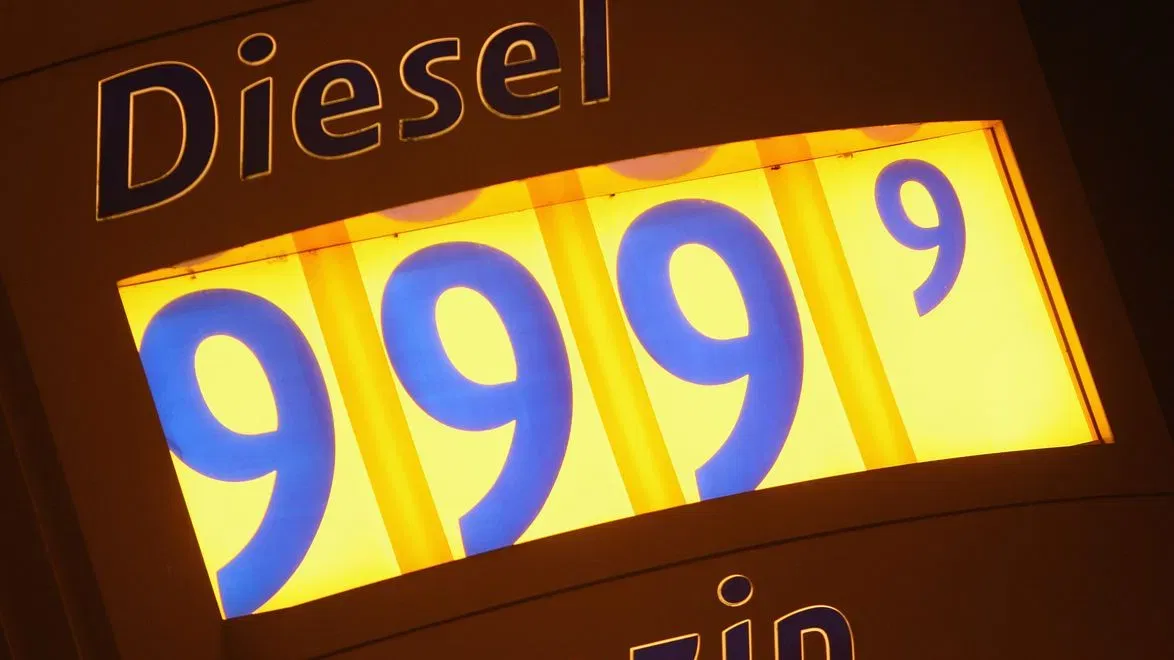
California’s diesel market is moving into territory rarely seen at U.S. fuel pumps, with the statewide average approaching $8 a gallon and several stations reportedly reaching the maximum price their pump displays can show.
GasBuddy petroleum analyst Patrick De Haan said five California diesel pumps were displaying $9.999 per gallon this week. The figure represents the maximum price supported by some older pump hardware.
There is an important limitation to that headline number. GasBuddy’s information comes from crowdsourced, real-time price submissions, and the five stations were not publicly identified. The $9.999 readings have therefore not been independently confirmed.
The broader price surge, however, is well documented.
The U.S. Energy Information Administration put California’s average on-highway diesel price at $7.764 per gallon for the week ended September 7, up 54.6 cents in just one week and $2.81 from a year earlier.
AAA’s daily measure was even higher Thursday, showing California diesel averaging $7.873 per gallon. That compares with $7.47 one week earlier, $6.86 a month earlier and $5.15 a year ago.
California’s diesel price is therefore up more than 50% from a year ago, turning what may initially look like a local gas-station story into a much larger issue for transportation costs, inflation and companies that depend heavily on trucking.
The pressure is not limited to California.
EIA data show the national diesel average reached a record $5.967 per gallon for the week ended September 7, up nearly 37 cents from the previous week and $2.20 from a year ago.
AAA’s more current daily measure stood at about $5.94 on September 10, also near a record.
Diesel now costs roughly $1.93 more per gallon in California than the national AAA average.
For investors, that gap matters, but the bigger concern is what happens if today’s elevated prices spread through freight networks, agriculture, construction and consumer goods during the fall.
Why Diesel Is Rising Faster Than Gasoline
Crude oil is part of the problem, but diesel is facing a more severe supply imbalance of its own.
Brent crude surged roughly 5% Thursday to around $106.60 a barrel, while U.S. West Texas Intermediate climbed above $101 as renewed tanker attacks and escalating fighting involving Iran and Iran-aligned forces intensified fears of further Middle East supply disruptions.
Oil is now trading at its highest levels since May.
The crude rally alone does not fully explain diesel’s record price.
Global supplies of refined middle distillates have become unusually tight after disruptions to refineries and exports in both the Middle East and Russia.
Industry executives estimate the wars in Iran and Ukraine have removed roughly 4 million barrels per day of diesel supply from those regions. U.S. refineries have responded by running at exceptionally high utilization rates, but additional output has not been enough to fully replace lost global supply.
The economics of refining show how severe the shortage has become.
The diesel crack spread — the difference between the value of diesel and the crude oil used to produce it, commonly used as a measure of refining profitability — recently reached a record $108.02 per barrel.
That means refiners currently have a powerful financial incentive to produce diesel. The problem is that much of the available refining system is already operating close to its limits.
EIA data showed U.S. refinery utilization at 98% for the week ended August 28.
Running refineries harder can help increase supply at the margin, but it leaves less spare capacity available if an unplanned outage occurs.
The EIA now forecasts U.S. distillate inventories — the category that includes diesel and heating oil — to fall below 100 million barrels during September and remain below their five-year seasonal low through the end of 2026 and much of 2027.
That is why diesel prices may remain vulnerable even if crude stops rising.
California Has an Additional Supply Problem
California tends to experience more extreme fuel prices because its transportation-fuel market is unusually isolated.
There are no major pipelines bringing finished transportation fuel into California from other U.S. refining centers. Instead, the state depends heavily on its own refineries and marine imports when additional supply is required.
The California Energy Commission has described the state as an isolated fuel market, with pipelines largely flowing outward from California toward Arizona and Nevada rather than bringing replacement fuel into the state.
That structure makes California more vulnerable when global supplies tighten.
If a refinery in Texas has a problem, fuel can move through an interconnected network of pipelines covering much of the country.
California does not have the same flexibility.
Replacement supply may need to arrive by ship, creating higher transportation costs and longer lead times.
Taxes also contribute to California’s unusually high diesel prices.
California’s state diesel excise tax is 48.2 cents per gallon for the fiscal year beginning July 1, while the federal diesel tax is another 24.4 cents. Retail diesel is also subject to a 13% statewide sales-tax rate before applicable district taxes.
Those costs help explain part of California’s premium, though they do not explain the rapid increase of more than 50 cents in a single week.
The latest surge is primarily a supply-and-commodity shock layered on top of California’s structurally higher fuel costs.
$9.999 Pumps Are Extreme, but $8 Diesel Is Becoming Common
GasBuddy’s $9.999 reports should not be treated as the typical price paid by California truckers.
The statewide average remains below $8.
But isolated stations above $8 are no longer extraordinary.
Reports earlier this week showed diesel prices exceeding $8 in parts of San Francisco and Oakland as California’s average reached new records.
De Haan had previously warned that California diesel could exceed $8 statewide and that older fuel pumps might encounter technical limitations as posted prices approach $10.
The current situation suggests those warnings were not far-fetched.
California has also seen other highly unusual individual station prices this year.
In March, a Chevron station in Fenner reportedly charged $9.69 per gallon for regular gasoline.
In May, a downtown Los Angeles Chevron station reportedly posted diesel at $8.89 per gallon and regular gasoline at $8.29.
Those stations were outliers and should not be confused with statewide averages. But repeated examples of extreme retail pricing have drawn scrutiny from California regulators.
California Regulators Are Examining Outlier Prices
California’s Division of Petroleum Market Oversight has broad authority to investigate the state’s transportation-fuel market under the California Gas Price Gouging and Transparency Law enacted in 2023.
The division operates independently within the California Energy Commission and can analyze refinery economics, investigate market behavior and make policy recommendations.
According to the source report, California regulators have an active investigation into unusually high fuel prices in the Los Angeles and San Bernardino areas and have subpoenaed information from the state’s five major refiners.
No finding of unlawful price gouging has been established.
That distinction matters because an unusually high retail price is not, by itself, evidence of illegal conduct.
Individual stations can face different wholesale costs, operating expenses, competition levels and supply conditions. Some stations in remote locations have historically charged considerably more than statewide averages.
Regulators are trying to determine whether certain price spikes can be explained by market conditions or whether other behavior contributed.
The issue could become more politically sensitive if California diesel remains near $8 while crude and national diesel prices continue rising.
Diesel Is Already Appearing in Inflation Data
The broader economic impact is beginning to show up in government inflation numbers.
The Bureau of Labor Statistics reported Thursday that the Producer Price Index increased 0.4% in August and 5.4% from a year earlier, accelerating from July.
Energy prices were a major contributor.
Diesel prices at the producer level jumped 24.1% during August alone and were roughly 78% higher than a year earlier.
Transportation and warehousing prices also increased 2.3%.
Those figures were measured before the latest move that pushed Brent crude above $100 and California diesel toward $8.
That creates a lag investors should keep in mind.
Higher diesel prices do not immediately appear in every consumer product.
A trucking company may first absorb the higher fuel cost. It might then impose a fuel surcharge on customers. A retailer receiving those shipments may absorb part of that increase, negotiate with suppliers or eventually raise prices.
The effect can therefore move through the economy over weeks or months rather than appearing all at once.
If diesel remains elevated, that cost pressure could eventually show up in groceries, manufactured goods, construction materials and other products moved through trucking networks.
Freight Companies Face a Margin Test
Transportation companies are among the businesses most directly exposed.
Diesel is a major operating expense for trucking fleets.
Large carriers can often use fuel-surcharge programs that pass a portion of changing fuel costs to customers. Companies such as FedEx and UPS also have established surcharge mechanisms that adjust as fuel benchmarks move.
That provides some protection.
It does not eliminate the problem.
Rapidly changing diesel costs can affect working capital, customer pricing and demand, while smaller trucking companies frequently have less bargaining power and fewer financial tools available to absorb sudden increases.
Independent owner-operators can be particularly exposed because they buy diesel directly while negotiating freight rates in a highly competitive market.
A truck traveling 100,000 miles annually at 7 miles per gallon consumes more than 14,000 gallons of fuel.
A $2 increase in diesel therefore represents roughly $28,000 of additional annual fuel expense before any surcharge recovery.
The current national diesel price is more than $2 above last year’s level.
California carriers face an even larger increase.
Agriculture Could Feel the Next Wave
The timing also coincides with seasonal increases in diesel demand.
Farmers rely heavily on diesel for tractors, harvest equipment and trucks moving crops to processors and markets.
Fall harvesting typically adds to diesel consumption just as heating-oil demand begins increasing ahead of winter.
That seasonal pattern is one reason industry executives expect global diesel supplies to remain tight through the coming winter.
Higher agricultural transportation and equipment costs could eventually feed into food prices, although the size and timing of that effect will depend on commodity prices, farm margins and how much of the increase businesses can pass through.
Construction companies face similar exposure through heavy equipment, generators and material transportation.
Mining, logistics and industrial businesses are also significant diesel consumers.
Investors should therefore view diesel differently from ordinary gasoline.
Gasoline prices primarily hit household transportation budgets directly.
Diesel works deeper inside the supply chain.
It can raise the cost of producing and delivering almost everything else.
Refiners Are One of the Few Clear Beneficiaries
Record diesel margins create a very different setup for refiners.
Companies with substantial refining operations can benefit when the spread between crude-oil costs and refined-product prices widens.
Publicly traded refiners including Marathon Petroleum, Valero Energy, Phillips 66 and PBF Energy are therefore worth watching while diesel crack spreads remain unusually high.
The financial benefit is not automatic.
Individual refinery configurations, regional exposure, maintenance schedules, hedging and feedstock costs all influence profitability.
Refiners can also lose substantial revenue during outages precisely when margins are strongest.
Still, a diesel crack spread above $100 per barrel represents an unusually favorable pricing environment for facilities capable of operating reliably and maximizing distillate output.
That creates a notable divergence across the economy: truckers and consumers absorb higher costs while some refiners may earn stronger margins from the same shortage.
Oil’s Surge Is Making the Fed’s Job Harder
The diesel shock is arriving at a particularly difficult time for monetary policy.
Thursday’s 5.4% annual increase in producer prices reinforced concerns that inflation remains well above the Federal Reserve’s comfort zone.
Interest-rate futures subsequently moved toward roughly a 70% probability of another Fed increase at its September meeting, up from around 60% before the PPI report.
The Federal Reserve meets September 15-16.
Friday’s Consumer Price Index will now carry even more weight.
A hotter-than-expected CPI reading could strengthen the case for another rate increase.
A softer result could provide policymakers more room to keep rates unchanged, although the latest jump in oil and diesel prices means the Fed must also consider inflation pressure that developed after much of the August data were collected.
That creates a potential second-round risk.
The immediate fuel shock raises headline inflation.
If companies then raise prices to recover higher transportation expenses, part of that increase could eventually spread into categories policymakers consider more persistent.
The Fed generally tries not to overreact to temporary commodity-price shocks.
The calculation becomes harder if oil and diesel remain elevated for months.
What Investors Should Watch Next
Crude oil remains the first variable.
Brent was around $106.60 Thursday after another sharp increase. A reversal back below $100 would remove some pressure from future diesel prices.
A sustained move toward $110 or higher would likely intensify the problem.
Diesel inventories are equally important.
EIA already expects U.S. distillate stocks to fall below 100 million barrels this month. Further declines heading into fall harvest and winter heating demand could keep refining margins and retail diesel prices elevated even if crude stabilizes.
California’s statewide average will provide another clear signal.
AAA had diesel at $7.873 Thursday. Crossing $8 statewide would be psychologically significant and could increase political pressure for intervention, investigations or other measures.
The reported $9.999 pumps will attract attention because the number looks extraordinary.
For the economy, however, California’s nearly $8 average and the record national price near $6 matter far more.
Those are the prices being paid across thousands of transactions by truckers, businesses and consumers.
And they are arriving while wholesale inflation is already accelerating.
If diesel prices retreat quickly, the economic damage could remain relatively contained.
If they stay near current levels through the fall and winter, the effects will increasingly move beyond filling stations and into freight bills, food distribution, construction costs, corporate margins and ultimately the prices households pay for everyday goods.
The question for investors is therefore no longer whether record diesel prices are visible at the pump.
It is how much of that increase businesses can absorb before they begin passing it through.