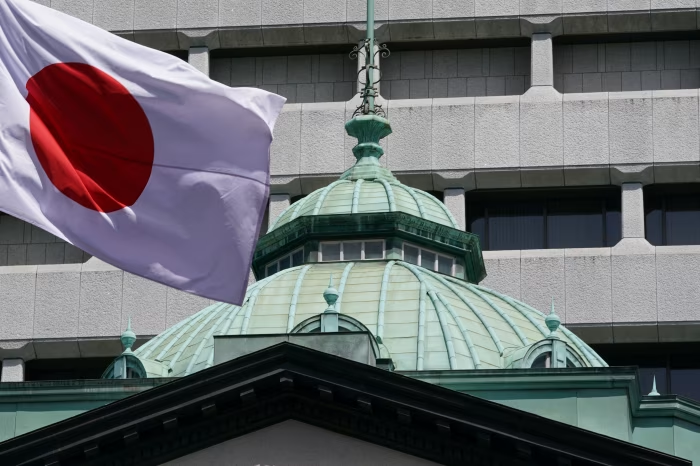
The Bank of Japan is widely expected to raise interest rates again this week, accelerating its retreat from decades of ultra-easy policy as higher import costs, a volatile yen and stronger wage growth reshape Japan’s inflation outlook.
Markets expect the BOJ to lift its policy rate by 0.25 percentage point to 1.25% when its two-day meeting ends Friday, September 18. That would be Japan’s highest benchmark rate in 31 years and would come only three months after the central bank raised rates to 1% in June.
The quarter-point increase itself is increasingly viewed as the easy part.
Investors are more focused on whether Governor Kazuo Ueda signals that Japan is entering a faster tightening cycle. A Reuters poll published last week showed economists expecting rates to reach 1.75% by the second quarter of 2027, earlier than previously forecast, while a majority expect at least 1.50% by next March.
A more aggressive path could support the yen and help contain imported inflation. It would also raise borrowing costs across an economy that has spent much of the past three decades operating with rates near or below zero.
Inflation Pressure Is No Longer Coming From One Place
Japan’s inflation picture has become increasingly difficult for the BOJ to treat as temporary.
Wholesale prices rose 7.6% from a year earlier in August, while yen-based import prices jumped 24.8%, according to government data cited by Reuters. Higher energy costs and the weakened currency have made imported goods substantially more expensive for Japanese businesses.
Consumer inflation is less extreme. Economists expect Japan’s core CPI, which excludes fresh food, to remain around 1.8% in August, slightly below the BOJ’s 2% target. Government energy subsidies have helped cushion some of the increase in fuel costs.
Wages, however, are moving in a direction the BOJ has spent years waiting to see.
Inflation-adjusted wages increased 2.4% from a year earlier in July, the strongest gain since 2021 and the seventh consecutive monthly increase. Sustained real-wage growth could support household spending and make inflation more durable than a short-lived rise driven only by imported energy.
That creates a more credible argument for higher rates than Japan had during previous bouts of inflation.
BOJ officials have also begun discussing the risk that repeated supply shocks — from energy, geopolitics and currency movements — could become embedded in inflation expectations rather than fading quickly. Executive Director Koji Nakamura warned that frequent external shocks could generate larger and more persistent changes in prices than Japan experienced in the past.
The Yen Has Made Policy More Complicated
The currency market has become inseparable from the rate debate.
The yen fell close to ¥164 per dollar this summer, its weakest level in roughly four decades, before Japanese and U.S. authorities coordinated intervention to support the currency. The operation helped push the yen sharply higher, with the currency recently strengthening beyond ¥153 before giving back some of those gains.
A weaker yen raises the cost of imported oil, food and raw materials, adding inflation pressure even when domestic demand is not particularly strong.
Higher Japanese rates could help by reducing the yield disadvantage between Japan and other major economies and making yen-funded trades less attractive.
But a rapid adjustment also carries market risk.
For years, investors have borrowed cheaply in yen and invested in higher-yielding assets elsewhere, a strategy known as the carry trade. Faster-than-expected BOJ tightening can make those positions less profitable and force investors to unwind them, potentially transmitting volatility from Japanese currency and bond markets into global equities and credit.
That risk became more visible as Japanese bond yields climbed. The 10-year government bond yield recently reached 3% for the first time since 1996, while Fitch said higher domestic yields could encourage Japanese institutions to keep more capital at home instead of investing abroad.
Pressure From Washington Adds Another Layer
The BOJ is also making the decision under unusually public pressure from outside Japan.
U.S. Treasury Secretary Scott Bessent has repeatedly argued that stronger Japanese monetary policy is necessary to support the yen and contain inflation. He met Ueda earlier this month and called for “decisive” monetary action, according to Reuters.
Bessent has also said U.S. officials have unusually good insight into Japanese policy following the joint currency intervention, comments that have drawn attention because central banks normally guard their decision-making independence closely.
Inside Japan, the political incentives are less straightforward.
Prime Minister Sanae Takaichi has supported policies aimed at stimulating economic growth and easing household living costs. Her government is also considering substantial fiscal measures, including a temporary reduction in the consumption tax on food. Those policies could support demand while also raising concerns over Japan’s already large public debt.
The BOJ therefore faces pressure in both directions: tighten enough to control inflation and stabilize the currency, but not so quickly that higher borrowing costs weaken consumption, investment or the government’s fiscal position.
Ueda’s Message May Matter More Than Friday’s Hike
Japan’s policy rate would still be low by international standards even at 1.25%.
What matters for markets is whether Ueda characterizes financial conditions as still accommodative and leaves the door open to another increase relatively soon.
Until recently, BOJ hikes had generally been separated by about six months. A September increase only three months after the June move would already represent a quicker pace of normalization. Consecutive increases later this year would be a much stronger signal that the central bank believes inflation risks have fundamentally changed.
The official BOJ calendar confirms that the policy meeting will take place September 17-18, with its statement released after the meeting.
The yen, Japanese government bonds and rate-sensitive financial stocks are likely to react less to the expected quarter-point move than to Ueda’s description of what comes next.
A cautious message could suggest the BOJ wants time to evaluate whether wage growth and inflation remain durable before moving again.
A stronger warning about imported inflation, oil prices or the weak yen would increase the likelihood that 1.25% is merely another step toward the 1.5%-1.75% rates economists increasingly expect in 2027.
After decades when Japanese rates barely moved at all, the market is no longer debating whether normalization is happening. It is trying to determine how quickly the BOJ is prepared to let it happen.