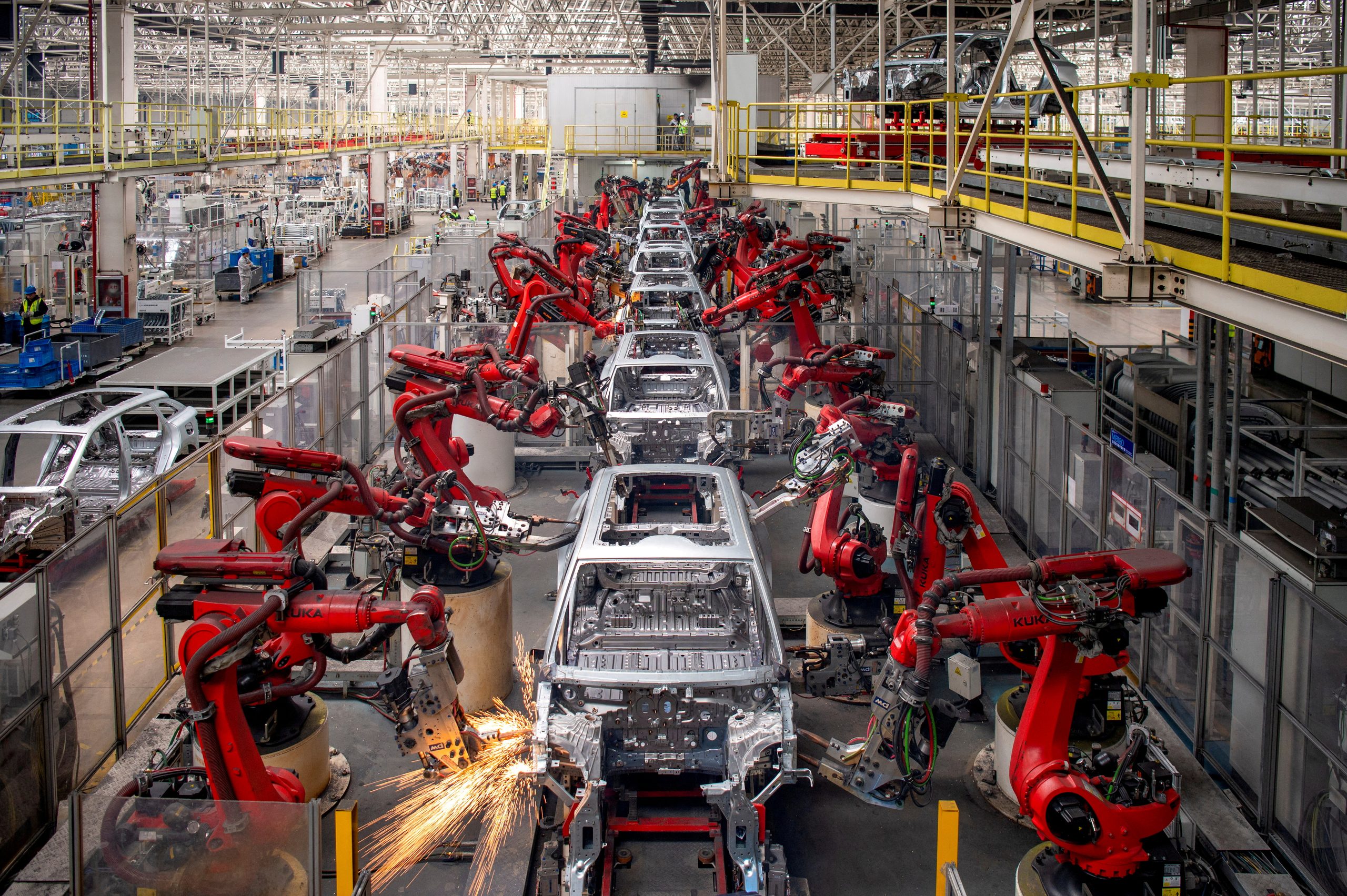
China’s economy delivered another split picture in August: factories accelerated and beat expectations, but consumers spent cautiously and investment contracted at its fastest pace in years, increasing pressure on Beijing to strengthen domestic demand.
Industrial production rose 5.2% from a year earlier, accelerating from 4.5% in July and beating the 4.8% increase economists surveyed by Reuters had expected. Retail sales moved in the opposite direction, rising just 0.4%, down from 0.6% in July and well below the 0.8% forecast.
The larger warning came from investment. Fixed-asset investment fell 7.2% during the first eight months of 2026 compared with a year earlier, worsening from a 6.7% decline through July. Private-sector investment fell 10.1%, manufacturing investment declined 2.3%, and infrastructure investment dropped 4%.
That combination exposes the imbalance increasingly defining the world’s second-largest economy. Chinese factories are producing more goods, particularly in high-tech industries, while households, property developers and private businesses remain reluctant to spend or invest.
China can continue leaning on manufacturing and exports for growth, but that model becomes harder to sustain when domestic demand remains weak and Chinese producers increasingly depend on overseas buyers.
Property Is Still Pulling Investment Lower
China’s prolonged housing downturn remains one of the largest drags.
Real-estate development investment fell 19.9% during the first eight months of the year. New construction starts dropped 24.8%, sales of newly built properties by floor area declined 12.1%, and their sales value fell 13%. Funding available to property developers was down 21%.
Home prices also continued falling in August. New-home prices across major cities declined 0.1% from July for a third consecutive month and were 3% lower than a year earlier. Larger tier-one cities performed better, but weakness persisted across many smaller markets.
Housing matters well beyond developers. Falling property values can make households feel less wealthy, reducing their willingness to spend. The downturn also limits land-sale revenue for local governments and weakens demand for everything from construction materials to appliances and furniture.
The latest lending numbers suggest lower borrowing costs and government support have not yet produced a strong private-sector response.
Chinese banks extended only 60 billion yuan, or about $9 billion, of new loans in August after lending contracted by a record 340 billion yuan in July. Economists had expected roughly 400 billion yuan. Outstanding yuan loan growth slowed to 4.9%, the weakest pace on record, while household borrowing contracted for a sixth consecutive month.
That is a different problem from banks being unwilling to lend. It points to weak demand for credit from households and businesses themselves.
Factories Remain the Economy’s Strongest Engine
Industrial data were considerably stronger.
Manufacturing output increased 6.1% in August, while high-tech manufacturing grew 16.7%. Production in computers, communications and other electronics jumped 17.2%, integrated-circuit output increased 20.6%, and industrial robot production surged 34.6%. New-energy vehicle production rose 21.9%.
Exports have provided another important outlet. China’s exports surged 25% from a year earlier in August, supported by high-tech products, autos and strong overseas demand, continuing a trade boom that has offset weakness at home.
The gap between production and consumption is becoming increasingly visible. Chinese manufacturers can keep factories busy by selling abroad even when domestic buyers remain cautious, but rising reliance on external markets carries its own risks.
Large trade surpluses are already increasing tensions with major trading partners concerned about inexpensive Chinese goods entering their markets. Chinese automakers illustrate the shift particularly clearly: passenger-vehicle exports rose 77.5% in August while domestic sales fell 23.7%.
A further weakening in global demand, additional tariffs or trade restrictions would therefore hit an economy increasingly dependent on its export engine at a time when consumption and investment are providing little cushion.
Growth Target Is Getting Harder to Reach
China’s economy grew 4.3% from a year earlier in the second quarter, slowing from 5% in the first three months of 2026. The government is targeting growth of roughly 4.5% to 5% for the full year.
August’s production rebound helps.
The investment, property and consumption numbers make the rest of the year more difficult.
China has already increased government bond issuance, expanded interest subsidies and introduced additional measures aimed at supporting consumption and housing. The People’s Bank of China has said it has room to provide further support, though policymakers have so far stopped short of signaling an imminent broad reduction in interest rates or banks’ reserve requirements.
Rising energy costs complicate that decision. China’s producer prices increased 3.8% in August, while consumer inflation accelerated to 0.8%, largely because of higher global energy prices. Core inflation remained much softer at 1%, another indication that domestic demand itself is not creating significant price pressure.
That leaves Beijing balancing two different economies: an export-oriented manufacturing sector still expanding rapidly and a domestic economy struggling to generate stronger consumption, credit demand and private investment.
The September data will show whether August was another weak month or the start of a deeper slowdown in domestic activity. If retail spending and investment fail to stabilize while property continues contracting near 20%, pressure for a larger fiscal response will grow even if China’s factories keep producing at a strong pace.