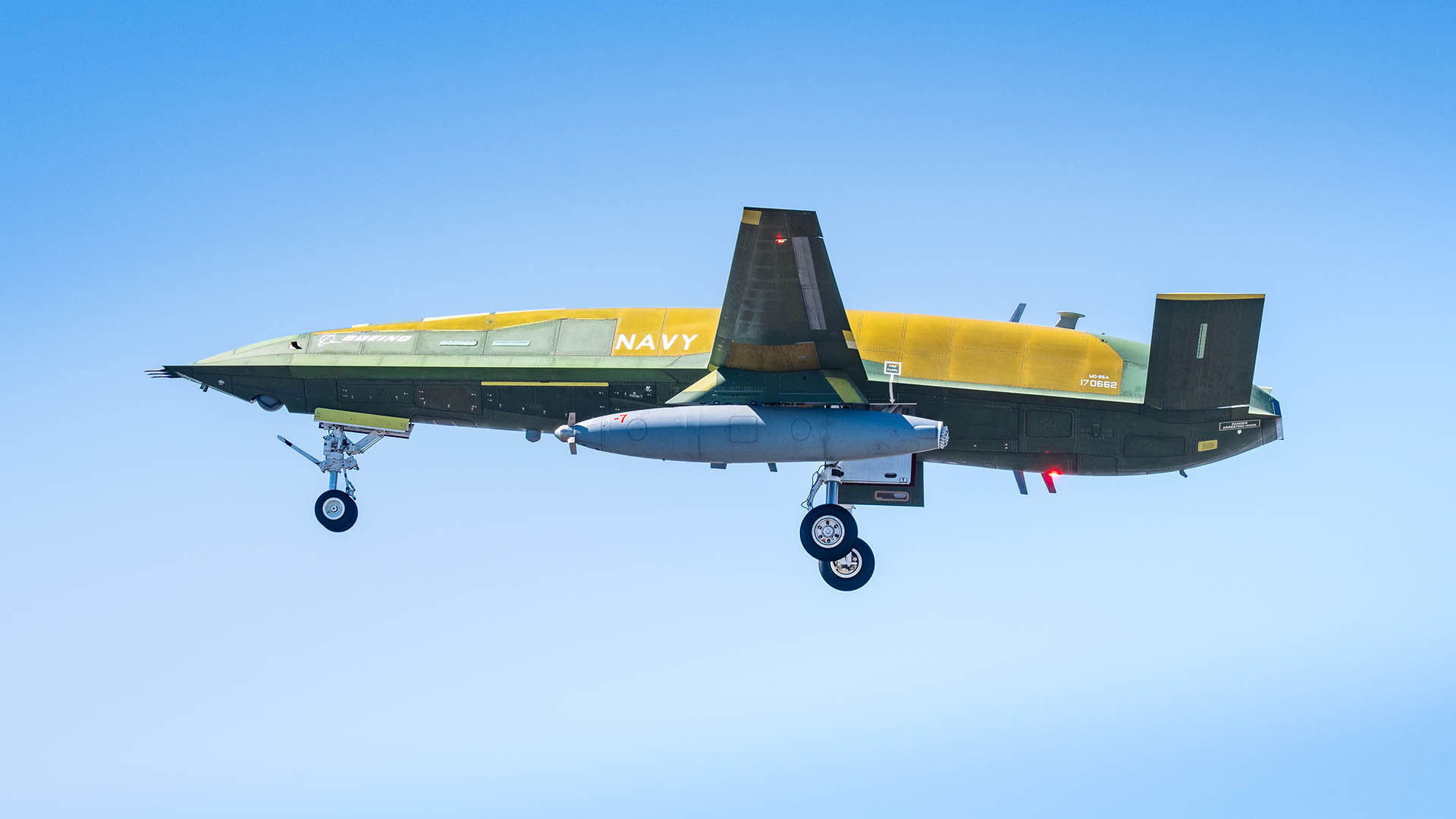
Boeing’s MQ-25A Stingray is moving into low-rate production after years of development, giving the company’s defense business a new production program while putting renewed attention on whether Boeing can execute it profitably.
The U.S. Navy awarded Boeing the first low-rate initial production contract for three MQ-25A aircraft, along with funding for long-lead components needed for three more aircraft in the next production lot. The Navy values the award at about $562 million. A separate Defense Department contract modification cited a value of $552.053 million for the production and long-lead work.
The difference in the reported contract values does not change the larger financial story. Boeing is moving MQ-25 out of its development phase and into an initial production run, creating a path toward additional Navy orders if the aircraft meets cost, schedule and performance targets.
Boeing said the three new aircraft raise the number of MQ-25s under Navy contract to 14. The company expects a second low-rate production lot to be awarded in 2027, while the Navy has said deliveries from the first production lot are expected to begin in 2029.
The transition comes several months after the MQ-25 completed its first flight in April and received Milestone C approval from the Navy in May, clearing the program to enter low-rate production. Before Monday’s award, the Navy had also outlined potential follow-on production covering three aircraft in Lot 2 and five in Lot 3.
Production Is More Important Than the Headline Contract Value
For Boeing, the roughly half-billion-dollar award is modest relative to the size of its defense operation. Boeing Defense, Space & Security ended the second quarter with $85.3 billion of backlog and generated $7.48 billion of quarterly revenue.
The significance is that MQ-25 is becoming a recurring production opportunity rather than remaining primarily a development program.
The Stingray is designed to operate from U.S. aircraft carriers as an unmanned aerial refueling aircraft. By taking over some refueling missions currently performed by F/A-18E/F Super Hornets, the Navy expects MQ-25 to extend the effective range of carrier air wings while freeing more fighter aircraft for combat missions.
That gives Boeing a chance to build production volume around a platform the Navy considers part of its broader move toward integrating unmanned aircraft into carrier operations. Full-rate production decisions are still ahead, however, and Boeing said the immediate work will focus on completing the initial production aircraft, starting deliveries and preparing operators.
The economics of those aircraft will matter more to shareholders than the number of units alone.
Boeing’s defense business generated a 0.2% operating loss in the second quarter despite a 13% increase in revenue. Results were hurt by another $280 million charge on the VC-25B presidential aircraft program, showing how quickly cost overruns on fixed-price defense programs can erase the benefits of higher volume.
MQ-25 already has its own history of losses.
Boeing’s original engineering and manufacturing development contract is a fixed-price agreement that now covers seven aircraft and test articles at a contract price of roughly $890 million. Boeing recorded a $291 million reach-forward loss when it won that contract in 2018 and has recognized additional losses since then. In its latest quarterly filing, the company warned that further losses on the development program remain possible.
The new production award uses a fixed-price incentive structure rather than simply extending the original development contract. That can give Boeing an opportunity to improve the economics as the design matures and production stabilizes, but profitability will still depend heavily on manufacturing costs, supplier performance and schedule execution.
Boeing Shares Show Little Immediate Reaction
Boeing shares slipped 0.09% on Monday, while the S&P 500 fell 0.48% during a broadly weaker market session. The muted move suggests investors did not treat the MQ-25 award as a major near-term change to Boeing’s valuation, particularly given the company’s much larger commercial aircraft business and existing defense backlog.
That does not make the award insignificant. A successful move from development into repeatable production would strengthen Boeing’s defense revenue base at a time when the company is trying to improve execution across several major fixed-price programs.
The next meaningful test will come from production itself. Boeing is expected to work toward the first Lot 1 deliveries in 2029 while the Navy prepares a planned Lot 2 award in 2027. For shareholders, the most important signal will be whether those additional aircraft arrive without another round of program charges.