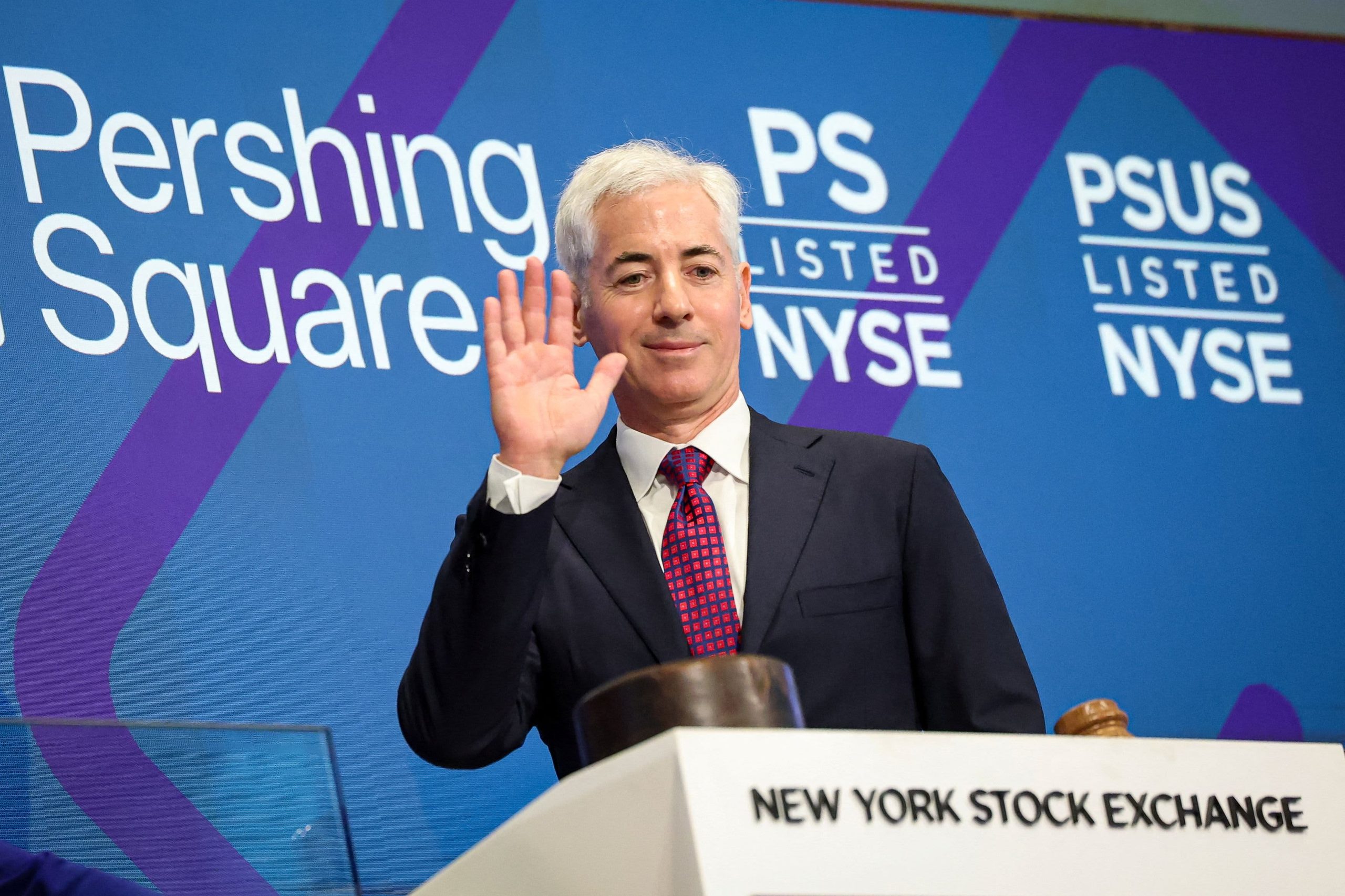
Pershing Square Inc. surged nearly 14% Friday, capping a 32% weekly advance as investors pushed Bill Ackman’s newly public asset-management company back toward the highs reached shortly after its April listing.
Shares closed at $49.83 after touching $50.60, their highest level since May. Trading volume jumped to more than 2.3 million shares, several times the stock’s recent daily pace.
The rally lifted Pershing Square’s market capitalization to nearly $20 billion.
That valuation is increasingly pricing in the idea that Pershing Square can turn a relatively small investment team into a much larger stream of recurring fees by managing permanent capital—money that does not have to be returned when investors redeem from a conventional hedge fund.
The strategy received its biggest expansion this spring through Pershing Square USA, or PSUS, a new U.S.-listed closed-end fund that raised $5 billion in a combined public and private offering.
By June 30, Pershing Square managed $32.5 billion of total assets and $22.3 billion of fee-paying assets, up from $26.6 billion and $17 billion, respectively, at the end of March.
About 98% of that fee-paying capital was permanent.
That is the financial argument investors are embracing.
The stock’s problem is that the rerating has happened far faster than either reported earnings or the market value of the new fund itself.
Pershing Square Inc. Is the Manager, Not the Fund
The April transaction created two separate publicly traded securities.
Pershing Square USA trades under PSUS and owns the investment portfolio.
Pershing Square Inc., ticker PS, is the parent company of Pershing Square Capital Management, the business that manages PSUS and Ackman’s other investment vehicles.
That distinction matters because PS shareholders are primarily betting on the economics of the manager: management fees, performance fees and the growth of assets under management.
The IPO structure was unusual.
Investors bought PSUS shares at $50 each and received shares in Pershing Square Inc. at no additional cost. Pershing Square Inc. itself did not receive cash from the combined transaction.
It issued roughly 24.7 million shares to participants while the $5 billion of proceeds went into PSUS.
PS shares began trading at $24 on April 29 and closed their first session at $24.20.
At Friday’s close, the manager has therefore more than doubled from its first-day price in less than five months.
The Fee Base Is Growing Faster Than Revenue Has Yet Shown
Second-quarter results only partially reflected the PSUS launch.
Pershing Square generated $54.2 million of revenue, compared with $53.2 million a year earlier.
Almost all of it came from management fees.
Fee-related earnings, the company’s preferred measure of recurring operating profitability, reached $56.1 million, up from $45.1 million in the same quarter last year.
Distributable earnings were $54.3 million, or $0.14 a share.
GAAP results looked much worse: Pershing Square reported a $42.7 million net loss, or $0.11 a share.
That loss was heavily affected by compensation accounting and changes in the value of Pershing Square’s investments, including a gain on Howard Hughes Holdings and a loss on its PSUS stake.
The recurring-fee figures are more useful for understanding the underlying asset-management business.
They also have an important limitation.
PSUS did not begin operations until the end of April, so the second quarter contained only about two months of management fees from the new $5 billion fund.
The next several quarters should therefore give investors a cleaner look at the earnings power of the enlarged capital base.
Permanent Capital Is the Main Attraction
Pershing Square’s structure differs from many hedge funds because most of its money cannot be redeemed by investors whenever markets weaken.
That reduces the risk of being forced to sell investments simply because clients want their money back.
It also makes fee revenue more predictable.
Pershing Square Holdings, the firm’s long-standing London-listed vehicle, and PSUS are closed-end structures. Howard Hughes Holdings adds another source of long-duration capital through a services agreement with Pershing Square.
Management says this stability allows a lean organization to manage significantly more assets without adding expenses at the same rate.
At the end of 2025, Pershing Square had just 44 employees while managing more than $30 billion.
Its prospectus showed fee-related earnings margins averaging roughly 85% over the previous several years, an unusually high level for an asset manager.
The business can therefore produce substantial incremental profit if assets continue growing without a comparable increase in operating costs.
PSUS Shows the Other Side of the Story
The new fund itself has not enjoyed the same market reception as the manager.
PSUS closed Friday at $38.90.
Its most recently published net asset value was $49.11 a share as of September 15, putting the shares at a discount of more than 20% to the underlying portfolio.
Since beginning operations, the fund’s NAV performance has also been modest.
PSUS reported a year-to-date return of negative 1.8% through September 15.
That creates an unusual split.
Investors are paying rapidly higher prices for the company earning fees from PSUS while assigning a significant discount to the fund whose assets generate those fees.
Ackman has argued that the discount reflects poor initial marketing and limited investor understanding rather than weak intrinsic value.
Closed-end funds can trade below NAV for long periods, however, even when portfolio performance is respectable.
A persistent discount does not directly reduce the management fee Pershing Square earns on the fund’s assets, but it could make future fundraising more difficult if investors view the original $50 offering as having performed poorly.
The manager therefore benefits from improving PSUS sentiment even if it does not need the fund’s shares to trade exactly at NAV.
Wall Street Has Not Kept Up With the Stock
Recent analyst target increases have helped sentiment, but they do not amount to broad agreement that Pershing Square is worth nearly $50 a share.
Tigress Financial raised its target to $41 from $39 while maintaining a Neutral rating.
Wells Fargo increased its target to $36 from $34 and retained an Equal Weight rating.
JonesTrading raised its target to $42 while maintaining Buy, and Citi downgraded the shares to Neutral in August with a $45 target.
All four targets are below Friday’s closing price.
That is a sharp contrast with the stock’s 32% weekly rally.
The published targets may eventually move higher if analysts increase their estimates for fee-paying assets or recurring earnings, but at current levels the market has already moved beyond much of the Street’s existing work.
The company is now valued at nearly $20 billion against $22.3 billion of fee-paying assets as of June.
AUM itself is not revenue, so that ratio should not be treated like a traditional price-to-sales multiple.
What matters is how much of those assets generate management and performance fees, how quickly the capital compounds and how much of the resulting economics remain with public shareholders.
Performance Still Drives the Model
Pershing Square’s long-term investment record remains one of its strongest selling points.
Across the broader Pershing Square strategy, the firm has generated a compound annual return of about 17.5% since 2004 through August, compared with roughly 11% for the S&P 500 over the comparable period.
Individual years can still be volatile.
Pershing Square Holdings was down 5.2% for 2026 through August despite gaining 4.4% during that month.
That matters because future performance fees and organic AUM growth ultimately depend on investment results.
The business becomes much more valuable if capital compounds at high rates while investors leave that money inside permanent vehicles.
The opposite is also true.
Persistent underperformance could widen fund discounts, slow new product launches and reduce performance-fee revenue even if existing capital cannot be redeemed.
The next major checkpoint will therefore be Pershing Square’s third-quarter results.
They should contain a fuller quarter of PSUS management fees and provide a better measure of what the $5 billion launch actually did to recurring earnings.
At $49.83, investors are no longer simply valuing Ackman’s public listing as an unusual new asset manager.
They are increasingly valuing Pershing Square as a scalable permanent-capital platform.
The next earnings report needs to show that the fee stream is beginning to scale as quickly as the stock price already has.