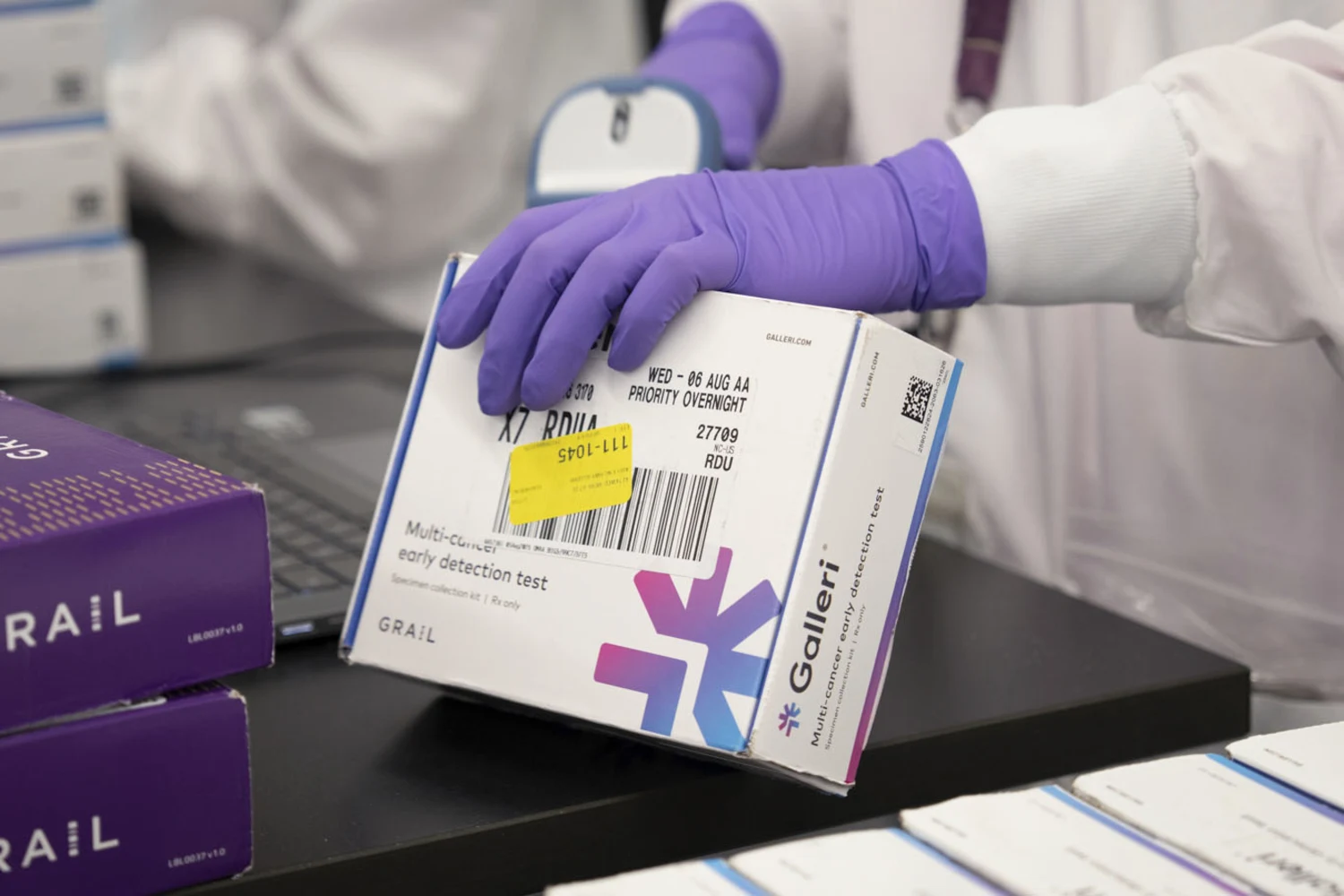
GRAIL shares climbed sharply Thursday after an FDA advisory committee delivered a favorable recommendation on Galleri, the company’s multi-cancer blood test, reducing one of the largest near-term regulatory risks surrounding the business. The stock was trading near $125.50 late in the session, up roughly 16% from Wednesday’s close and extending a rally that had already accelerated ahead of the meeting. The panel did not approve Galleri itself; final authority rests with the Food and Drug Administration, which is reviewing GRAIL’s premarket approval application.
The 10-member Molecular and Clinical Genetics Devices Panel voted 7-2, with one abstention, that Galleri’s benefits outweigh its risks for adults 50 and older. Members unanimously supported the test’s safety, while the effectiveness vote was considerably closer at 6-4, an important qualification to an otherwise favorable outcome. FDA advisory recommendations are not binding, but the agency considers them as part of its review, leaving the eventual approval decision and the wording of any approved indication as the next major catalysts for GRAIL.
A favorable vote, but not a clean one
Galleri analyzes cancer-associated methylation patterns in cell-free DNA from a blood sample and is designed to identify a cancer signal while predicting where that signal most likely originated. In the PATHFINDER 2 data reviewed by the FDA, Galleri detected 35% of cancers diagnosed within 12 months, with specificity of 99.85% and a positive predictive value of 77%. High specificity is particularly important in population screening because even a relatively small false-positive rate can lead to large numbers of unnecessary diagnostic procedures when a test is deployed across millions of people.
The more difficult regulatory question is how well those results support GRAIL’s description of Galleri as an “early detection” test. FDA reviewers specifically asked the advisory committee to consider whether performance by cancer stage justified that wording. PATHFINDER 2 showed sensitivity of 24.9% for stage I and II cancers compared with 60.9% for stage III and IV disease, including sensitivity of 63.2% for stage IV cancers. Those results do not mean Galleri lacks value, but they help explain why effectiveness drew a narrower panel vote than safety and why the eventual label remains important.
The clinical evidence also contains a notable complication from the large NHS-Galleri trial in England. GRAIL has disclosed that the study did not produce a statistically significant reduction in its combined stage III and IV cancer endpoint, although later screening rounds showed reductions of 22% and 26% in stage IV diagnoses among 12 prespecified aggressive cancers. The company has argued that the broader evidence supports Galleri’s clinical utility, but the mixed result means FDA approval would not settle every question about how much the test ultimately changes cancer outcomes in a population-screening setting.
Panel members also stressed that Galleri should supplement established cancer screening rather than replace it. A negative Galleri result does not rule out cancer, and patients would still be expected to follow recommended screening programs such as mammography, colonoscopy and other cancer-specific tests. That distinction is commercially relevant because Galleri is being positioned as an additional screening layer, especially for cancers that lack widely recommended population-screening programs, rather than as a substitute for existing procedures.
Why FDA approval matters financially
GRAIL already sells Galleri in the United States as a laboratory-developed test, so an FDA decision is not simply about whether the company can begin generating revenue. Second-quarter Galleri revenue rose 24% from a year earlier to $42.6 million as test volume increased 35% to more than 61,000. Total company revenue reached $44.7 million, up 26%, although an 8% decline in Galleri’s average selling price partially offset the higher volume. GRAIL, Inc.
The business remains far from profitability. GRAIL reported a $110.2 million second-quarter net loss and an adjusted EBITDA loss of $90.3 million, while cash, cash equivalents and short-term investments totaled $861.6 million at the end of June. The combination of rising test volumes and continued heavy losses makes reimbursement and broader adoption more important than simply expanding the number of individual cash-pay customers.
GRAIL currently has reimbursement arrangements with some employers and health plans, including TRICARE, but it does not have broad Medicare coverage or broad reimbursement from major commercial insurers. Management has said FDA approval could improve its ability to secure broader coverage, which would potentially expand the addressable patient population beyond the channels supporting Galleri today. Approval would not automatically produce widespread reimbursement, however, and GRAIL has acknowledged that securing coverage and inclusion in screening guidelines could remain a lengthy process. SEC
Thursday’s rally therefore represents more than enthusiasm over a single regulatory meeting. GRAIL shares had already jumped earlier in the week after FDA staff reviewers raised no major concerns about Galleri’s analytical performance and safety, and the favorable advisory vote removes another potential obstacle. The 6-4 effectiveness vote nevertheless leaves room for the FDA to impose conditions, request changes to the proposed indication or use wording that is narrower than GRAIL originally sought.
The FDA’s final decision now carries considerably more weight than the advisory-panel headline alone. Investors will be watching not only whether Galleri receives approval, but whether the agency permits an “early detection” claim, which patient population is included on the label and whether the decision begins translating into broader insurer coverage. Those details will determine whether Wednesday’s panel vote becomes a regulatory milestone primarily—or the beginning of a materially larger commercial market for GRAIL.