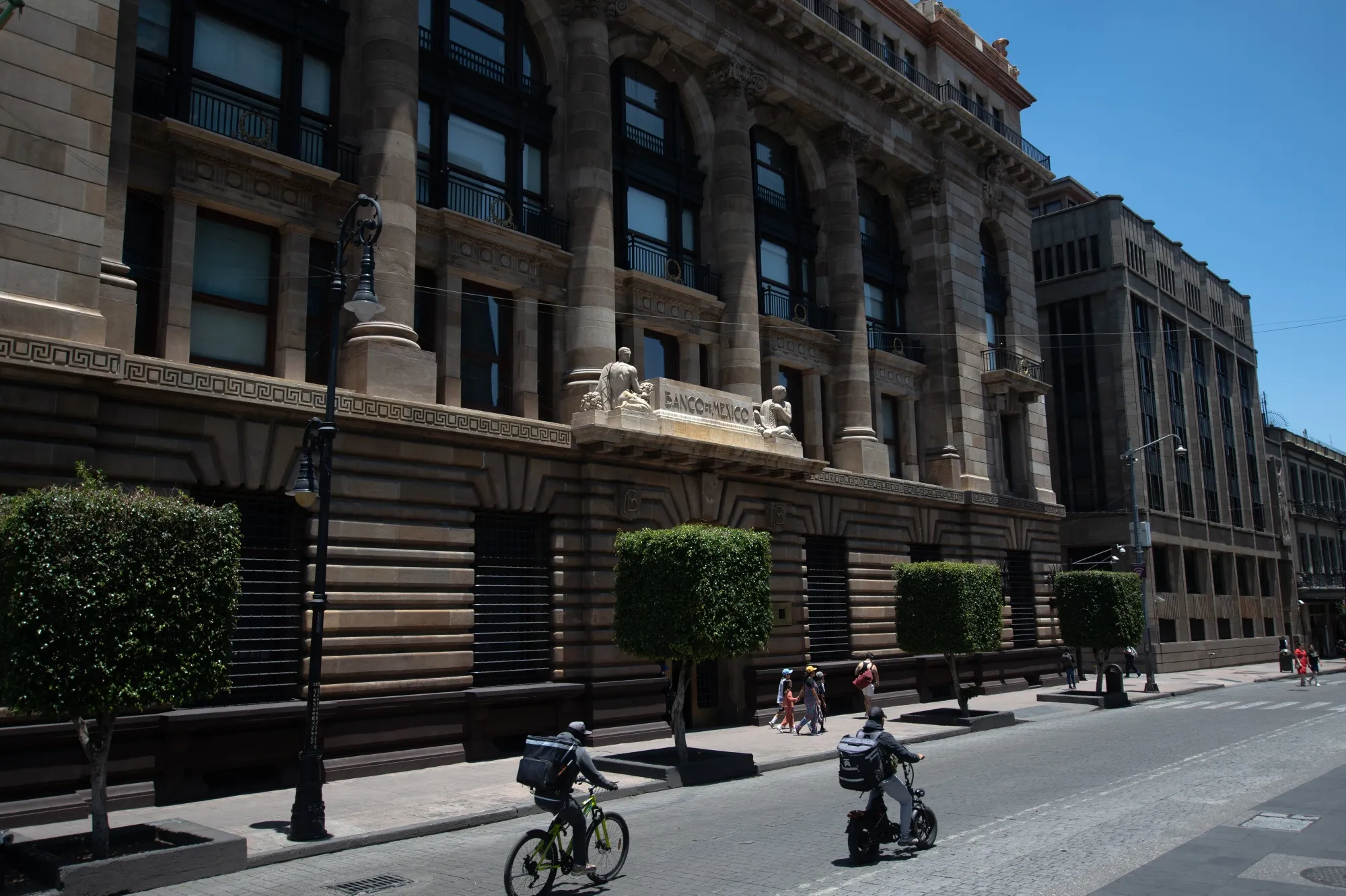
Banco de México left its benchmark interest rate unchanged at 6.50% on Thursday for a third consecutive meeting, but the more important change came in what policymakers no longer promised. The five-member Governing Board voted unanimously to hold rates while removing language that had explicitly said keeping the reference rate at its current level would remain appropriate, giving the central bank more flexibility as Mexico’s inflation picture becomes less straightforward.
The decision itself was widely expected. Banxico had already paused after cutting borrowing costs by a cumulative 475 basis points from the 11.25% level that prevailed before its easing cycle began in March 2024, bringing the policy rate to 6.50% in May 2026. Rather than committing to another extended hold, the bank now says future decisions will depend on the disinflation process and the forces shaping it, including exchange-rate pass-through, spare capacity in the economy and inflation expectations.
That shift does not amount to a signal that a rate cut or increase is imminent. It does, however, remove the unusually direct guidance used in August, when Banxico said it expected maintaining the rate at 6.50% to remain appropriate and described the policy stance as well suited to the macroeconomic environment. The September statement replaces that commitment with a more data-dependent approach, effectively restoring optionality if inflation, growth or the peso changes enough to alter the balance of risks.
Inflation Is Improving Underneath a Noisier Headline
The decision arrived hours after fresh inflation data showed why Banxico has little reason to rush in either direction. Mexico’s annual headline inflation accelerated to 3.42% in the first half of September from 3.26% in August, slightly above the 3.37% consensus in a Reuters poll. Prices rose 0.33% from the previous two-week period, according to INEGI.
Underlying inflation moved the other way. Core inflation, which strips out some of the more volatile prices, eased to 3.79% from 3.95% in the first half of July and came in slightly below the 3.81% level economists had expected. Banxico attributed the rise in headline inflation since July primarily to the non-core component, allowing policymakers to distinguish the recent rebound in the overall index from a renewed broad acceleration in underlying prices.
Banxico’s own forecasts reinforce that mixed picture. The bank lowered its forecast for average headline inflation in the third quarter to 3.3% from 3.5%, but raised its core forecast for the same period to 3.9% from 3.8%. The fourth-quarter core projection was also increased to 3.6% from 3.5%, while the headline estimate remained at 3.5%. Policymakers continue to expect both headline and core inflation to reach 3% during the fourth quarter of 2027.
That combination helps explain why the bank is reluctant to pre-commit. Headline inflation remains within Banxico’s 3% target plus-or-minus-one-percentage-point tolerance range, and core inflation has been declining, but the central bank still describes the balance of inflation risks as tilted upward. Persistent core inflation, higher business costs, possible peso depreciation, trade disruptions, geopolitical conflicts and climate-related pressures remain among the threats identified by policymakers.
Fed Tightening Adds Pressure Without Dictating Banxico’s Next Move
The international backdrop has also become less comfortable. The Federal Reserve raised U.S. rates by 25 basis points at its September meeting, while the dollar strengthened and government bond yields increased. A higher U.S. policy rate narrows the interest-rate advantage Mexican assets offer over comparable dollar investments, potentially weakening some of the support that high domestic rates have provided to the peso.
Banxico nevertheless made a point of separating its policy path from the Fed’s. The central bank said Mexico and the United States are at different stages of their economic cycles and that Mexican monetary policy does not need to respond mechanically to changes in the federal funds rate. Domestic economic slack is expected to persist throughout Banxico’s forecast horizon, while the bank said Mexico’s economic expansion likely moderated during the third quarter and downside risks to activity remain.
The peso weakened noticeably during Thursday’s session. Banco de México data show the interbank closing rate at 17.7148 pesos per dollar, compared with 17.5112 a day earlier. The currency had already been under pressure before the policy announcement, however, so the roughly 1.2% daily decline cannot be attributed solely to Banxico’s change in guidance.
For financial markets, the September meeting therefore changes the policy setup more than the policy rate. Banxico is still running a restrictive stance with inflation above its 3% objective, but it is no longer telling investors to assume that 6.50% will automatically persist. Incoming core inflation, the peso’s response to a narrower U.S.-Mexico rate differential and evidence of how quickly economic activity is cooling will now carry more weight in determining whether the next move eventually becomes another cut, an extended hold or, if inflation pressures reaccelerate materially, a renewed tightening response.
The next several inflation readings will be particularly important because Banxico is trying to reconcile softer domestic demand with an inflation outlook it still considers skewed to the upside. If core inflation continues moving toward 3% while economic slack deepens, the removal of the explicit hold guidance gives policymakers room to reconsider the 6.50% rate. A renewed rise in underlying inflation or sustained peso depreciation would point in the opposite direction, making the bank’s newly restored flexibility the most consequential part of Thursday’s decision.