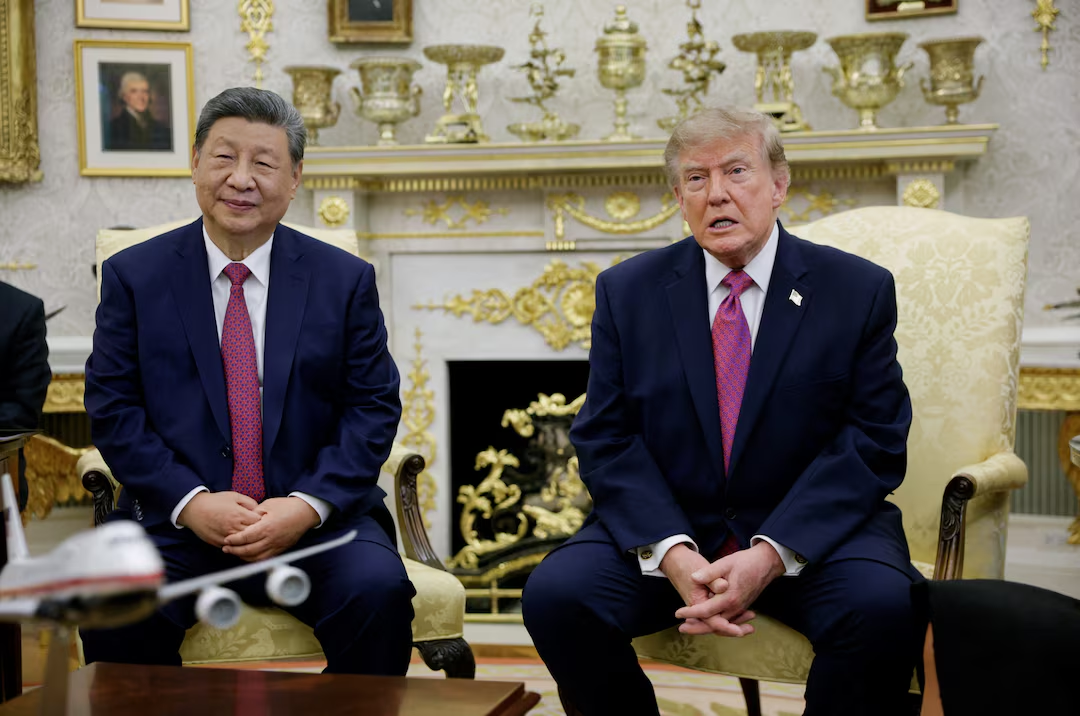
President Donald Trump and Chinese President Xi Jinping used their White House summit to keep the U.S.-China economic relationship from sliding back toward last year’s trade confrontation, but the meeting produced little evidence of a broader settlement on the issues most important to companies and investors. The clearest economic result was an agreement to extend the existing trade truce by two months, giving negotiators until January to continue discussions while leaving tariffs, Chinese purchases of U.S. goods, critical-mineral supplies and technology restrictions unresolved.
The extension reduces the immediate risk of another sharp tariff escalation, which is financially significant even without a larger agreement. The current framework followed a period in 2025 when retaliatory tariffs climbed into triple digits before Washington and Beijing stepped back; U.S. policy subsequently retained a 10% reciprocal tariff on Chinese imports alongside other existing duties and trade measures. By postponing the next deadline rather than settling those disputes, the two governments have provided businesses with more time but not necessarily more certainty over sourcing, pricing or investment decisions.
Markets did not respond as though the summit had materially rewritten the economic outlook. The S&P 500 finished Thursday almost unchanged, down 0.02%, while the Nasdaq Composite edged up 0.01% and the Dow fell 0.31%; oil prices and rising Treasury yields tied to the Middle East conflict were larger drivers of the session. Asian markets were similarly restrained Friday, with MSCI’s broad Asia-Pacific index outside Japan roughly flat as investors continued to wait for evidence of more concrete U.S.-China agreements.
The trade truce buys time, not a settlement
The economic relationship remains large even after tariffs and supply-chain diversification changed the direction of bilateral trade. Through July, the United States imported $156.4 billion of goods from China and exported $65.2 billion, leaving a $91.2 billion goods deficit, according to Census Bureau data. During the same seven months of 2025, U.S. imports from China were about $194 billion while exports were roughly $65.1 billion, meaning much of the narrowing in the deficit has come from weaker direct imports rather than a significant increase in American sales to China.
Implementation of earlier agreements is now as important as any new announcement. A May package said China would address U.S. concerns about rare-earth supply, purchase at least $17 billion annually of American agricultural products from 2026 through 2028 in addition to separate soybean commitments, and approved an initial purchase of 200 U.S.-made Boeing aircraft. Those announcements established potential commercial opportunities, but they should not be treated as the same thing as completed purchases, delivered aircraft or recognized corporate revenue.
Progress has also been uneven. Treasury Secretary Scott Bessent said China was meeting an earlier commitment to purchase 25 million metric tons of soybeans but was behind on the separate $17 billion agricultural commitment, while U.S. officials have said rare-earth deliveries remain below agreed levels. The two-month extension therefore keeps the existing framework alive while shifting the test toward actual shipments, purchases and regulatory actions rather than another round of headline commitments.
Rare earths and technology remain the larger corporate exposure
Critical minerals are one of the most consequential unresolved issues because China remains difficult to replace in several supply chains. The U.S. Geological Survey estimates that China accounts for more than 70% of global rare-earth extraction and about 87% of processing, giving changes in Chinese export licensing the potential to affect automakers, electronics producers, defense contractors and other advanced manufacturers well beyond the companies directly involved in bilateral trade.
Artificial intelligence and semiconductor policy also produced dialogue rather than a major commercial breakthrough. Xi said the two countries could cooperate on AI risk management and argued that the technology should remain under human control, while the Chinese government’s readout said Trump supported continued U.S.-China dialogue on AI. No broad easing of U.S. restrictions on advanced technology exports was announced, and Reuters reported that Washington was expected to maintain significant controls despite Beijing’s interest in gaining greater access to U.S. technology.
That distinction is particularly relevant for semiconductor companies and other businesses with significant exposure to China. Improved diplomatic communication can lower the risk of sudden escalation, but earnings and investment decisions depend on the specific rules governing chip exports, equipment sales, licensing and market access. Until those rules change, the commercial implications of the summit are narrower than the scale of the state visit might suggest.
The next measurable catalyst is now the January trade deadline. Markets will be watching whether rare-earth shipments improve, whether China fulfills agricultural purchasing commitments, how the Boeing arrangement develops, and whether negotiators can turn the temporary tariff framework into something longer-lasting. Any documented change to tariff rates, critical-mineral licensing or semiconductor restrictions would have a more direct effect on corporate costs and revenue expectations than the diplomatic language surrounding this week’s meetings.