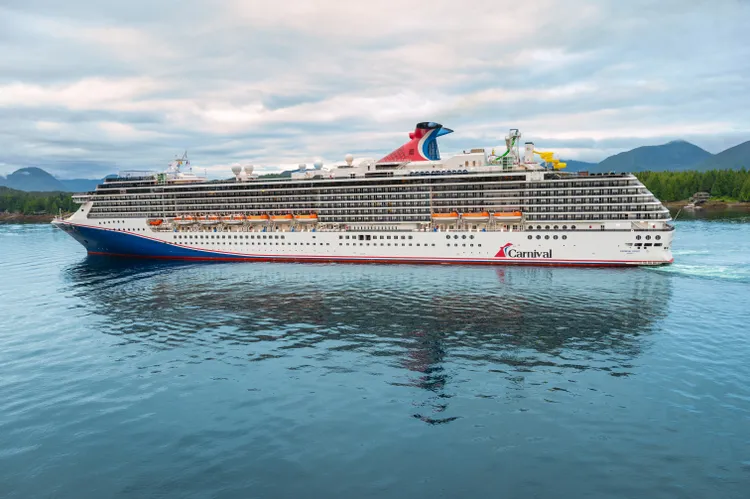
Carnival shares surged about 13% Tuesday after the cruise operator delivered record third-quarter revenue, beat earnings expectations and showed that demand for 2027 sailings remains strong despite a sharp increase in fuel costs. Revenue rose 3.5% from a year earlier to $8.44 billion, above the roughly $8.35 billion expected by analysts, while adjusted earnings of $1.43 per share topped the $1.35 consensus. Carnival also reported record net income attributable to the company of $1.92 billion.
The size of the stock reaction reflected more than a modest revenue beat. Carnival generated higher pricing and onboard spending while holding non-fuel cost growth below its previous guidance, allowing the company to absorb a substantial increase in energy expense without cutting its full-year profit outlook. Management instead raised adjusted full-year earnings per share to approximately $2.24 from $2.22 and said operational improvements had added more than $150 million to its adjusted net-income outlook since June, enough to offset roughly $150 million of additional fuel expense.
The results also lifted the broader cruise group. Royal Caribbean closed Tuesday up roughly 7.5%, while Norwegian Cruise Line gained about 3.5%, suggesting investors were treating Carnival’s demand data as a positive read-through for the industry rather than a company-specific improvement. Carnival finished near $25.14 after closing Monday at $22.14, although the shares remain down substantially for 2026 even after Tuesday’s rally.
Demand Held Up Better Than Fuel Costs Suggested
Carnival’s operating data showed why the report relieved some of the concern that had built around cruise demand. Net yields, which measure revenue generated relative to available passenger capacity, increased 2.4% in constant currency and reached a company record, compared with the 1.2% growth Carnival had projected in June. Adjusted cruise costs excluding fuel increased only 1.8% per available lower berth day, a full percentage point better than management’s previous guidance.
Revenue growth was also driven by more than added capacity. Passenger-ticket revenue increased 1.8% to $5.53 billion, while onboard and other revenue climbed 6.7% to $2.91 billion as guests spent more once aboard. Carnival’s capacity increased only 1.5% during the quarter, and occupancy remained essentially unchanged at 111.8%, indicating that pricing and guest spending contributed materially to the top-line increase rather than growth coming primarily from adding berths.
Fuel remained the clearest drag. Carnival paid $826 per metric ton of fuel during the quarter, excluding emission allowances, up from $607 a year earlier, and the company attributed $149 million of the increase in operating expense directly to higher fuel prices. Operating income consequently slipped to $2.22 billion from $2.27 billion even as revenue and net income reached records. Adjusted net income was $1.96 billion, slightly below $1.98 billion a year earlier, while adjusted EPS was unchanged at $1.43.
That distinction makes the quarter stronger operationally than the flat adjusted EPS figure initially suggests, but it also shows how exposed Carnival remains to energy prices. Fuel consumption per available berth day improved 3.8% year over year, helping offset part of the increase in commodity costs, yet fuel remains an expense the company cannot fully control through pricing or efficiency measures alone.
Record 2027 Bookings Shift Attention Beyond the Fourth Quarter
The most important forward-looking data came from Carnival’s booking curve. The company said both booked occupancy and pricing for full-year 2027 are at record levels, while customer deposits reached a third-quarter record of approximately $7.6 billion, about $500 million above the previous year’s record despite essentially flat capacity growth over the coming 12 months. Carnival also said bookings for 2028 are running at higher occupancy and pricing than at the comparable point last year.
One guidance figure deserves clarification. Carnival expects full-year net yields to increase about 3.8% in current dollars, the figure highlighted in some reports following the earnings release. On the constant-currency basis Carnival uses to evaluate underlying operating performance, the forecast is approximately 2.3%; after normalizing for the Arabian Gulf itinerary changes and Carnival Cruise Line loyalty-accounting effects, the company puts growth at roughly 2.7%. The distinction matters because currency translation contributes to the larger 3.8% headline figure.
The outlook is not uniformly stronger. Carnival expects fourth-quarter adjusted EPS of approximately $0.20, below Wall Street expectations of roughly $0.24 to $0.25, as elevated fuel costs continue to weigh on the final quarter of the fiscal year. Fourth-quarter adjusted EBITDA is projected at about $1.30 billion, with full-year adjusted EBITDA near $7.14 billion.
Carnival has nevertheless regained enough cash-flow flexibility to continue repairing its balance sheet while returning money to shareholders. Total debt fell to approximately $23.9 billion at the end of August from $26.6 billion at the end of fiscal 2025, and the company has repurchased about $1.2 billion of stock this year while paying $618 million in dividends through the first nine months. Carnival also redeemed $500 million of 7% notes during the third quarter, while S&P upgraded the company to investment grade.
The next test is whether Carnival can convert its record 2027 booking position into another year of higher yields while fuel remains expensive. Tuesday’s results showed that pricing, onboard spending and cost discipline can absorb a meaningful energy shock, but fourth-quarter guidance makes clear that fuel has not disappeared from the earnings equation. The company’s next results and initial detailed 2027 guidance should provide a clearer view of whether today’s booking strength can translate into faster profit growth once that cost pressure begins to normalize.