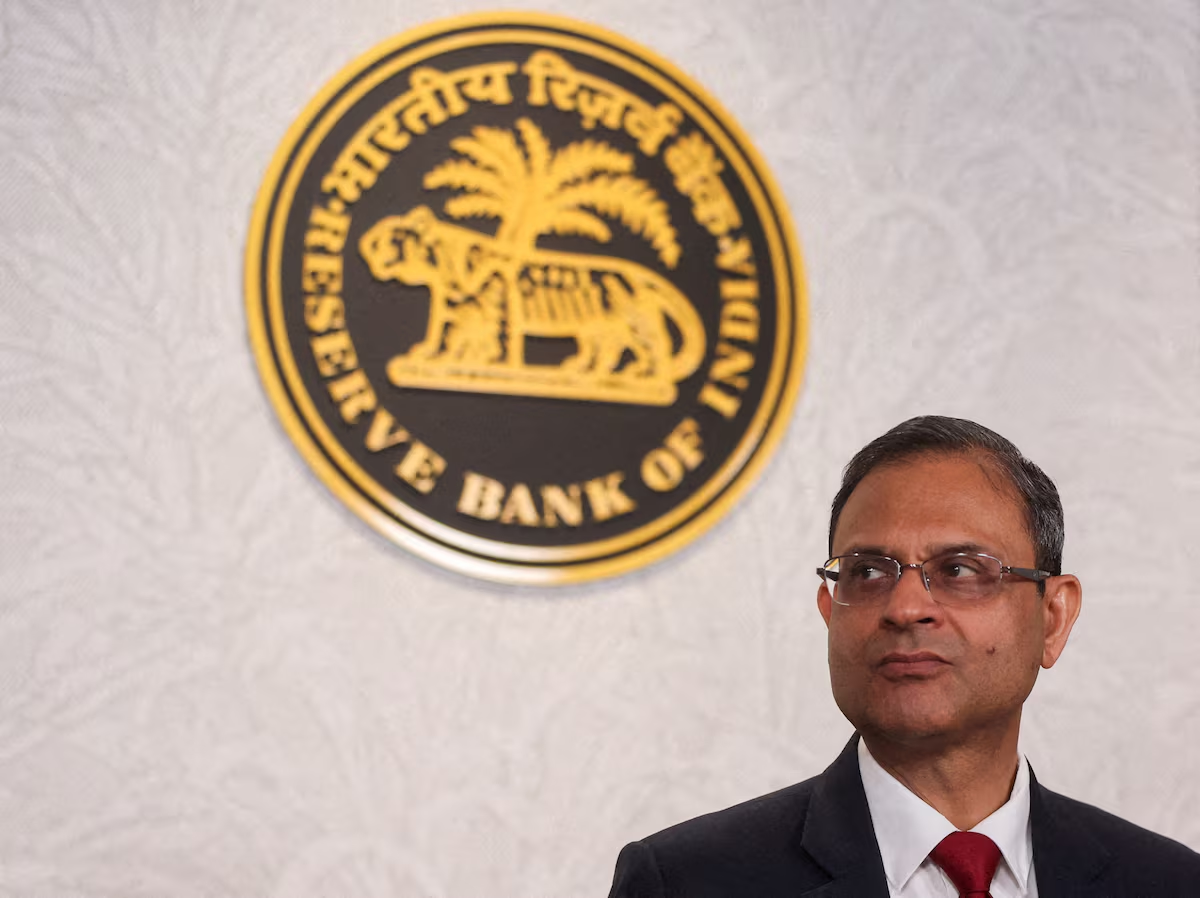
India’s central bank raised interest rates for the first time in nearly four years on Wednesday, responding to a renewed inflation problem that has become harder to dismiss as temporary even as the economy continues to grow at a strong pace.
The Reserve Bank of India increased its benchmark repo rate by 25 basis points to 5.50%, a move that had been expected by a majority of economists. More important for markets, the RBI shifted its policy stance from “neutral” to “calibrated tightening,” opening the door to additional increases if inflation remains elevated. Governor Sanjay Malhotra said the size and duration of any further tightening will depend on how inflation and economic growth develop.
The change marks a significant turn in India’s monetary-policy cycle. Inflation has moved back above the RBI’s 4% medium-term target while higher energy costs, food-price pressures and a weaker currency threaten to keep it there. At the same time, India’s economy has remained strong enough that policymakers have considerably more room to raise borrowing costs than they would during a broader slowdown.
Inflation Is Becoming Harder to Contain
India’s consumer-price inflation accelerated to 4.82% in August from a year earlier, its third consecutive month above the RBI’s target. Government data also showed food inflation at 5.95%, while the central bank said price pressures have begun to spread across a larger portion of the consumer basket rather than remaining concentrated in a handful of categories.
The RBI now expects inflation to average 5.2% during the current financial year, up from its previous forecast of 5%, while its estimate for core inflation was raised to 4.4% from 4.3%. Malhotra said headline inflation could average almost 5.8% over the next three quarters, signaling that policymakers see the current pressure as persistent enough to require a higher policy rate rather than simply waiting for commodity prices to normalize.
Oil is an especially important risk for India because the country is a major energy importer. The rise in global crude prices associated with the conflict in the Middle East raises import costs and can filter into transportation, manufacturing and consumer prices while simultaneously increasing pressure on the rupee. Weak monsoon conditions associated with El Niño have added another source of uncertainty by threatening agricultural output and food prices.
That combination complicates the RBI’s task. Monetary policy cannot produce more oil or improve rainfall, but persistent supply-driven inflation can still become embedded in wages, pricing decisions and inflation expectations. The central bank’s decision suggests it is increasingly concerned about preventing that second-round effect.
Strong Growth Gives the RBI Room to Tighten
Unlike many rate-hike cycles that begin as economic activity is already deteriorating, India is entering this one with substantial growth momentum. The RBI raised its real GDP growth forecast for the current financial year to 7.1% from 6.7%, while official data showed the economy expanded 7.8% year over year during the April-through-June quarter, accelerating from 6.9% in the same quarter a year earlier.
That strength gives the RBI more flexibility to prioritize inflation without immediately threatening a recession. Credit conditions also remain expansionary: bank credit was growing 18.8% in October, according to figures cited by the central bank, evidence that demand for financing remains robust despite earlier monetary restraint.
Higher rates will nevertheless begin flowing through to borrowers. The repo rate influences the cost at which banks obtain short-term funding from the RBI, and increases generally translate over time into more expensive home, auto, personal and corporate loans. Deposit rates can rise as well, which may benefit savers but increases banks’ funding costs.
The balance for Indian banks may therefore be mixed. Higher lending rates can support interest income, but aggressive tightening can eventually slow loan growth and increase stress among highly leveraged borrowers. Bank stocks initially fell after the announcement but recovered after the RBI stopped short of introducing more aggressive liquidity restrictions, with the Nifty Bank index moving modestly higher.
Rupee and Bond Markets Now Face a Longer Rate Debate
The market reaction to Wednesday’s decision was relatively restrained. India’s benchmark 10-year government bond yield edged up to roughly 7.23%, while the rupee traded near 96.43 against the U.S. dollar. The Nifty 50 was down about 0.3% but recovered from its session lows.
The currency remains an important part of the policy equation. The rupee has fallen roughly 7% against the dollar this year as high U.S. yields and foreign capital outflows have weighed on emerging-market assets. A Reuters survey conducted before the RBI meeting found strategists expected the currency to remain close to record lows despite significant central-bank intervention.
Higher Indian interest rates can provide some support by improving the yield available on rupee-denominated assets, but monetary policy alone may not reverse the currency pressure if global yields remain elevated or foreign investors continue withdrawing capital.
Liquidity presents another complication. The RBI has accumulated dollars through swap operations designed partly to manage the currency, but those transactions have injected large amounts of rupee liquidity into the banking system. Surplus liquidity reached 11.16 trillion rupees in early September, and the RBI has been using government-bond sales and longer-term foreign-exchange swaps to absorb some of that excess.
The central bank did not announce an increase in reserve requirements Wednesday, despite expectations that it could use such a move to remove additional liquidity from the financial system. Instead, Malhotra said the RBI would continue using an appropriate combination of liquidity-management tools.
How Far the RBI Goes Depends Heavily on Oil
Wednesday’s increase may be the beginning rather than the end of the tightening cycle. Economists cited by Reuters offered forecasts ranging from another 50 to 100 basis points of cumulative tightening, although those estimates depend heavily on energy prices, food inflation and global financial conditions rather than representing a predetermined RBI path.
The most important near-term question is whether inflation continues broadening beyond food and fuel. If headline inflation stays close to the RBI’s projected 5.8% average over the next several quarters while economic growth remains near 7%, policymakers would have room to raise rates again without sacrificing their growth mandate. A decline in crude prices or meaningful improvement in food inflation could make the cycle shallower.
That leaves India entering a different monetary environment than it faced only a few months ago: growth remains unusually resilient, but that resilience is now giving the RBI the freedom to attack inflation more aggressively. The next inflation readings, the path of global oil prices and the RBI’s December policy meeting will determine whether Wednesday’s quarter-point increase becomes a limited adjustment or the first step in a much longer tightening cycle.