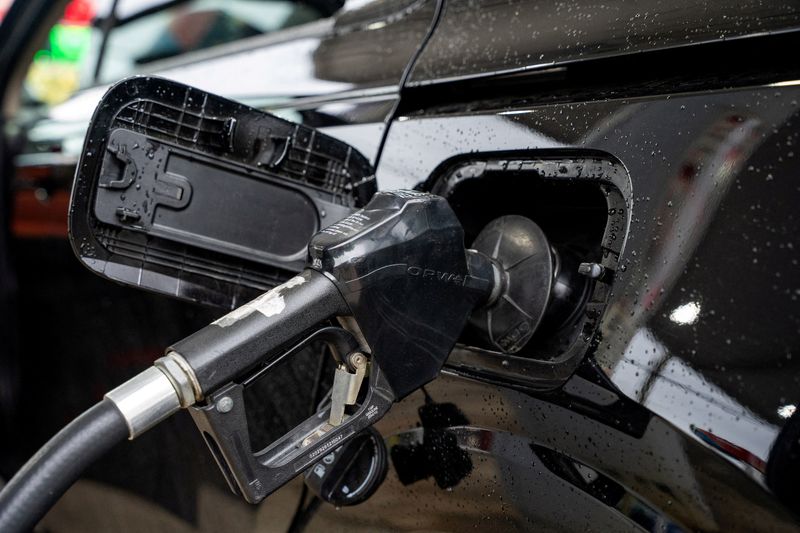
President Donald Trump is considering suspending the federal gasoline tax as the White House searches for additional ways to reduce fuel costs that remain sharply above year-ago levels. The idea could lower prices at the pump, but it would require congressional approval and would address only a fraction of the increase consumers have absorbed during this year’s disruption to global energy markets.
Trump said Tuesday that his administration was “thinking about” suspending the tax, without specifying how long a holiday might last or how the government would replace lost transportation revenue. The federal levy currently adds 18.4 cents to each gallon of gasoline, including an 18.3-cent excise tax largely directed to transportation programs and a 0.1-cent charge supporting the Leaking Underground Storage Tank Trust Fund.
The discussion comes even as gasoline prices have started retreating from September highs. The national average for regular gasoline fell to $4.354 a gallon for the week ended Oct. 5, down 11.1 cents from the previous week but still $1.23 higher than a year earlier, according to the U.S. Energy Information Administration. Diesel averaged $6.199 a gallon, down from $6.382 a week earlier but still at levels that create substantially greater transportation costs for trucking, agriculture and other fuel-intensive businesses.
A full 18.4-cent reduction would equal about 4% of the current national regular-gasoline price if every cent reached drivers. For a 15-gallon fill-up, the maximum direct saving would be about $2.76. That would provide measurable relief, particularly for commuters and lower-income households that spend a larger share of their budgets on transportation, but it would not unwind most of the fuel-price increase generated by tighter global oil and refined-product supplies.
A Tax Holiday Would Not Guarantee an 18.4-Cent Price Cut
The financial effect depends heavily on how much of the tax suspension is actually passed through to consumers. The federal gasoline tax is collected from suppliers, distributors, refiners and blenders rather than directly at individual filling stations, meaning retail prices would still respond to wholesale fuel costs, local competition, refinery economics and regional supply conditions.
Congressional Research Service analysis published earlier this year noted that previous state gasoline-tax holidays generally did not produce a one-for-one reduction in pump prices. One frequently cited study found that consumers received roughly 70% of the suspended tax through lower prices, while other research has similarly found incomplete pass-through. At that rate, eliminating the 18.4-cent federal tax would translate into a reduction closer to 13 cents per gallon rather than the full amount.
That limitation is particularly relevant in the current energy market because taxes are not the primary reason gasoline and diesel became more expensive. Oil and refined-product supplies have been disrupted by the U.S.-Israeli war with Iran and attacks on energy infrastructure and refineries in the Middle East and Russia. EIA data for Oct. 5 showed Brent crude near $125.51 a barrel and U.S. regular gasoline around $4.37 a gallon on a daily retail basis, while diesel stood around $6.32.
A tax holiday therefore could soften the consumer impact without fixing the underlying supply problem. If crude prices, refining margins or product shortages worsen, market-driven increases could quickly exceed the savings generated by removing the tax.
Highway Funding Creates the Larger Budget Trade-Off
Suspending the levy would also remove one of the federal government’s largest dedicated sources of transportation funding. Fuel taxes accounted for 82% of Highway Trust Fund revenue between fiscal 2015 and 2024, with the gasoline tax alone responsible for 58%, according to CRS. Federal Highway Administration data show that 77% of the $54 billion in federal highway revenue used in 2024 came from the Highway Trust Fund.
The Congressional Research Service cited an estimate from the Bipartisan Policy Center that suspending the gasoline tax from May through September 2026 would have reduced trust-fund revenue by about $17 billion. Congress could prevent that loss from weakening transportation funding by transferring an equivalent amount from the Treasury’s general fund, as several existing gas-tax-holiday proposals would require, but that approach would shift the cost to the broader federal budget rather than eliminate it.
That funding question matters because the Highway Trust Fund already spends more than it collects. CRS has said expenditures have consistently exceeded revenue since fiscal 2008, while current projections indicate the mass-transit account could approach depletion in fiscal 2027 and the highway account in fiscal 2028 without additional funding or policy changes.
Trump’s comments also extend a broader effort to reduce fuel costs. A day earlier, he signed an executive order expanding access to tax-exempt red-dyed diesel, traditionally reserved for agriculture and other off-road uses, as the administration responds to unusually high diesel prices.
The next meaningful development is now in Congress. Any gasoline-tax suspension would require legislation, and the duration of the holiday, whether consumers are guaranteed the benefit and how lawmakers replace lost Highway Trust Fund revenue would determine its true economic cost. Until those details emerge, the proposal is best viewed as a potential short-term consumer subsidy rather than a solution to the supply constraints keeping U.S. fuel prices elevated.