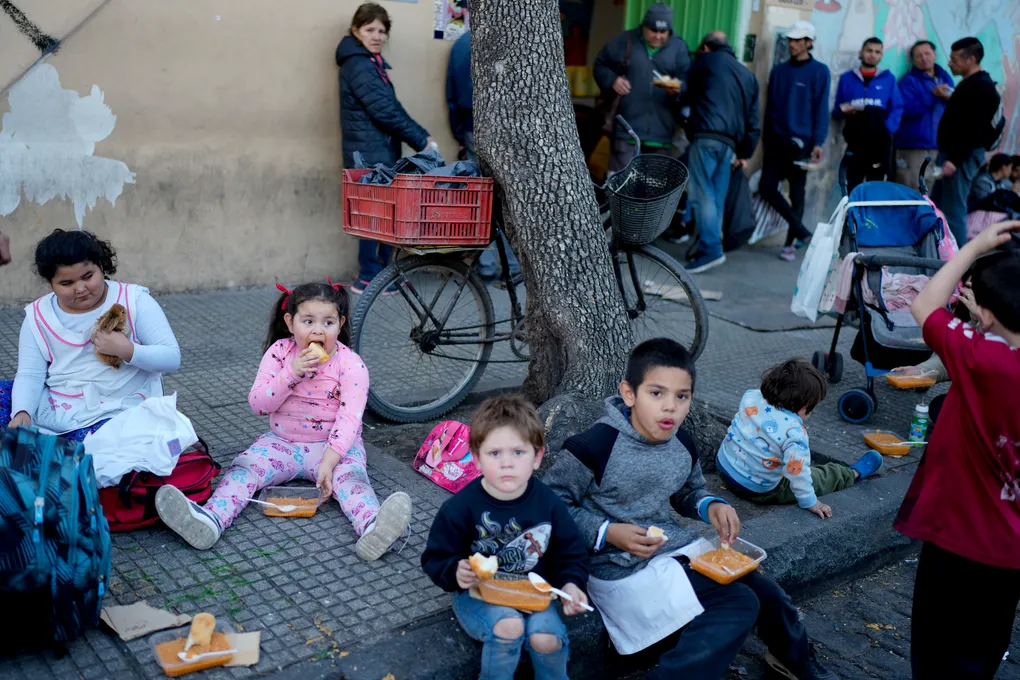
Argentina’s poverty rate rose to 32.3% in the first half of 2026, reversing part of the improvement recorded last year as household incomes failed to keep pace with the cost of basic necessities. The rate increased from 28.2% in the second half of 2025, while indigence — the share of people living in households unable to afford a basic food basket — climbed to 7.5% from 6.3%, according to Argentina’s national statistics agency, INDEC.
Across the 31 urban areas covered by INDEC’s Permanent Household Survey, 9.73 million of roughly 30.14 million people were below the poverty line, including 2.25 million classified as indigent. The deterioration was significant compared with the previous six months, although the agency said the year-over-year change from the first half of 2025, when poverty stood at 31.6%, was not statistically significant. Poverty also remains far below the 52.9% recorded in the first half of 2024.
The official survey does not directly count poverty across Argentina’s entire population. Figures of roughly 15 million poor people nationwide are extrapolations from the 32.3% rate; INDEC’s directly measured total is the 9.73 million people living in the 31 urban agglomerations included in the survey. That distinction is important when comparing estimates from different reports.
Household income lost ground to basic costs
The clearest explanation for the increase came from the income data. Average per-capita family income rose 11.5% from the previous six-month period, while the average basic food basket increased 21.4% and the broader basket used to determine the poverty threshold rose 19.6%. The gap was large enough to push more households below both thresholds even as Argentina continued to make progress in slowing the broader inflation rate.
Conditions also worsened for households already classified as poor. Their average monthly family income was 922,755 pesos in the first half, compared with an average basic total basket of 1.44 million pesos, leaving the average poverty gap at 35.9%. In other words, the deterioration was not limited to households narrowly crossing the poverty line; the distance between income and the amount required to exit poverty also widened from the second half of 2025.
There are signs that the income picture may have improved after the period covered by the poverty report, but the recovery has been uneven. Argentina’s overall wage index rose 2.8% in July against a 2.1% monthly increase in consumer prices. Private-sector registered wages gained 2.3% that month, but their cumulative increase through July was only 17%, compared with a 19.3% rise in consumer prices over the same period. August inflation subsequently slowed to 1.7%, according to INDEC, giving wages a better chance to recover purchasing power if the recent pattern is sustained.
The burden remains concentrated among younger Argentines. INDEC found that 44.5% of children age 14 or younger lived below the poverty line, compared with 36.9% of people ages 15 to 29 and 28.8% among those ages 30 to 64. Poverty was lowest among people 65 and older at 14.8%. Regional differences were also wide, ranging from 28.4% in Patagonia to 41.5% in Argentina’s northeast.
Activity data add a warning for consumer demand
The poverty report arrived alongside economic data showing a sharper-than-expected slowdown in July. Argentina’s monthly economic activity indicator fell 1.4% from a year earlier and 2.9% from June on a seasonally adjusted basis. Economists surveyed by Reuters had expected year-over-year growth of 1.8%, making the July reading a sizable downside surprise after economic activity had expanded 3.1% from a year earlier in June.
Consumer- and industry-sensitive sectors were among the weakest parts of the report. Wholesale and retail trade and repairs contracted 5.1% from July 2025, while manufacturing declined 4.6%; together, the two sectors subtracted 1.3 percentage points from the annual change in the activity index. Mining continued to provide support, rising 8.4%, while an unusually large increase in fishing also lifted the headline figure. Despite July’s decline, economic activity was still 1.7% higher over the first seven months of the year than during the same period in 2025.
The broader GDP data tell a similar story of positive annual growth but weaker sequential momentum. Second-quarter GDP increased 2.0% from a year earlier, topping the 1.6% growth expected by economists surveyed by Reuters, but output fell 0.6% from the first quarter after seasonal adjustment. Private consumption grew only 0.4% year over year, while exports increased 13.7%, highlighting the difference between stronger export-oriented parts of the economy and a softer domestic demand environment.
Retail data reinforce that split. Inflation-adjusted supermarket sales fell 2.1% in July from a year earlier and were down 2.7% over the first seven months of 2026. That weakness is financially relevant beyond the poverty figures themselves: slower real household spending can weigh on retailers, consumer-goods producers and other businesses dependent on domestic demand even when aggregate GDP continues to expand.
Economy Minister Luis Caputo acknowledged the increase in poverty and indigence but emphasized the longer comparison with the first half of 2024. On that basis, the official data show poverty falling from 52.9% to 32.3% and indigence from 18.1% to 7.5% over two years, capturing the substantial improvement that followed the initial spike in poverty early in President Javier Milei’s administration. The latest report nevertheless shows that the decline has not continued in a straight line, with household income growth falling behind the cost of basic baskets during the first half of 2026.
The next test is whether the more favorable wage-inflation relationship seen recently can persist while economic activity stabilizes. Argentina’s September inflation report is scheduled for October 13, followed by August economic activity and wage data on October 21 and August supermarket sales on October 22. Those releases should provide the first clearer indication of whether the first-half deterioration in household purchasing power is beginning to reverse or is being reinforced by weaker domestic growth.