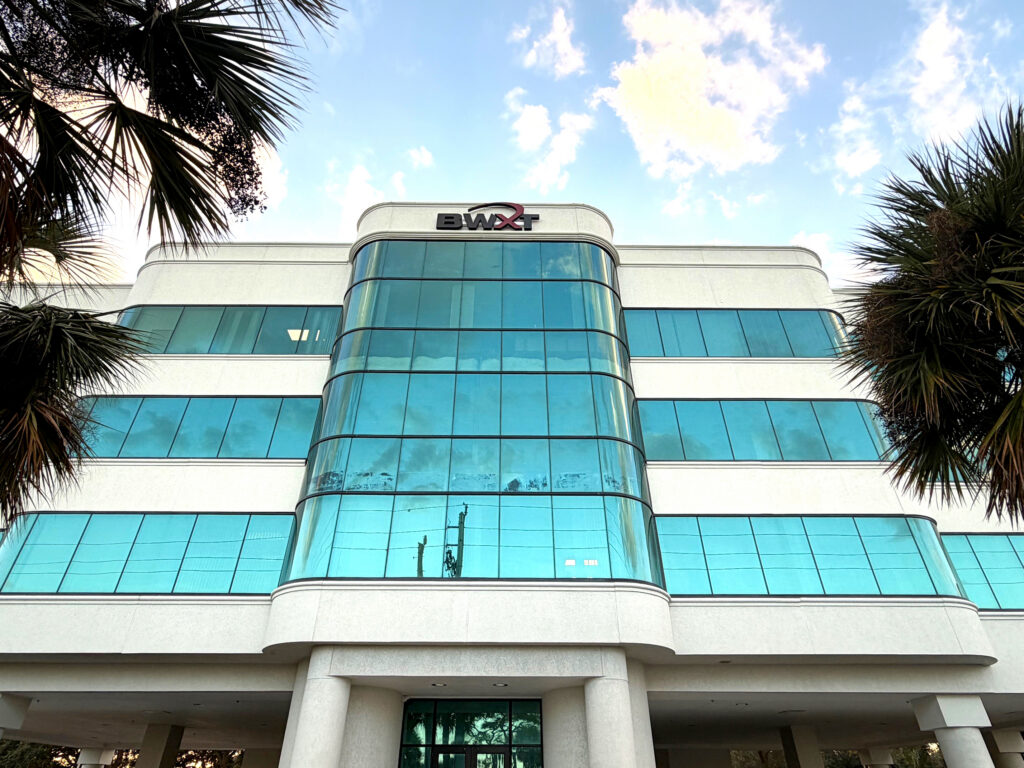
BWX Technologies shares climbed 7.7% Tuesday after the nuclear engineering company’s BANR microreactor was selected for a proposed transportable nuclear power plant in New Brunswick, giving one of BWXT’s emerging reactor technologies a potential commercial deployment outside its traditional U.S. government business.
The stock closed at $145.70, up $10.35, after trading as high as $147 during the session. The rally still leaves BWXT roughly 20% below where it began 2026 and well below its 52-week high above $240, but Tuesday’s move reflected growing investor interest in whether the company can translate its advanced-nuclear technology into a larger commercial business.
Prodigy Clean Energy, Pabineau First Nation and Eel River Bar First Nation selected BWXT’s Advanced Nuclear Reactor, known as BANR, for an Indigenous-led Transportable Nuclear Power Plant planned for Belledune, New Brunswick. The project is designed for as much as 50 megawatts of electricity and would use two BANR units, with commercial operation targeted for the early 2030s.
The selection is more significant as a commercialization milestone than as an immediate revenue event. BWXT and Prodigy are still working toward a definitive cooperative agreement covering project development, engineering, licensing, supply-chain integration, financing and deployment, meaning the announcement should not be treated as a finalized reactor order or committed backlog.
A Reference Project for BWXT’s Microreactor Strategy
BANR is a high-temperature gas-cooled reactor designed to produce about 22 megawatts of electricity and 75 megawatts of thermal power using TRISO fuel. Prodigy’s transportable plant architecture can accommodate multiple units and is intended to allow much of the power plant to be factory-built before being shipped to its final location.
For the New Brunswick project, the two reactors and other nuclear and non-nuclear systems are expected to be fabricated primarily at BWXT facilities in Ontario. Prodigy says the plant could be installed in roughly 18 months after factory construction, an approach aimed at reducing the lengthy on-site construction schedules that have historically complicated large nuclear projects.
The economics still have several steps to clear. The Government of New Brunswick has signed a letter of intent with Prodigy and the participating First Nations to purchase electricity produced by the facility, but a letter of intent is not equivalent to a final long-term power purchase agreement. Licensing, financing, final contractual terms and execution will determine whether the proposed early-2030s deployment becomes a revenue-producing project for BWXT.
The broader opportunity is what helped attract investors Tuesday. Prodigy intends to use Belledune as a reference plant for additional transportable nuclear facilities serving remote communities, industrial customers and other markets where conventional grid infrastructure or fuel logistics can be difficult. A successful first deployment could therefore create follow-on demand for BWXT reactors rather than leaving Belledune as a one-off project.
BANR Is Beginning to Build a Deployment Pipeline
The Canadian project comes only weeks after the U.S. Army selected BANR for its Janus advanced nuclear program. BWXT said in August that it plans to work toward construction at Fort Campbell, Kentucky, with groundbreaking targeted for late 2028 and reactor operations expected in the early 2030s. The Army program provides a second potential deployment path for the same reactor technology, this time in the defense market.
That combination is strategically useful for BWXT because the company is already profitable and supported by substantial nuclear manufacturing operations rather than depending entirely on future reactor projects. In the second quarter, revenue rose 18% from a year earlier to $901.6 million, while Commercial Operations revenue jumped 72% to $302.5 million. BWXT raised its full-year 2026 outlook to approximately $3.8 billion in revenue, adjusted EBITDA of $662 million to $672 million and adjusted earnings of $4.70 to $4.80 per share.
Its existing government business also continues to generate large contract awards. On October 1, BWXT disclosed a roughly $189 million U.S. Navy contract to manufacture naval nuclear reactor fuel, with work scheduled through August 2027. That established defense business gives BWXT a different financial profile from many publicly traded advanced-reactor developers that are still years away from generating meaningful reactor revenue.
Advanced Nuclear Interest Is Broadening
Tuesday’s gain also arrived during a broader resurgence in nuclear-related stocks. Constellation Energy surged after announcing a 20-year agreement with Google tied to upgrades at 11 nuclear plants, another sign that rapidly rising electricity requirements from data centers are pushing large technology companies toward long-duration nuclear supply arrangements.
BWXT’s Canadian announcement is separate from that agreement, but both developments reinforce the same underlying investment theme: nuclear power is increasingly being considered for markets that require reliable, high-density electricity while governments and corporations seek lower-carbon sources of generation.
For BWXT, however, the next phase will be measured less by enthusiasm surrounding nuclear power and more by contract conversion. Investors now have evidence that BANR is attracting prospective government and commercial deployments, but the Belledune project still needs definitive agreements, licensing, financing and construction milestones before it can materially alter BWXT’s earnings base.
The company’s next financial checkpoint comes November 2, when BWXT is scheduled to report third-quarter results. Beyond its core defense and commercial nuclear performance, any additional detail on BANR contracting, project economics or the timetable for the Canadian and Army deployments could help determine whether Tuesday’s rally represents the beginning of a broader revaluation of BWXT’s advanced-reactor business or simply recognition of another promising project still several years from operation.