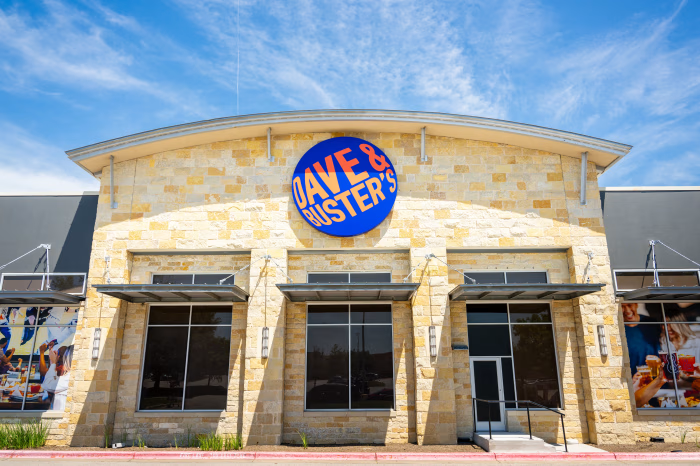
Dave & Buster’s shares dropped sharply in after-hours trading Monday after the entertainment chain reported weaker-than-expected second-quarter revenue, a surprise adjusted loss and a steep decline in profitability as its core gaming business continued to struggle.
Revenue fell 2.4% from a year earlier to $544.1 million, below Wall Street’s roughly $556.8 million expectation. Adjusted earnings swung to a loss of $0.27 per share from a $0.40 profit a year ago, compared with analysts expecting roughly $0.18 to $0.19 of profit. Adjusted EBITDA fell to $98.9 million from $129.8 million and missed the $116.6 million consensus estimate.
The stock fell as much as roughly 16% after the results, extending a difficult year for a company already trading more than 60% below its 52-week high before the report.
Dave & Buster’s also reported a $12.5 million GAAP net loss, or $0.36 per share, compared with an $11.4 million profit a year earlier. Operating income dropped to $19.4 million from $53 million, pushing the operating margin down to 3.6% from 9.5%.
The quarter exposed the problem facing new Chief Executive Darin Harper: customers are spending more on food and drinks, but the entertainment business that differentiates Dave & Buster’s remains under pressure.
Entertainment Revenue Keeps Falling
Comparable-store sales declined 2.9% from the same calendar period last year.
That figure is worth clarifying because StockStory’s earnings summary described comparable sales as having risen 2.9%. Dave & Buster’s SEC-filed results state that they decreased 2.9%.
The composition of sales shows where the weakness is concentrated.
Entertainment revenue fell about 9% to $332.6 million from $364.5 million a year earlier. Food and beverage revenue increased roughly 10% to $211.5 million from $192.9 million. As a result, entertainment represented 61.1% of total revenue compared with 65.4% a year ago.
For Dave & Buster’s, weaker entertainment demand carries an outsized financial effect because gaming has historically been central to both traffic and economics at its venues. Higher food and beverage sales helped offset part of the decline, but they were not enough to prevent total revenue and margins from falling.
Store operating income before depreciation and amortization declined to $127.8 million from $155.4 million. The related store-level margin fell to 23.5% from 27.9%. Payroll, other store operating expenses and depreciation all consumed a larger percentage of sales than they did last year.
That margin deterioration helps explain why the market reacted more severely than the 2.4% revenue decline might suggest.
Adjusted EBITDA fell nearly 24% while revenue declined only modestly, showing that lower sales are currently having a much larger effect on earnings.
New CEO Is Trying to Reset the Business
Harper became CEO in August after former chief executive Tarun Lal retired. Harper had served as Dave & Buster’s chief financial officer since 2024 and previously held senior finance roles at Main Event before Dave & Buster’s acquired that business.
His early strategy has centered on what management calls a “Back-to-Basics” approach: improving the guest experience, strengthening food and beverage sales, rebuilding special-events demand, tightening costs and getting more performance from renovated locations.
Management said remodeled stores continue to outperform the broader system and that comparable-sales trends improved in July and continued improving during the third quarter to date.
That commentary gives investors a potential sign that the decline may be moderating, but the company did not provide a numerical third-quarter comparable-sales figure in its earnings release.
Six new domestic locations opened during the second quarter, and Dave & Buster’s expects to finish two additional remodels during the remainder of fiscal 2026, bringing the year’s total to eight.
Cash Flow Improved, but Debt Leaves Less Room for Error
One part of the quarter improved meaningfully.
Adjusted free cash flow for the first six months of fiscal 2026 was positive $19.5 million, compared with negative $36.5 million during the same period last year. Operating cash flow increased to $160.6 million while capital expenditures fell to $190 million from $243.8 million.
The balance sheet still makes a sustained earnings recovery important.
Dave & Buster’s ended the quarter with about $1.54 billion of total debt and just $16 million of cash. Its credit-agreement measure of net leverage stood at 3.5 times trailing Credit Adjusted EBITDA. The company reported $492.1 million of available liquidity.
That does not indicate an immediate liquidity crisis, but high debt makes falling EBITDA more consequential. A business carrying significant leverage has less flexibility if comparable-store sales remain negative and margins continue contracting.
The next few quarters will therefore be less about new store openings and more about whether existing locations begin producing better economics.
Management says sales trends have improved since July, remodeled locations are outperforming and cost-saving initiatives are underway. Investors now need to see that improvement show up in positive comparable sales and higher EBITDA.
After a quarter in which a small revenue decline turned into a much larger earnings decline, the key test is whether Dave & Buster’s can reverse that operating leverage — turning even modest sales improvement into stronger margins rather than continuing to lose profitability as traffic softens.