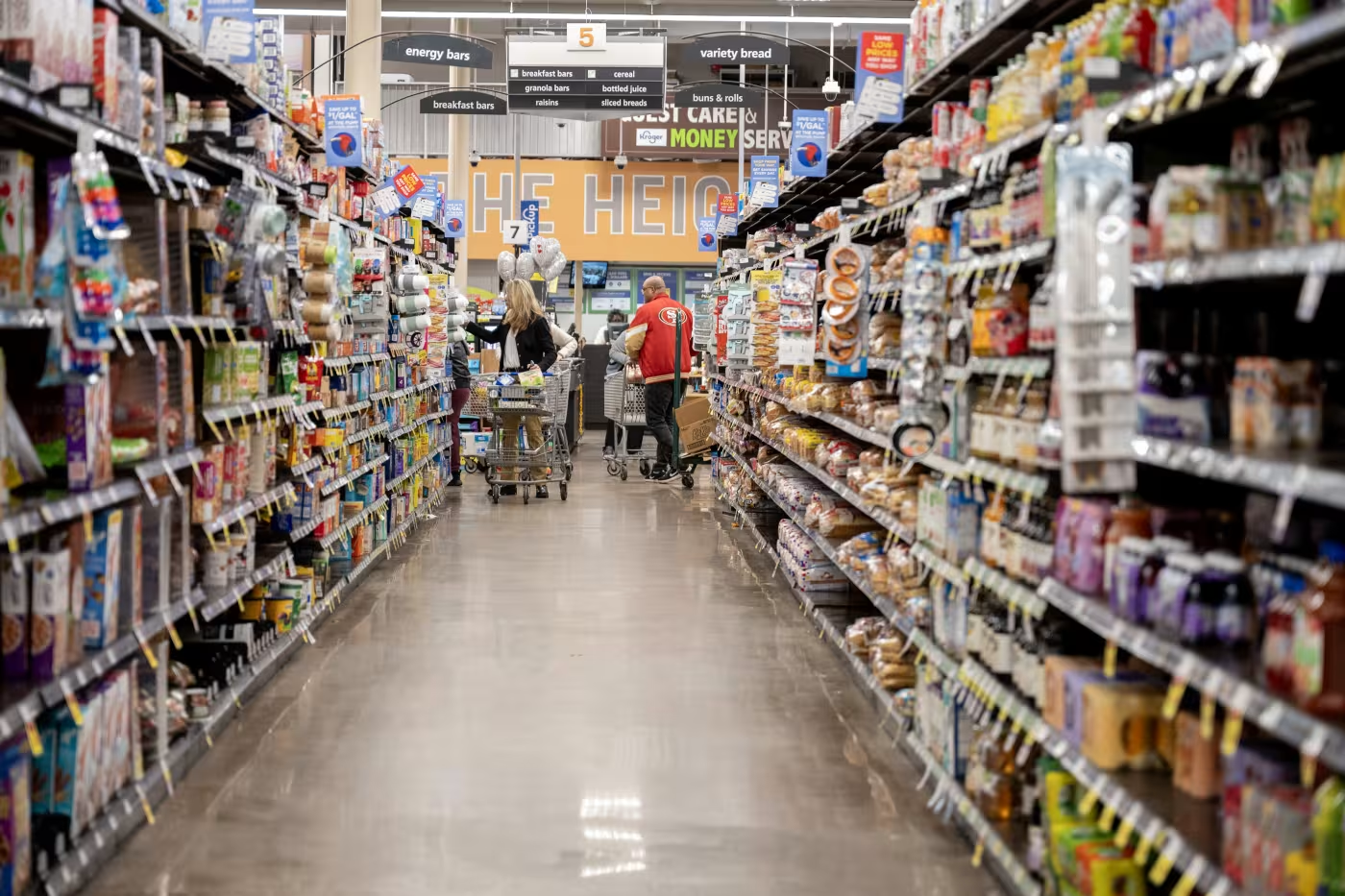
Kroger cut its full-year sales outlook after shoppers pulled back and several unusual headwinds slowed its grocery and pharmacy businesses, but the company kept its profit forecast intact as cost savings and improving digital economics helped offset the weaker top line.
Second-quarter sales rose 2% to $34.62 billion, narrowly below the $34.64 billion expected by analysts surveyed by FactSet. Adjusted earnings increased 5% to $1.09 a share, topping the $1.06 consensus. Identical sales excluding fuel grew just 0.2%, down sharply from 3.4% a year earlier and below Wall Street expectations.
Kroger responded by reducing its full-year identical-sales forecast to growth of 0.2% to 0.8%, from its previous 1% to 2% range. It left adjusted EPS guidance unchanged at $5.10 to $5.30 and maintained its forecast for $5.0 billion to $5.2 billion of adjusted FIFO operating profit.
Shares initially dropped before the market opened Friday, then reversed course and closed 2.7% higher. The rally continued Monday, with Kroger climbing another 4.1% to $60.91 while the S&P 500 fell 0.5%.
The reversal reflects an unusual quarter: Kroger’s sales outlook became substantially weaker, but the deterioration did not translate into an equivalent hit to earnings.
Sales Growth Was Hit From Several Directions
Some of the slowdown came from consumers.
Chief Executive Greg Foran said traffic increased during the quarter, but customers were becoming more selective about what they purchased as household budgets remained under pressure. Higher fuel prices, reduced government food benefits and broader economic uncertainty are encouraging shoppers to focus more heavily on necessities.
Kroger also faced several company-specific revenue headwinds.
Changes stemming from the Inflation Reduction Act reduced identical sales by roughly 140 basis points as lower negotiated drug prices reduced reported pharmacy revenue. A shift from branded medicines toward cheaper generic prescriptions took another roughly 60 basis points from sales.
Management stressed that neither of those pharmacy effects materially reduced profit.
Egg-price deflation removed another 30 basis points from identical-sales growth, while a Cyclospora outbreak tied to produce reduced the metric by approximately 35 basis points late in the quarter.
Together, Kroger said those four factors represented roughly 265 basis points of pressure on comparable sales.
The Cyclospora impact was especially disruptive because shoppers did not merely avoid individual affected products. Management said consumer caution spread more broadly across the produce department, hurting fresh-food sales and creating additional inventory shrink.
Those effects were still lingering early in the third quarter, although Kroger said the pressure has been diminishing week by week.
The pharmacy drag is likely to persist longer. Kroger expects the Inflation Reduction Act impact on identical sales to worsen to roughly 150 basis points in the fourth quarter as additional high-cost drugs enter Medicare price negotiations. Management again expects little effect on pharmacy profit from the change.
That helps explain why Kroger was willing to make a large reduction to its sales forecast without touching its earnings outlook.
Digital Growth Is Becoming More Useful to Profit
The more encouraging part of Kroger’s quarter came from businesses that management has been trying to make more economically productive.
Adjusted e-commerce sales increased 20%, while new digital customers rose 20%. Kroger said the quarter marked its second consecutive period of profitable e-commerce growth.
Kroger Precision Marketing, its retail-media operation, increased profit by 24%.
Those businesses matter because grocery retail operates on thin margins. Advertising income, better fulfillment economics and increased digital engagement can allow Kroger to grow customer relationships without relying entirely on additional store sales.
Adjusted FIFO gross margin excluding fuel, rent, depreciation and amortization improved 13 basis points from a year ago. Better e-commerce profitability, retail media, favorable pharmacy mix and sourcing savings helped offset higher transportation expenses, increased shrink and Kroger’s investments in lower prices.
The reported gross margin was 22.4%, compared with 22.5% last year.
Operating costs remain a pressure point. Kroger’s adjusted operating, general and administrative expense rate increased 33 basis points, reflecting higher employee wages, healthcare expenses and the effect of slower sales growth.
Adjusted FIFO operating profit slipped to $1.08 billion from $1.09 billion a year earlier even as adjusted EPS increased.
Share repurchases are helping the per-share numbers. Kroger bought back $1 billion of stock during the quarter and has repurchased $1.2 billion year to date under its $2 billion authorization. Roughly $800 million remains, which the company expects to complete before the end of fiscal 2026.
Kroger also raised its dividend 11% earlier this year, extending its streak of annual dividend increases to 20 years.
The Consumer Remains the Bigger Risk
Kroger’s quarter leaves investors with two different trends.
Operationally, the company is doing a better job protecting profitability. E-commerce is becoming more profitable, retail media is expanding, sourcing initiatives are supporting margins and management continues finding costs it can redirect toward lower consumer prices.
Demand is less reassuring.
Traffic may be holding up, but weaker unit trends and increasingly need-based shopping show that customers are managing tighter budgets. Foran specifically pointed to fuel prices above $4 as a constraint on discretionary spending.
That creates a delicate equation for Kroger.
The company wants to invest more aggressively in value to keep shoppers from defecting to Walmart, Costco, Aldi and other food retailers, but grocery margins leave relatively little room for a price war. Cost savings therefore have to keep funding those investments without eroding earnings.
So far, Kroger believes they can.
The company continues to expect between $2.7 billion and $2.9 billion of free cash flow this year and capital spending of $3.8 billion to $4.0 billion. Net debt stood at 1.91 times adjusted EBITDA, still below management’s long-term target range of 2.3 to 2.5 times.
The preserved profit forecast is why the sales-guidance cut looks less damaging than it would under normal circumstances. A considerable portion of Kroger’s revenue pressure is coming from lower pharmacy prices and product deflation rather than an equivalent deterioration in profitability.
That does not make the sales slowdown irrelevant. Grocery units softened during the quarter, consumers remain cautious, and Kroger still needs stronger underlying sales growth if it wants earnings to expand without leaning as heavily on cost savings and share repurchases.
The next major checkpoint arrives October 20, when Kroger plans to hold an investor update and provide new detail on its strategic priorities and longer-term financial targets.
After a quarter in which weak sales and resilient earnings pulled in opposite directions, investors will be looking for evidence that Foran’s push toward lower costs, better stores and sharper pricing can eventually produce something Kroger did not deliver this quarter: stronger underlying sales without sacrificing margin.