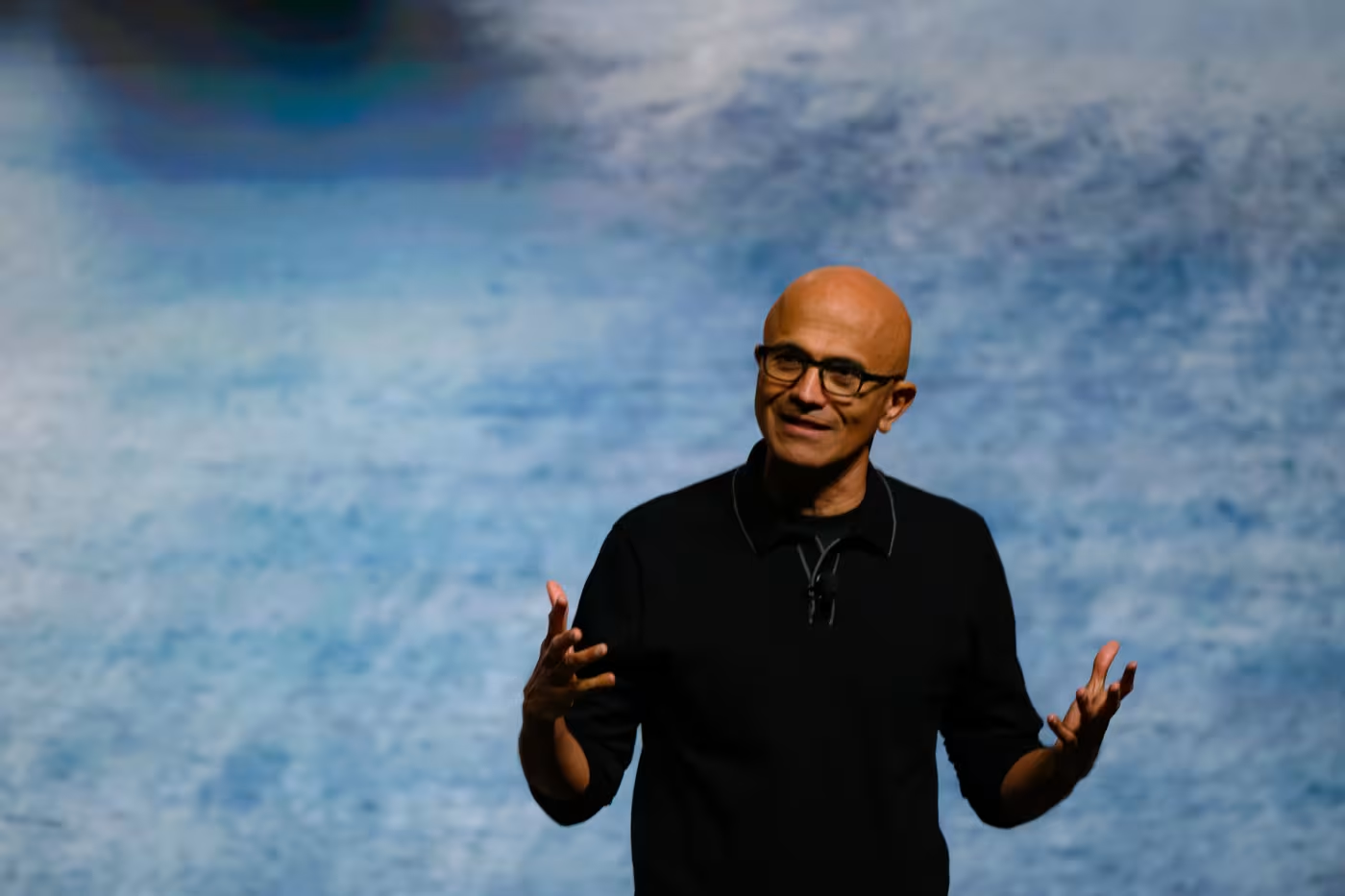
Microsoft CEO Satya Nadella sold approximately $43.4 million of company stock this week, but the regulatory filing shows the transaction was arranged months in advance rather than representing a sudden decision by the executive to reduce his exposure to Microsoft.
Nadella sold 86,525 Microsoft shares on September 1 across eight transactions at prices ranging from $497.69 to $505.76, according to a Form 4 filed with the Securities and Exchange Commission. Based on the weighted-average prices disclosed for each transaction, the shares were sold for approximately $43.39 million, or about $501.46 per share on average.
The filing states that the sales were made under a Rule 10b5-1 trading plan adopted on March 8, 2026. Such plans allow corporate insiders to establish predetermined trading instructions before transactions occur, helping separate future sales from information executives may possess when the trades are eventually executed.
That detail makes the transaction considerably different from an unscheduled insider sale made in response to a recent earnings report, stock-price movement or undisclosed company development.
Nadella also continues to hold a large Microsoft position.
After the September 1 sale, the filing showed 486,762.534 shares held directly. Another 431,464 shares were reported indirectly through five grantor retained annuity trusts, bringing the disclosed direct and indirect holdings to roughly 918,227 shares.
At Microsoft’s Thursday closing price of $510.12, those disclosed holdings would be worth approximately $468 million, although that calculation does not account for other unvested equity awards or future compensation.
The sale also came immediately after a large performance-stock award vested.
A separate SEC filing shows that 178,622 Microsoft shares vested for Nadella on August 31 under a performance award granted in September 2023 for the three-year performance period ending June 30, 2026. Microsoft withheld approximately 70,466 of those shares at $513.53 to satisfy tax obligations, leaving Nadella with 573,287 directly held shares before the following day’s sale.
Seen in that context, the $43 million transaction followed the vesting of a sizable compensation award and reduced Nadella’s direct position by roughly 15%, while leaving the majority of his disclosed Microsoft ownership intact.
It was also not unusual compared with his previous trading activity.
Nadella’s last reported open-market sale came in September 2025, when he sold approximately 149,205 Microsoft shares for about $75.3 million. Those transactions were likewise conducted through a Rule 10b5-1 plan that had been established months earlier.
Microsoft Shares Rise Despite Insider Sale
The transaction does not appear to have created meaningful selling pressure in Microsoft’s stock.
The Form 4 was filed after the market closed Wednesday. Microsoft shares then advanced 2.68% Thursday to $510.12, outperforming the S&P 500’s 1.06% gain during a broader technology rally.
That does not mean investors were specifically buying because they viewed Nadella’s sale as unimportant. Thursday’s market was broadly stronger after Federal Reserve Governor Christopher Waller’s comments reduced fears of an imminent interest-rate increase, helping lift technology and other growth stocks.
Still, the price action offers little evidence that investors interpreted the CEO’s pre-arranged stock sale as a material negative signal for Microsoft.
The bigger questions surrounding MSFT remain centered on Azure growth, artificial-intelligence spending and whether Microsoft’s massive investment in data-center infrastructure can continue producing enough revenue and cash flow to justify the cost.
Azure Growth Is Accelerating
Microsoft’s most recent earnings report gave investors a strong answer on the revenue side.
For the fiscal fourth quarter ended June 30, Microsoft generated $90 billion of revenue, up 18% from the previous year. Operating income increased 18% to $40.6 billion, while adjusted earnings reached $4.74 per share, up 23%.
GAAP net income climbed 31% to $35.8 billion, and GAAP diluted earnings increased 32% to $4.81 per share.
Azure and other cloud-services revenue grew 43%, accelerating from 39% growth in Microsoft’s fiscal third quarter.
Microsoft Cloud revenue reached $59.3 billion, up 27%, while commercial remaining performance obligations jumped 84% to $678 billion. RPO represents contracted business that has not yet been recognized as revenue and provides investors with visibility into future demand, although the timing of recognition can vary.
Management expects Azure growth to accelerate again in the current quarter.
That trajectory has helped keep Wall Street focused on Microsoft as one of the largest beneficiaries of continued enterprise spending on cloud infrastructure and artificial intelligence.
Microsoft 365 Copilot has also surpassed 30 million paid seats, giving the company another avenue for monetizing AI beyond cloud-computing infrastructure.
Bank of America analyst Tal Liani recently raised his Microsoft price target to $600 from $500 while maintaining a Buy rating. He cited accelerating Azure growth, improving visibility into AI returns and Microsoft’s ability to use a mix of proprietary and third-party AI models rather than relying exclusively on the most expensive models for every task.
Microsoft Will Finally Show Investors Azure Revenue
Microsoft also gave shareholders an important new piece of information this week: Azure’s actual revenue.
Until now, investors primarily received percentage growth figures for Azure rather than a standalone dollar amount.
Microsoft disclosed that Azure generated approximately $29.4 billion of revenue during the fiscal fourth quarter and $101.9 billion for the full fiscal year ended June 30.
Starting in fiscal 2027, Microsoft will report Azure revenue separately as part of a broader overhaul of its financial reporting structure.
The company is replacing its three previous reportable segments with two: Agents and Infra, and Devices and Consumer.
Agents and Infra will house much of Microsoft’s cloud, enterprise software and AI ecosystem, while Devices and Consumer will include operations such as Windows, Xbox, search advertising and other consumer-facing businesses.
The change should give investors a cleaner view of how much revenue Azure generates as Microsoft commits enormous amounts of capital to cloud and AI infrastructure.
There is a limitation.
Microsoft still will not separately disclose Azure’s operating expenses or profit margins, meaning investors will be able to track the cloud platform’s revenue more precisely without receiving a complete picture of its standalone profitability.
AI Spending Remains the Biggest Financial Debate
Microsoft spent approximately $41 billion on capital expenditures during the June quarter alone.
About two-thirds of that spending went toward shorter-lived assets such as CPUs and GPUs, while the remainder went toward longer-lived infrastructure including data centers.
The company generated $55.4 billion in operating cash flow during the quarter and $19.6 billion in free cash flow.
For fiscal 2027, management expects capital expenditures to increase again as Microsoft attempts to bring additional capacity online to satisfy demand across Azure and its AI products. Microsoft has repeatedly said customer demand has exceeded available infrastructure capacity.
That creates the central debate around Microsoft stock.
The company is generating enormous revenue, earnings and cash flow while Azure growth is accelerating. But keeping that growth going requires unprecedented spending on chips, servers, networking equipment, data centers and power infrastructure.
Microsoft’s companywide gross margin was 67% in the latest quarter, down from the previous year partly because Azure represents a larger percentage of revenue and because the company continues investing heavily in AI infrastructure.
For investors, the question is therefore not whether AI is producing revenue for Microsoft. The recent numbers show that it is.
The question is whether the incremental revenue and profits generated by AI can continue growing fast enough to produce attractive returns on the extraordinary amount of capital Microsoft is deploying.
What Microsoft Investors Should Watch Next
The first major test will arrive with Microsoft’s fiscal first-quarter results.
Azure growth will remain the headline metric, particularly after reaching 43% last quarter and with management expecting further acceleration.
The new Azure revenue disclosure should also make it easier to measure how quickly Microsoft’s cloud business is expanding in absolute dollars and compare its scale more directly with Amazon Web Services and Google Cloud.
Commercial RPO will be another important indicator. Microsoft’s $678 billion backlog provides substantial future revenue visibility, but investors will want to see whether new customer commitments remain strong as AI infrastructure spending expands across the technology industry.
Margins and free cash flow deserve equal attention. Microsoft can continue spending heavily as long as Azure, Copilot and other AI offerings generate enough incremental revenue and operating leverage to support those investments.
Nadella’s $43 million stock sale is notable because of its size, but the filing itself provides little evidence that the CEO suddenly became less confident in Microsoft. The trade was established under a plan adopted nearly six months earlier, followed the vesting of a large performance award and left Nadella with hundreds of millions of dollars of disclosed Microsoft stock.
For MSFT shareholders, Azure’s acceleration, AI monetization, capital spending and the returns Microsoft earns on that investment are likely to matter far more than one pre-arranged insider transaction.