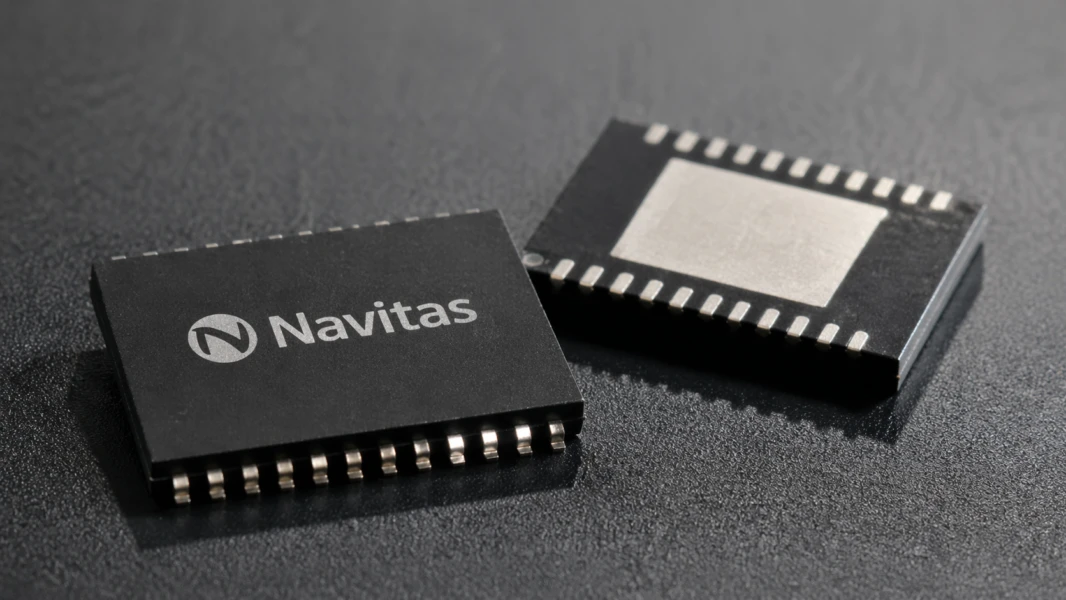
Navitas Semiconductor has been selected for a U.S. Army program to develop ultra-high-voltage silicon carbide power devices, giving the power-chip company a new defense-backed opportunity as it expands beyond its traditional markets and concentrates on higher-power applications. The award sent Navitas shares sharply higher in after-hours trading Monday, though much of that initial reaction faded during Tuesday’s session.
The Army’s ALATTIS program — short for Accelerated, Large-Area, 10 kV SiC IGBT — is focused on creating and validating a domestic manufacturing process for silicon carbide devices capable of operating at 10 kilovolts or more. The Army Research Laboratory is sponsoring the prototype effort, which will include development of 10 kV silicon carbide insulated-gate bipolar transistors, or IGBTs, alongside related PiN diode technology.
Financial terms were not disclosed, making the award more important for its technological and strategic implications than for any immediately measurable contribution to Navitas’ revenue. The announcement describes ALATTIS as a prototype program centered on design, fabrication and testing; it does not establish a large production order or disclose committed follow-on purchases by the Army.
Navitas shares had jumped roughly 20% in postmarket trading following Monday’s announcement, but the move narrowed substantially after the market reopened. The stock finished Tuesday at about $11.83, up less than 1%, after trading as high as $12.88 during the session. Trading volume climbed to roughly 21 million shares, highlighting the initial interest in the announcement even as investors stopped short of maintaining the after-hours rally.
A Defense Validation for Navitas’ High-Voltage SiC Strategy
Silicon carbide is designed to handle higher voltages, temperatures and power levels more efficiently than conventional silicon in many demanding applications. Navitas already sells GeneSiC devices spanning roughly 650 volts through 6.5 kV, while the Army project would push its development work farther into ultra-high-voltage territory.
The company intends to use its trench-assisted planar architecture as part of the ALATTIS work, extending technology previously used in its silicon carbide MOSFET portfolio toward 10 kV IGBTs. Navitas has worked on ultra-high-voltage SiC for years, including earlier development of 10-to-15 kV PiN diodes and 6.5 kV devices. The Army program is also explicitly aimed at establishing a U.S.-based manufacturing process, adding a supply-chain component to the technical work.
That makes the award relevant beyond a single military project. Navitas has increasingly positioned its high-voltage SiC portfolio for power-intensive markets including electrical-grid infrastructure, industrial systems and AI data centers. Demonstrating reliable devices at still-higher voltage levels could broaden the technology available for those markets, although commercial adoption and meaningful production revenue would require additional development and customer commitments.
The company’s financial profile also puts the announcement into perspective. Second-quarter revenue was $10.5 million, up 22% sequentially but down from $14.5 million a year earlier as Navitas continued moving away from mobile and lower-end consumer products. Non-GAAP gross margin improved to 39.5%, while the company still recorded an $11.4 million non-GAAP operating loss. Navitas ended June with $557.4 million of cash and cash equivalents.
AI Infrastructure Remains the Larger Commercial Test
Management expects the company’s transition toward higher-power applications to produce stronger growth during the second half of 2026. Navitas guided for third-quarter revenue of $13 million to $14 million, with the $13.5 million midpoint representing approximately 28% sequential growth. It also expects AI infrastructure, including data centers and grid and energy infrastructure, to account for more than one-third of revenue by the end of the year.
That commercial ramp remains more consequential to Navitas’ near-term financial results than the Army award. The company has said it is supplying production samples of GaN and SiC products for customer programs tied to next-generation AI data-center architectures and expects selected hyperscaler and computing-platform opportunities to begin ramping in 2027. Its August agreement to acquire power-management company Claros for consideration valued at up to roughly $233 million further reinforced the strategy of building a broader portfolio around AI power delivery.
The Army selection nevertheless gives Navitas another external test of the technology behind that broader strategy. Unlike a large production contract, ALATTIS does not yet provide investors with a disclosed revenue stream to model. Successful development could lead to additional defense opportunities and strengthen Navitas’ position in ultra-high-voltage SiC, but the next meaningful milestones will be technical validation, any disclosed follow-on procurement and evidence that the company’s larger high-power pipeline is converting into sustained revenue growth.
Navitas’ third-quarter results will provide the nearer-term financial test. Investors will be watching whether revenue reaches the company’s $13 million-to-$14 million target and whether the expected shift toward AI infrastructure and other high-power applications can continue improving growth without materially widening operating losses.