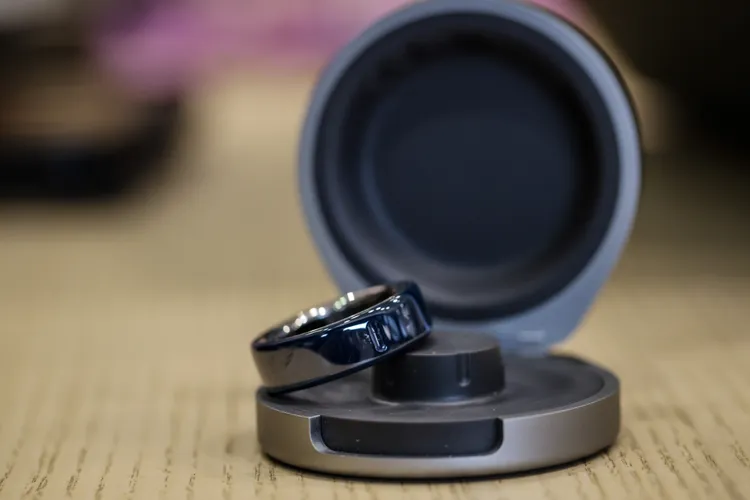
Oura has postponed its planned Nasdaq debut, pulling a potentially $2.2 billion initial public offering from the market just days after setting a $40-to-$44-per-share price range. The smart-ring maker cited uncertainty in the IPO market despite what it described as strong investor demand, leaving one of the fall’s more closely watched consumer-technology listings without a new timetable.
The delay comes even as Oura enters the public-market process with financial results that are stronger than those of many recent growth-company IPO candidates. Revenue reached $1.21 billion during the nine months ended June 30, up 74% from $697.6 million a year earlier, while net income increased to $60.8 million from $1.6 million. Gross margin also improved to 55% from 51%.
That performance makes the postponement more notable. Oura is not shelving an IPO because its business is shrinking or because it urgently needs new capital. Instead, the decision arrives as higher interest rates, elevated bond yields and broader market volatility have made investors more selective about the prices they are willing to pay for newly listed companies. Reuters reported that the offering had attracted substantial demand, but Oura ultimately chose not to proceed under current conditions.
Oura’s IPO Was Mostly a Secondary Offering
The structure of the proposed deal helps explain why management has room to wait. Oura planned to sell 50 million shares, but only 13.5 million would have been newly issued by the company. Existing shareholders were offering the remaining 36.5 million shares, with an additional 7.5 million shares potentially available from those holders if underwriters exercised their overallotment option. Oura would not have received any proceeds from those secondary sales.
Even the cash Oura expected to receive from its own portion of the offering was largely committed before reaching the balance sheet. At the $42 midpoint of the proposed range, the company estimated net proceeds of about $532.6 million, with roughly $526.4 million earmarked for tax withholding and remittance obligations tied to the settlement of restricted stock units. Only the remaining amount was expected to be available for general corporate purposes such as technology development, working capital and capital spending.
That means postponing the IPO does not deprive Oura of a large pool of growth capital it was counting on to fund operations. The company reported $371.8 million of cash and cash equivalents as of June 30 and approximately $380.1 million of debt, including $375 million outstanding under its revolving credit facility. The original transaction was therefore as much about creating liquidity for shareholders, dealing with employee equity obligations and establishing a public market for Oura stock as it was about financing the business.
The Business Is Growing Faster Than the IPO Market
Oura’s underlying growth remains substantial. Hardware generated $974 million of revenue during the first nine months of fiscal 2026, while membership revenue more than doubled to $240.5 million from $108.8 million. Subscriptions represented about 20% of total revenue, up from 16% a year earlier, and carried an 89% gross margin during the period.
Paid membership reached 5 million as of June 30, double the year-earlier level. Oura said in its prospectus that it expected to finish fiscal 2026 with roughly 5.7 million paid members, representing 96% year-over-year growth, supported by demand for the Oura Ring 5. Its weighted-average 12-month paid-member retention rate was about 85% as of June 30, giving the company a recurring-revenue component alongside its hardware sales.
That mix is important because investors considering Oura are not simply valuing a consumer-electronics manufacturer. The company is trying to establish a hardware-plus-subscription model in which ring sales bring customers onto the platform and recurring memberships generate higher-margin revenue over time. Still, roughly 80% of revenue during the first nine months of fiscal 2026 continued to come from hardware, leaving Oura exposed to product-cycle demand, competition and the need to keep customers buying new generations of its rings.
Pricing May Matter as Much as Market Volatility
At the midpoint of its proposed IPO range, Oura would have had a market capitalization of roughly $13.5 billion, while Reuters calculated a fully diluted valuation of as much as approximately $15.6 billion at the top of the range. That represented a substantial premium to the roughly $11 billion valuation attached to Oura’s previous private funding round.
Strong demand for an IPO does not necessarily mean investors are willing to accept the issuer’s preferred valuation. That distinction becomes especially important when most shares are being sold by existing investors rather than issued to fund the company itself. With Oura profitable and growing rapidly, management has more flexibility to postpone the offering instead of accepting a lower price simply to complete the transaction.
Potential cornerstone demand also had been lined up. Eli Lilly indicated interest in purchasing as much as $100 million of Oura shares, while funds affiliated with Dragoneer Investment Group indicated interest in buying up to $300 million. Those expressions were not binding purchase commitments, but they reinforced that the delay was not necessarily the result of an absence of interest in the company.
Oura’s next move will depend less on proving that consumers want its product and more on whether public-market conditions support the valuation its shareholders are seeking. With revenue growing rapidly, profitability established and membership expanding, the operating case has strengthened considerably since its previous private financing. The unresolved question is what price public investors will ultimately assign to that growth when Oura returns to the IPO market.