
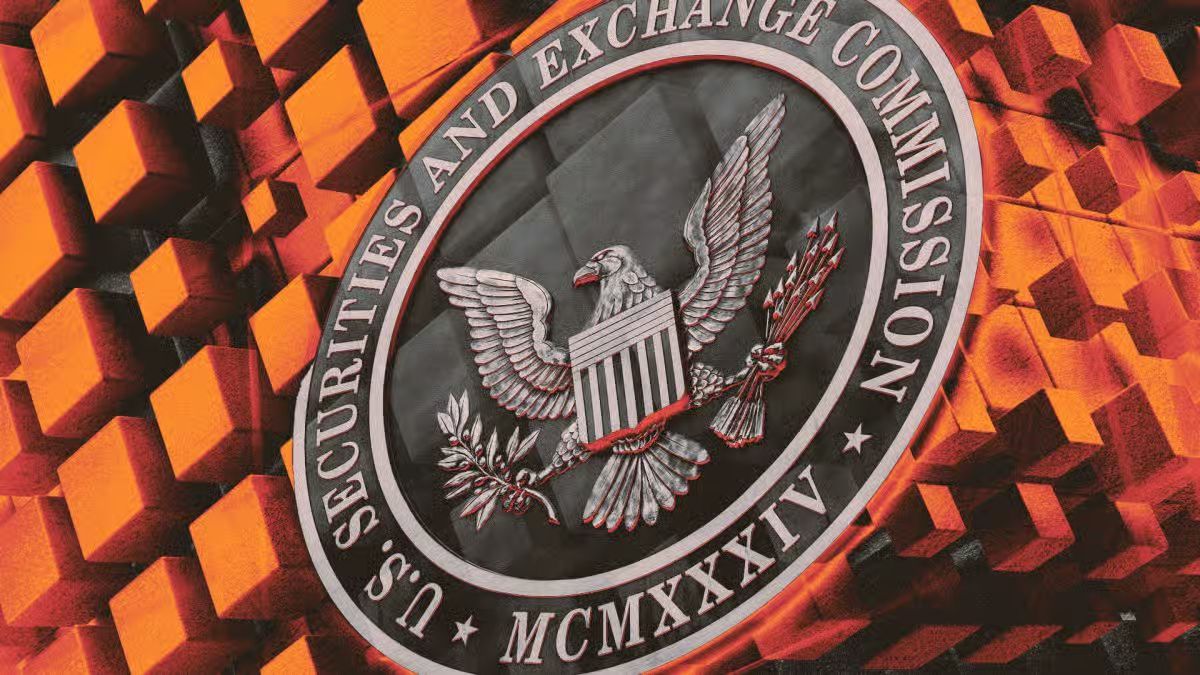
The Securities and Exchange Commission has filed civil charges against Florida resident Zan Shaikh and his company, Bright Vision Distribution LLC, which operated under the name Mining Automatic, over an alleged cryptocurrency-mining investment fraud that collected approximately $22 million from more than 380 investors. The SEC described the case as partially settled because Shaikh and the company have agreed to certain judgments, although the court must still approve them.
According to the SEC’s complaint, the defendants solicited investments from approximately June 2023 through May 2025 by presenting Mining Automatic as a cryptocurrency-mining operation capable of producing dependable passive income. Investors were allegedly told that their money would fund mining equipment and related infrastructure that could generate guaranteed monthly returns. The SEC claims the underlying operation was not capable of producing enough revenue to fulfill those promises.
Mining Automatic’s investment agreements generally required customers to provide a fixed amount of money upfront. In exchange, investors were supposed to receive 80% of the profits generated by their assigned portion of the mining operation for five years, while Mining Automatic would keep the remaining 20%. The company retained control and ownership of the equipment, leaving investors dependent on Mining Automatic to select, install, maintain and operate the machines.
Many agreements allegedly guaranteed a minimum monthly return, commonly around 3%, while nearly all promised to make investors whole at the end of the five-year term when their total returns failed to equal their original investment. The company also marketed the arrangement as being protected from cryptocurrency-price volatility because investors were supposedly financing the infrastructure rather than purchasing individual digital assets.
The SEC alleges that Mining Automatic promoted its experience, technology and ability to generate consistent returns with low-cost energy. Its website reportedly claimed annual returns of 51.5% in 2021, 46.2% in 2022 and 51.8% in 2023. Regulators contend those representations lacked a factual basis because Mining Automatic was not operating in 2021 or 2022, while Shaikh and several employees allegedly had no previous cryptocurrency-mining experience.
Despite telling customers their money would support mining activities, Shaikh and Mining Automatic allegedly spent only about 13% of investor funds on mining-related equipment, energy and hosting costs. The complaint says approximately $2.9 million was paid to a third-party company that provided equipment and hosting services, while the mining performed through that provider generated only about $1.1 million.
Regulators claim investor money was pooled rather than used to purchase equipment assigned to individual customers. Mining Automatic also allegedly lacked a system capable of determining whether it had acquired enough computing power to provide the specific hashrates promised in its contracts or whether each investor’s payments reflected earnings from an assigned portion of the operation.
The SEC said approximately $1.8 million was distributed to investors as supposed returns or complimentary payments. Those payments were generally based on a predetermined percentage of an investor’s contribution rather than the actual output of mining equipment. The complaint alleges Shaikh decided when individual investors would be paid and sometimes prioritized people who complained about missing returns.
The alleged mining activity conducted by the third-party provider ended by early February 2025, and Mining Automatic had stopped making payments to investors by March. Because the amount distributed as supposed returns exceeded the profits produced by the mining operation, the SEC said some payments appear to have been financed with money collected from other investors, giving the operation certain characteristics associated with a Ponzi scheme.
The complaint alleges the defendants took in at least $20 million more than they returned to investors. No investor had been repaid their original principal as of the filing, according to the SEC, and the amount identified as outstanding did not include the additional investment returns that customers had been promised.
A substantial amount of the money was allegedly spent for purposes unrelated to cryptocurrency mining. The SEC said approximately $7 million went toward marketing and advertising designed to recruit additional investors, while about $500,000 supported Shaikh’s other business ventures.
The complaint also identifies alleged personal expenditures involving investor funds, including approximately $375,575 in real-estate charges, $151,750 paid to a car dealership, $76,547 for entertainment and $118,585 in cash withdrawals. Another $778,550 was allegedly transferred to bank accounts owned by Shaikh. The SEC argues these expenses greatly exceeded the approximately $220,000 in mining profits the company would have been entitled to retain under its agreements.
Regulators further accuse Shaikh and Mining Automatic of misleading investors about how their money was being used, the company’s mining experience, the condition of its operations and the reasons monthly payments were not arriving on schedule. The SEC claims investors were given explanations involving equipment changes and delayed mining performance even when there was allegedly no corresponding upgrade that would have caused those problems.
In one example included in the complaint, an Army servicemember invested $25,000 after seeing a social-media advertisement promising a minimum monthly return of 3% and potential returns exceeding 10%. He allegedly received only one Bitcoin payment worth about $63, representing approximately 0.25% of his investment. After questioning the amount, he was told it was a complimentary payment connected to a transition to newer equipment. He was later informed that the company was being liquidated and that he would receive his investment plus additional money, but the SEC said those payments never arrived.
The SEC filed the case in the U.S. District Court for the District of Massachusetts. Shaikh and Mining Automatic are charged with violating registration and antifraud provisions of the Securities Act of 1933 and the Securities Exchange Act of 1934, including Rule 10b-5.
Subject to court approval, the defendants have agreed to judgments permanently prohibiting them from committing similar violations. Shaikh also faces an officer-and-director bar and an injunction restricting certain securities-related conduct. The amount of disgorgement, prejudgment interest and civil penalties will be determined by the court at a later stage of the case.
Source: The Block