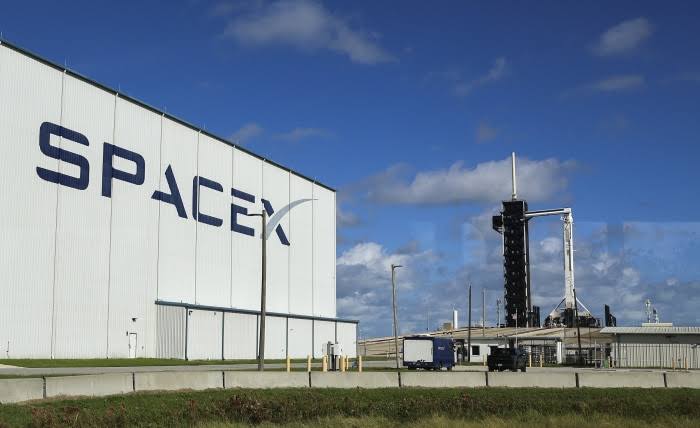
SpaceX is reportedly seeking $40 billion in new financing to fund purchases of Nvidia chips, adding another large layer of capital to Elon Musk’s push to build out the company’s artificial-intelligence infrastructure. Shares of SpaceX fell about 1% in after-hours trading Tuesday following the report, as investors weighed the potential expansion of its AI ambitions against a rapidly growing spending and debt load.
The proposed financing would consist of roughly $10 billion in bank loans and $30 billion of investment-grade debt, according to the Financial Times, which cited people familiar with the discussions. Apollo Global Management is expected to lead the effort and help place the debt with investors, while Pimco is among the lenders reportedly involved in talks. The transaction is expected to close in 2027, although the financing has not been completed and Reuters said it could not independently verify the report.
The size of the package is notable even for SpaceX, which raised extraordinary amounts of capital when it entered the public markets this summer. The company generated about $85.7 billion in net proceeds from its June IPO and separately issued $25 billion of senior unsecured notes that month. As of June 30, SpaceX reported $38.4 billion of total principal indebtedness, meaning a fully debt-funded $40 billion chip financing would represent a substantial increase from the debt position disclosed at the end of the second quarter.
AI Spending Was Already Accelerating
The proposed Nvidia purchase would build on an AI expansion that had already become SpaceX’s largest source of capital spending. In the second quarter, the company spent $18.4 billion across its operating segments, including $15.8 billion in its AI business alone. First-half capital expenditures reached $28.5 billion, with $23.6 billion directed toward AI — more than eight times the $2.8 billion spent by that segment during the same period a year earlier.
That spending is supporting data centers and computing infrastructure associated with the company’s AI operations, including the businesses SpaceX consolidated through xAI. Musk said during SpaceX’s August earnings call that the company had decided to build its AI infrastructure exclusively around Nvidia hardware, according to reporting on the proposed financing. A $40 billion hardware package would deepen that relationship and give Nvidia another large source of demand as hyperscalers and AI developers compete for increasingly powerful accelerators.
SpaceX has begun generating meaningful revenue from AI, but the business has not yet reached operating profitability. AI revenue totaled $2.56 billion in the second quarter, up sharply from $737 million a year earlier, while the segment recorded an operating loss of $1.26 billion. For the first six months of 2026, AI generated $3.38 billion of revenue but lost $3.73 billion from operations, even as adjusted EBITDA turned positive at $537 million.
The broader company is growing quickly enough to absorb some of that spending. SpaceX reported second-quarter revenue of $7.8 billion, up 92% from $4.1 billion a year earlier, while its net loss narrowed to $541 million from about $1 billion. Connectivity remains the company’s financial anchor, with Starlink and related services generating $4.29 billion of quarterly revenue and $1.66 billion of operating income.
More Debt Would Put Greater Weight on AI Returns
SpaceX entered the second half of the year with substantial liquidity. It reported $93.5 billion of cash and cash equivalents, another $6.5 billion of short-term marketable securities and $5 billion available through its credit facility as of June 30. The IPO dramatically strengthened that position, but management has also made clear that future spending will depend heavily on the scale and pace of its data-center expansion.
The company is already carrying financing tied directly to that buildout. SpaceX disclosed roughly $13.3 billion of debt associated with failed sale-leaseback transactions involving AI infrastructure assets as of the end of June, while the $25 billion of notes issued during the IPO period carry coupon rates ranging from 5.35% to 6.65%. Adding tens of billions more in bank and bond financing would increase fixed financing costs even as the company continues investing heavily in Starship, Starlink, spectrum and AI infrastructure.
The after-hours decline was modest compared with the stock’s recent rally. SpaceX shares had gained roughly 18% since the beginning of the previous week before the financing report emerged, helped in part by bullish analyst commentary and renewed optimism around the company’s growth prospects. That makes Tuesday’s reaction less a rejection of the AI strategy than an early indication that investors are scrutinizing how aggressively the company will finance it.
The next test will be whether SpaceX can translate that expanding compute footprint into enough revenue and cash generation to justify the capital committed to it. Its third-quarter results should provide a clearer picture of how quickly AI revenue is scaling, whether losses are narrowing and whether management is prepared to further increase its spending outlook as the proposed Nvidia financing moves toward a possible 2027 closing.