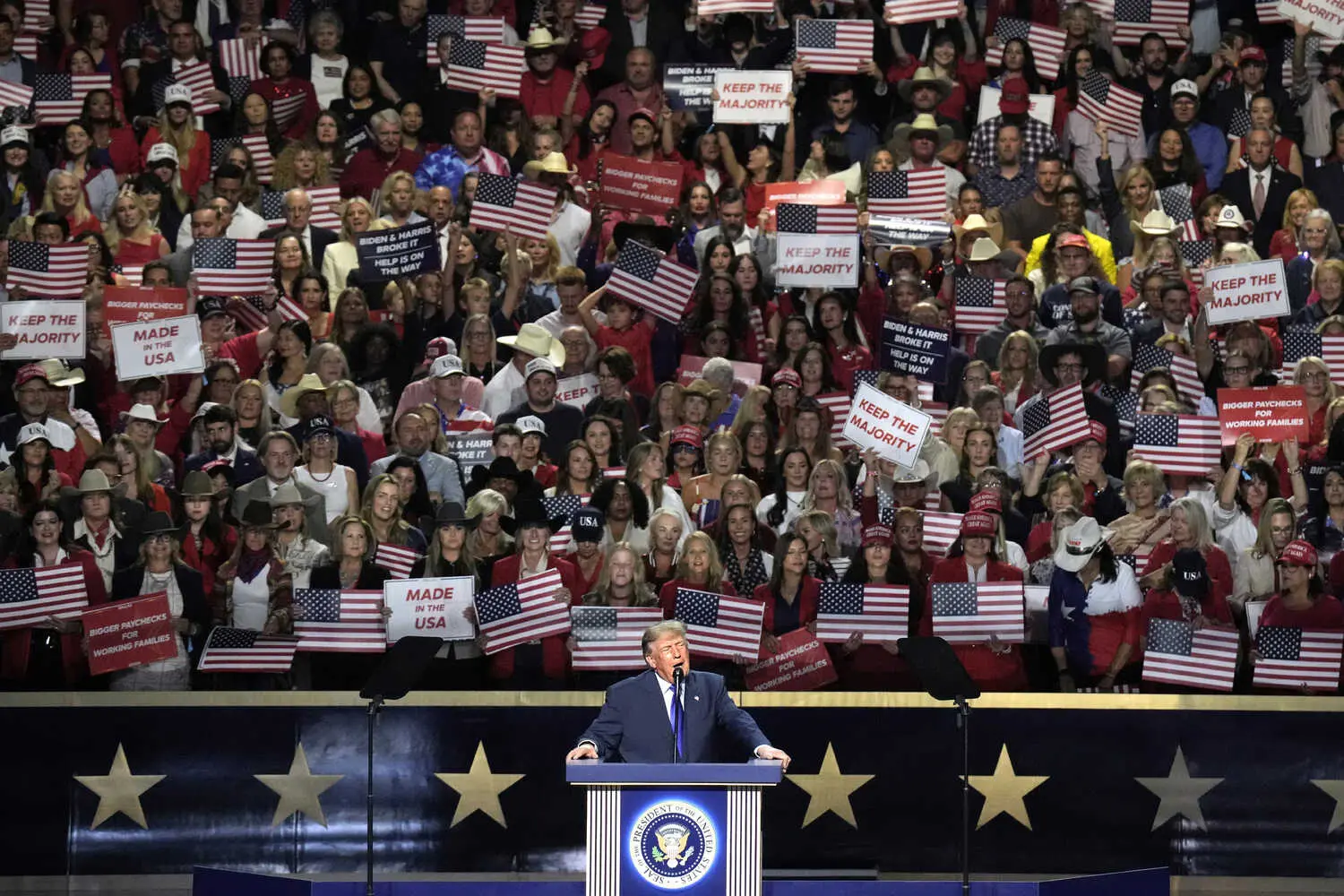
President Donald Trump used the Republican Party’s unusual midterm convention in Dallas to make a new economic promise with potentially enormous fiscal consequences: a $5,000 payment to U.S. adults if Republicans retain control of Congress in November.
Trump described the proposed payment as a “Trump dividend,” comparing it with a shareholder distribution and saying recipients would have to spend the money in the United States. Details on eligibility, timing and financing were not provided, and the proposal would require congressional action before any payments could be made.
Depending on who ultimately qualified, independent estimates put the potential cost at roughly $1.2 trillion to $1.35 trillion.
That makes the proposal financially significant well beyond the election campaign. It was introduced while the federal government is already running a deficit approaching $2 trillion for the current fiscal year, inflation remains above the Federal Reserve’s target and long-term Treasury yields are hovering near levels that have made government borrowing increasingly expensive.
Trump’s speech also focused on the tax cuts enacted in 2025, energy prices and his administration’s economic record. The broader convention was designed to place Trump at the center of Republican messaging ahead of the November 3 midterms, with party officials emphasizing tax policy, domestic manufacturing, border enforcement and drug prices.
For markets, the most consequential new proposal was the cash payment.
A $5,000 Promise Has a Trillion-Dollar Price Tag
There are roughly 270 million adults living in the United States, though not all are citizens and Trump did not establish specific income or eligibility limits during his speech.
A simple payment to nearly every adult would therefore cost more than $1 trillion. Reuters estimated approximately $1.35 trillion based on the adult population, while subsequent reporting placed a potentially narrower version around $1.2 trillion before interest costs.
Vice President JD Vance later suggested wealthier Americans might not receive the payment and floated tariff revenue as a potential funding source, indicating that the final structure could differ significantly from Trump’s initial announcement.
Current tariff collections would not come close to funding a universal $5,000 payout on their own.
Treasury data through August showed the government had collected $292.5 billion in customs duties during the fiscal year but refunded $125.2 billion, leaving net customs revenue of approximately $167.3 billion. The federal deficit over the same period stood at $1.97 trillion.
A $1.2 trillion to $1.35 trillion program would therefore equal roughly seven to eight times the government’s net tariff revenue collected so far this fiscal year.
Unless eligibility were narrowed substantially or Congress paired the payment with spending cuts or additional revenue, a large portion could require additional federal borrowing.
That matters in the current bond market.
Long-term Treasury yields have recently approached 5% as investors price persistent inflation, heavy government borrowing and uncertainty over Federal Reserve policy. Additional deficit-financed stimulus could place further pressure on Treasury supply and borrowing costs, depending on the final structure and the economic environment when the payments occurred.
The proposal would also come on top of the major tax-and-spending law enacted in 2025.
The Congressional Budget Office estimated that Public Law 119-21 would increase cumulative federal deficits by about $3.4 trillion between 2025 and 2034 relative to its prior baseline, reflecting roughly $4.5 trillion less revenue partly offset by $1.1 trillion in lower direct spending.
The Convention’s Economic Pitch Meets Hotter Inflation
Trump used the convention to argue that his administration is bringing costs lower and highlighted tax reductions passed during his second term.
Government inflation data show a more complicated picture.
The Consumer Price Index rose 0.4% in August and 3.4% from a year earlier, according to data released after the convention. Core prices, excluding food and energy, rose 0.3% for the month.
Producer prices had already climbed 5.4% from a year earlier in August, with energy costs contributing to the increase.
That backdrop makes a large direct-payment program different from stimulus distributed during a recession.
Cash transfers can support consumer spending, which could benefit retailers, restaurants, travel companies and other consumer-facing businesses. But if households receive substantial new purchasing power while inflation is already running above target and supply remains constrained in some areas, part of that demand could also appear in higher prices rather than additional real economic output.
The size and timing would determine the effect. A narrowly targeted or delayed program would have different consequences from sending $5,000 simultaneously to most American adults.
Trump also used the convention to defend his economic record and said prices were falling. Recent data show consumer prices remain higher than a year ago, while energy has become a particularly visible source of pressure.
Oil has surged above $100 a barrel as the conflict with Iran disrupts energy markets and shipping routes.
Trump said before the convention that he expected the war to end shortly after the November election and predicted oil prices would then decline. That remains a forecast rather than a confirmed timetable; the conflict has continued for seven months and recent fighting has pushed crude prices sharply higher.
The combination of high energy prices and potential fiscal stimulus could complicate the Federal Reserve’s job if both keep inflation elevated.
Republicans Are Also Running on Their 2025 Tax Law
The convention was not built entirely around new spending promises.
Republican speakers repeatedly promoted the 2025 reconciliation law, which extended and expanded tax reductions while changing spending for Medicaid, food assistance, immigration enforcement and other federal programs.
For households, provisions included tax relief involving tips and overtime income and a larger child tax credit. For investors and businesses, the legislation also changed the longer-term outlook for taxes, federal spending and deficits.
Those policies provide a clearer near-term economic record for markets to evaluate than the newly proposed dividend, which currently has no enacted legislation behind it.
The distinction matters. The tax law is already affecting federal receipts and household tax liabilities. The $5,000 payment remains a campaign proposal whose cost, eligibility and funding structure have not been defined.
Markets will therefore have little reason to price the dividend directly into earnings or economic forecasts unless Congress begins advancing legislation.
Oil, Rates and Congress Are the Near-Term Tests
The next major financial developments tied to the convention’s economic message will arrive well before November.
The Federal Reserve meets September 15-16 after August inflation accelerated. A hotter inflation trend or sustained oil prices above $100 could strengthen the case for tighter monetary policy, while cooler readings would give policymakers more room to hold rates steady.
Treasury yields will provide another signal. With the 10-year yield already near 5%, investors are increasingly sensitive to proposals that could materially increase federal borrowing.
The White House is separately examining measures to expand U.S. refining capacity as high gasoline and diesel prices create additional pressure on consumers and businesses. No final policy has been announced.
And the $5,000 dividend itself remains dependent on congressional action.
Some Republican lawmakers have already expressed skepticism about the cost and possible inflation effects, while others have supported the idea. Senate Majority Leader John Thune has not committed to advancing the proposal.
For investors, that makes the convention’s biggest economic promise less a forecast than a new fiscal variable to monitor.
If Republicans retain Congress and legislation begins moving, markets would have to assess how a trillion-dollar-scale payment is financed, how quickly the money reaches households and whether the additional demand arrives while inflation and interest rates are still elevated.
Until then, oil prices, Treasury yields, Federal Reserve policy and the existing 2025 tax law remain the economic forces with the more immediate impact on markets.