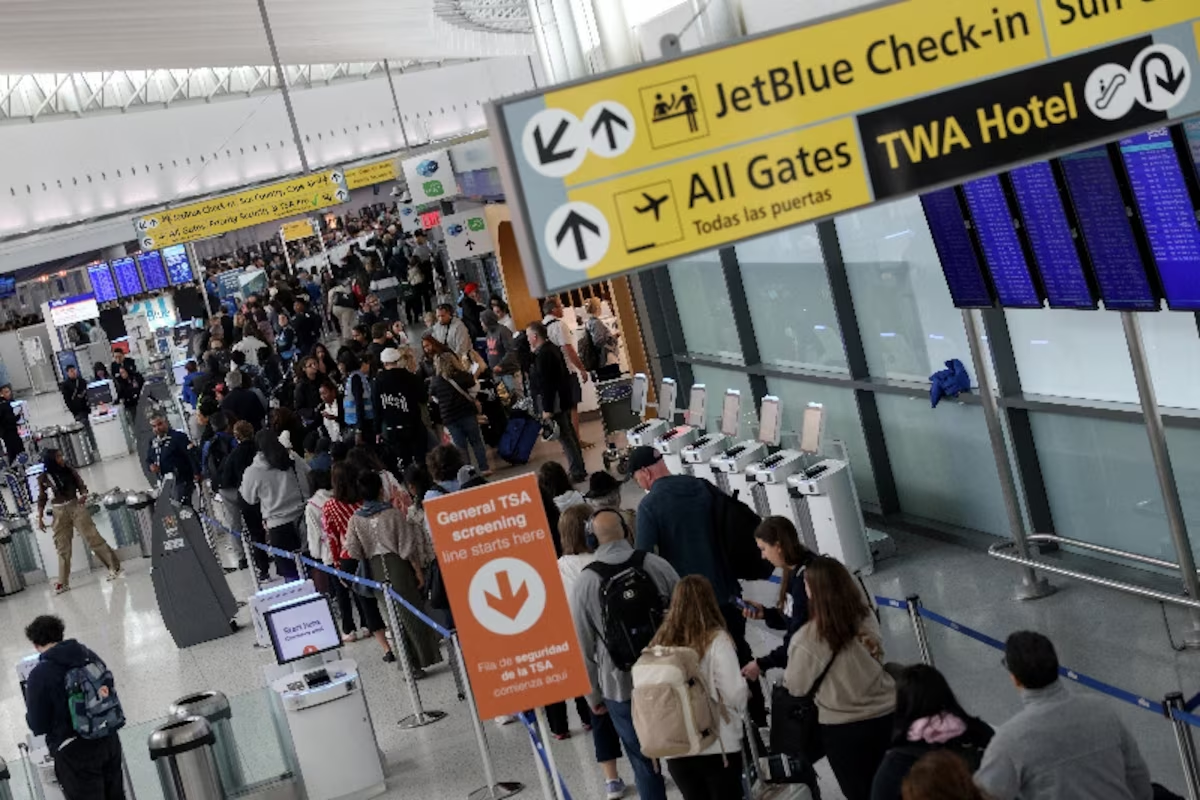
U.S. retailers could see holiday sales climb to as much as $1.71 trillion this season, with Deloitte forecasting resilient consumer spending despite high household costs, elevated inflation and a shopping environment increasingly dominated by promotions and value.
Deloitte expects retail sales between November 2026 and January 2027 to rise 4% to 4.8% from the previous holiday period, reaching approximately $1.70 trillion to $1.71 trillion.
That compares with roughly $1.63 trillion in holiday sales and 4.1% growth a year earlier. The forecast excludes motor vehicle and parts dealers as well as gasoline stations.
The range deserves some context. Deloitte’s upper-end forecast would represent a meaningful acceleration from last year’s 4.1% growth, while the 4% low end would actually be slightly slower.
The more useful takeaway for investors is that Deloitte does not expect consumers to retreat from the holiday season despite mounting financial pressures. Instead, households appear increasingly willing to spend while becoming more selective about where, when and on what.
That environment could favor retailers able to combine low prices, broad product selection, convenient fulfillment and aggressive digital promotions while making the holiday period more difficult for brands dependent on discretionary purchases at full price.
Disposable Income Is Supporting the Forecast
Deloitte’s central argument is that household income growth should provide enough support to keep holiday spending expanding.
The firm expects disposable personal income to increase between 4.5% and 5.2% during the holiday season. Deloitte considers disposable income one of its most useful indicators for forecasting retail and e-commerce demand.
Recent government data provide some support for that view.
Disposable personal income increased 0.5% in July from the previous month, according to the Bureau of Economic Analysis, while inflation-adjusted disposable income rose 0.4%.
Personal consumption expenditures increased 0.2% in nominal terms during July, although inflation-adjusted spending was essentially flat.
The composition of that spending was also uneven. Consumers increased spending on services by $86.2 billion while reducing spending on goods by $49.9 billion.
That split matters for holiday retailers.
Consumers may have more money available, but retailers are still competing with restaurants, travel, entertainment, housing, insurance and other services for each incremental dollar.
The personal saving rate was only 3% in July, suggesting consumers do not have an unusually large savings cushion available to finance additional purchases.
Deloitte Vice Chair Natalie Martini said shoppers still want to make the holidays meaningful but are making “deliberate choices about how they spend.”
Consumers across income levels are searching for promotions, switching between brands and comparing retailers as they attempt to stretch their budgets, according to Deloitte.
Holiday Growth Will Not Necessarily Mean Much Higher Shopping Volumes
The headline forecast is expressed in dollars, not units sold.
That distinction has become particularly relevant because inflation remains elevated.
The Federal Reserve’s preferred PCE price index increased 3.7% from a year earlier in July, while core PCE inflation, excluding food and energy, stood at 3.3%.
Retail prices do not move exactly in line with the overall PCE index, so investors should not simply subtract 3.7% from Deloitte’s holiday forecast.
Still, if consumer prices remain elevated into November and December, part of the expected 4% to 4.8% increase in retail sales could reflect higher prices rather than substantially larger purchasing volumes.
That would create a different earnings environment than a holiday season driven by strong unit growth.
A retailer can report higher revenue because customers bought more products, because prices increased, or through some combination of both. The margin implications can be very different depending on which force drives the increase.
Retailers facing higher import, labor, shipping or fuel costs may generate stronger revenue without seeing the same improvement in profitability.
That makes gross margin, promotional intensity and inventory levels especially important heading into the season.
Current Retail Sales Show Consumers Are Still Spending
The broader U.S. retail market has remained relatively resilient on a year-over-year basis.
Commerce Department data showed retail and food-services sales of $763.6 billion in July, up 5% from July 2025.
Month to month, however, sales declined 0.6%.
Total sales between May and July were 6.3% higher than during the same three-month period a year earlier.
Those numbers fit the pattern Deloitte is describing: the consumer has not disappeared, but spending is uneven.
Month-to-month weakness can coexist with healthy annual growth when household incomes are rising and prices remain elevated.
For retailers, the challenge is therefore less about whether Americans will spend anything during the holidays and more about which companies will capture the spending that does occur.
Value Retailers Enter the Holiday Season From a Position of Strength
Recent corporate results suggest value remains one of the strongest themes in retail.
Walmart reported a 2.6% increase in U.S. comparable sales during its most recent quarter, excluding fuel, while U.S. e-commerce sales surged 24%.
The company said it continued gaining market share across income groups, with particularly strong gains among higher-income households.
That is a notable trend because it suggests value shopping is no longer concentrated primarily among lower-income consumers.
Consumers with greater financial flexibility are also becoming more willing to use discount-oriented retailers for groceries, household products and general merchandise.
Walmart’s store-fulfilled delivery business grew more than 40%, while marketplace sales increased more than 50%, reinforcing the role that convenience and digital fulfillment now play alongside price.
Costco is showing similar momentum.
The warehouse retailer reported August U.S. comparable sales growth of 9%, while total monthly net sales climbed 9.9% to $23.7 billion.
Those results suggest retailers associated with value and scale could enter the holiday season with significant consumer momentum.
Target is also competing more aggressively on affordability.
The company said it has lowered prices on more than 10,000 items over the past year while investing in merchandise differentiation and convenience.
Target’s second-quarter comparable sales rose 3.8%, driven largely by a 3.6% increase in customer traffic. Digital comparable sales increased 8.7%, including more than 25% growth in same-day delivery.
Management subsequently raised its full-year sales growth expectations to around 5%.
These results do not guarantee holiday success, but they show that consumers continue rewarding retailers that offer a combination of pricing, convenience and product availability.
Online Holiday Sales Could Approach $319 Billion
E-commerce is expected to grow much faster than the broader retail market again this holiday season.
Deloitte forecasts online sales between $316.1 billion and $318.9 billion during the November-to-January period.
That would represent growth of 7.5% to 8.4% from approximately $294 billion last year.
Online holiday sales grew about 7.5% during the previous season.
The forecast therefore suggests digital spending could accelerate at the upper end of Deloitte’s range.
That would favor companies with mature fulfillment networks and the ability to offer rapid delivery without destroying margins.
Amazon remains the dominant pure e-commerce player, but Walmart, Target and other large retailers have increasingly turned their physical stores into local fulfillment centers.
That model can shorten delivery times and reduce some of the distance products need to travel, while allowing traditional retailers to compete with online-first businesses.
Walmart’s latest results show how important that transition has become: e-commerce accounted for roughly 23% of Walmart U.S. sales during its most recent quarter.
Target generated nearly 20% of merchandise sales digitally.
The holiday competition is therefore becoming less about physical retail versus online retail and more about which companies can profitably serve customers across both.
Promotions Could Determine Who Wins
Deloitte’s expectation that consumers will continue comparing prices and switching brands suggests the holiday season could remain highly promotional.
That creates opportunities and risks.
Retailers with healthy inventory levels can use targeted promotions to generate traffic while protecting profitability on the rest of their merchandise.
Companies carrying too much unwanted inventory may need deeper discounts simply to clear products.
The apparel industry already offers examples of that divergence.
American Eagle recently acknowledged continued promotional activity as it works through inventory issues, while Lululemon has faced weakening demand in its Americas business and cut its full-year sales outlook.
Those individual companies face business-specific problems, but their experiences reinforce a broader point: an expanding holiday market does not mean every retailer benefits equally.
Consumers can increase total spending while simultaneously abandoning certain brands.
Retailers that misjudge fashion trends, product assortment or price sensitivity can lose share even during a growing holiday season.
Tariffs and Input Costs Add Another Margin Risk
Retail investors should also separate sales expectations from profit expectations.
Companies have spent much of 2026 navigating tariff-related costs, changing sourcing strategies and shifting consumer demand.
Several major retailers received substantial tariff refunds this year, producing unusual benefits to reported earnings.
Target recognized $994 million of pretax tariff refunds during its second quarter, while Walmart also reported a meaningful tariff-related benefit to operating income.
Those refunds helped profitability but are not necessarily recurring sources of earnings.
At the same time, higher energy prices create another potential cost pressure for retailers through shipping, manufacturing and household budgets.
Consumers paying more for gasoline, electricity or other necessities have less discretionary income available for clothing, electronics, gifts and home products.
Deloitte’s forecast assumes disposable income growth will be strong enough to keep total holiday sales expanding despite those pressures.
If energy and household costs rise more sharply than expected, consumers could become even more promotion-sensitive.
What Retail Investors Should Watch
The first major signal will come from monthly retail sales before the holiday season begins.
The Commerce Department’s August retail-sales report is scheduled for September 16. Investors will be watching whether July’s 0.6% monthly decline was temporary or the beginning of a broader slowdown.
Inflation will matter just as much.
Higher prices can lift nominal retail revenue while simultaneously reducing household purchasing power and raising retailer costs.
Disposable-income growth therefore needs to stay strong enough to outrun at least some of that pressure.
Retailer guidance during the next earnings cycle will provide a more company-specific picture.
Walmart, Target, Amazon, Costco and other major chains will begin giving investors greater visibility into holiday inventory, promotions and demand expectations as the season approaches.
E-commerce growth will be another key measure. Deloitte’s 7.5% to 8.4% forecast is considerably stronger than its expected growth for retail sales as a whole, reinforcing the long-running shift toward digital purchasing and omnichannel fulfillment.
Margins may ultimately matter more for stocks than headline holiday revenue.
A company that produces 5% holiday sales growth while relying on aggressive discounting could deliver a weaker financial outcome than a competitor growing 3% with healthier full-price demand and better inventory control.
Deloitte’s forecast suggests the American consumer still has enough income to keep holiday spending growing and potentially push sales above $1.7 trillion for the first time.
But the consumer entering the 2026 holiday season is not spending indiscriminately.
Shoppers are comparing prices, moving between brands, demanding convenience and searching for promotions even as their incomes rise.
For retailers, the size of the holiday market may be less important than how much of that $1.7 trillion they can capture without giving away their margins to win it.