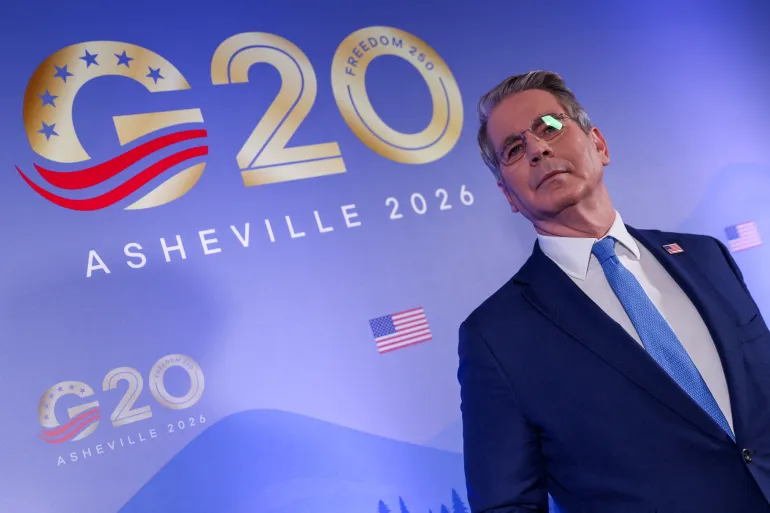
The United States is pressing the world’s largest economies to take stronger action against persistent trade imbalances, with China’s enormous export surplus emerging as the central focus of a contentious Group of 20 finance meeting in North Carolina.
Treasury Secretary Scott Bessent urged other G20 governments to consider tariffs, trade restrictions and other measures aimed at protecting domestic industries from the growing volume of inexpensive Chinese goods entering international markets.
The Trump administration argues that China’s dependence on exports, extensive industrial support and weak domestic consumption are creating distortions that suppress economic growth elsewhere.
Bessent said countries outside the United States are increasingly experiencing the effects of policies Washington had warned about.
The U.S. dramatically increased trade barriers against China after President Donald Trump returned to office in 2025, reducing the flow of Chinese goods directly into the American market.
Washington imposed high tariffs on a broad range of Chinese imports and banned some products outright, including Chinese vehicles.
Bessent said he warned other major economies last year that those restrictions would not eliminate China’s excess production. Instead, he predicted Chinese companies would redirect more products toward Europe, Latin America and other markets.
That shift is now becoming increasingly visible.
China’s total exports jumped 23.9% in July compared with the same month a year earlier.
Electric vehicles, semiconductors and other manufactured products have become particularly important parts of Beijing’s export strategy as weak domestic demand limits opportunities for businesses inside China.
Bessent argues that the approach is not sustainable for the global economy.
China has been running an enormous goods trade surplus, and Bessent recently put the total at approximately $1.2 trillion.
He has called on Beijing to reduce its reliance on foreign demand and increase consumption within China instead.
Washington’s message is that other governments may need to create stronger incentives for China to make that transition.
Bessent has encouraged countries facing rapidly growing imports from China to reconsider the terms under which those goods enter their markets.
The two-day meeting of G20 finance ministers and central bank governors in Asheville, North Carolina, ultimately demonstrated broad support for addressing the problem.
Financial leaders from 19 of the 20 G20 members backed language calling for action against what the group described as non-market policies and economic distortions.
China was the lone member that did not support portions of the final position.
The concluding chair’s statement called on countries with large and persistent external surpluses to eliminate policies that suppress domestic consumption and leave their economies excessively dependent on exports for growth.
Although the language did not identify China by name, the discussions were overwhelmingly focused on Beijing.
Bessent said the willingness of 19 countries to address the issue demonstrated how significant the problem has become.
The United States believes export-oriented economic systems supported by extensive government intervention can damage other economies by forcing domestic manufacturers to compete with artificially inexpensive goods.
European governments have become increasingly concerned about the same problem.
China’s merchandise trade surplus with the European Union reached approximately 360.6 billion euros in 2025, increasing about 15% from 2024.
The imbalance has continued expanding during 2026.
European officials have become particularly concerned about Chinese electric vehicles, batteries, solar equipment, semiconductors and other strategic products.
European Economy Commissioner Valdis Dombrovskis agreed that China represents a major source of global economic imbalances.
However, he argued that responsibility does not rest exclusively with Beijing.
Dombrovskis said the United States and Europe also need to address policies contributing to global imbalances.
That reflects a broader disagreement within the G20 over whether Washington can credibly criticize other countries’ trade policies while simultaneously relying heavily on tariffs itself.
Trump’s tariff strategy has faced criticism from economists and governments that argue import taxes increase costs for American consumers while disrupting trade with allies.
The Tax Foundation estimated that tariffs introduced by the Trump administration throughout 2025 increased retail prices for imported consumer products by approximately 7% relative to the trajectory prices would otherwise have followed.
Some U.S. trading partners have also objected to Washington using tariffs against friendly countries as part of broader economic and political disputes.
German Finance Minister Lars Klingbeil offered one of the strongest criticisms during the G20 gathering.
He argued that uncertainty generated by both the U.S.- and Israeli-led war against Iran and Washington’s continuing tariff disputes was damaging global economic growth.
Klingbeil specifically pointed to the United States’ current trade confrontation with Canada as an example of policies that undermine confidence between countries.
He warned that economic uncertainty damages investment and growth because companies become reluctant to make long-term decisions when they cannot predict future tariffs, trade relationships or geopolitical conditions.
Canada itself has recently moved toward closer economic cooperation with China while continuing to navigate its increasingly difficult relationship with Washington.
Canadian Finance Minister François-Philippe Champagne said Ottawa’s engagement with China is broadly comparable to the approach taken by other Group of Seven economies and operates within clearly established limits.
Britain also indicated that it intends to maintain what it described as a pragmatic trading relationship with Beijing while working to reduce problematic economic imbalances.
That demonstrates one of Washington’s biggest challenges.
Many major economies agree that China’s industrial policies and enormous trade surplus are a problem, but they do not necessarily agree that the U.S. approach of aggressive tariffs and restrictions provides the best solution.
China has shown little willingness to embrace the structural economic changes repeatedly requested by its trading partners.
Foreign governments have called on Beijing for years to reduce industrial subsidies, allow household consumption to play a larger role in the economy and become less dependent on manufacturing exports.
China’s currency is another point of controversy.
The yuan is considered substantially undervalued by several economic measurements.
The International Monetary Fund has estimated that the Chinese currency may be undervalued by as much as 21%.
A cheaper yuan makes Chinese products less expensive in foreign markets and increases the relative cost of imported goods for Chinese consumers.
Some economists and European policymakers have suggested that coordinated international action to strengthen the yuan could help reduce trade imbalances.
Bessent has rejected the idea that exchange-rate intervention alone would solve the underlying problem.
He has specifically pushed back against proposals resembling a new Plaza Accord.
The original Plaza Accord was reached in 1985, when the United States, Japan, West Germany, France and the United Kingdom coordinated action intended to weaken the U.S. dollar against other major currencies.
Bessent argues that attempting a similar currency agreement today would avoid confronting what he sees as the real issue: Chinese industrial subsidies and insufficient domestic demand.
Instead, the Treasury secretary believes countries purchasing enormous quantities of Chinese exports must reconsider their own trade policies and create stronger incentives for Beijing to change its economic model.
The International Monetary Fund has taken a more balanced position.
IMF Managing Director Kristalina Georgieva said she believes Chinese officials recognize that adjustments are necessary.
But Beijing has pushed for coordinated changes involving other major economies as well.
One Chinese argument is that the United States should reduce its enormous fiscal deficits, which contribute to strong domestic demand and consequently increase American demand for imported goods.
The dispute therefore involves more than tariffs.
It encompasses savings, government spending, exchange rates, domestic consumption, industrial subsidies and the basic economic models used by the world’s largest countries.
The United States has nevertheless made progress in shrinking its direct trade imbalance with China.
During the first six months of 2026, the U.S. trade deficit with China fell by approximately one-third compared with the same period in 2025.
The deficit totaled about $73.9 billion.
Some of the year-over-year comparison was affected by unusually strong Chinese imports into the United States during January 2025, when companies accelerated shipments ahead of expected tariffs.
Even so, Washington considers the decline evidence that its barriers against Chinese imports are working.
The difficulty is that the same goods can be redirected elsewhere.
Europe and Latin America have absorbed more Chinese exports as American market access has become more restrictive.
That is why Bessent wants a coordinated response rather than leaving the United States to impose trade barriers on its own.
China’s control over critical minerals has created another source of tension.
Beijing dominates the global processing of many rare-earth elements and other materials essential for electric vehicles, electronics, defense equipment and advanced manufacturing.
China imposed additional export restrictions on rare-earth materials in April 2025 in response to Trump’s tariffs.
Those restrictions affected companies outside the United States as well.
Japan used the G20 gathering to raise the issue directly.
Japanese Finance Minister Satsuki Katayama told other finance leaders that arbitrary restrictions on exports of critical minerals were damaging the world economy.
The concern was ultimately included in the G20 chair’s statement.
Participants called on governments to avoid unnecessary export restrictions so that global supply chains can continue operating normally.
The agreement on trade distortions occurred during an increasingly unstable moment for global financial markets.
Government bonds around the world have been selling off as investors worry about inflation, expanding national debts and the possibility that central banks will need to keep interest rates elevated.
Japan’s government bond market has become particularly important.
The yield on Japan’s benchmark 10-year government bond reached 3% Tuesday for the first time since 1996.
The move reflected concerns about inflation driven partly by higher energy prices, the possibility of additional Bank of Japan rate increases and Japan’s fiscal outlook.
Bessent has also been discussing Japanese monetary policy directly with officials in Tokyo.
Treasury officials said he emphasized the importance of monetary policies capable of anchoring inflation expectations and preventing destabilizing currency movements during a meeting with Bank of Japan Governor Kazuo Ueda.
Bessent has publicly expressed confidence that Japanese authorities will ultimately take steps leading to a stronger yen.
His remarks have reinforced expectations that the Bank of Japan could raise interest rates when policymakers meet September 17 and 18.
The broader bond-market selloff formed an important backdrop to the G20 negotiations.
Governments are simultaneously being asked to address trade imbalances, stimulate sustainable economic growth and reassure investors about rapidly expanding public debt.
The United States itself faces significant fiscal challenges, making some international officials reluctant to accept Washington’s argument that China alone represents the primary imbalance requiring correction.
There were also geopolitical disagreements surrounding the Asheville meeting.
European countries and Canada objected to Russia’s participation after the United States invited Russian representatives back to the G20 finance gathering for the first time since Moscow launched its full-scale invasion of Ukraine in 2022.
The war involving the United States, Israel and Iran has added another source of disagreement and economic uncertainty.
Higher energy prices associated with the conflict have intensified inflation concerns while putting additional pressure on global bond markets.
Those disputes made it uncertain during much of the meeting whether the G20 would be able to produce a traditional joint communiqué.
U.S. Treasury Undersecretary for International Affairs Erin Browne said negotiators encountered disagreements between countries running large trade surpluses and those running large deficits.
The United States wanted any final statement to reflect Trump administration priorities and its America First economic agenda.
Browne said Washington was prepared to accept a chair’s statement rather than a unanimously negotiated communiqué if members could not resolve their differences.
She also warned that persistent economic imbalances could eventually become a financial-stability threat.
As countries become more economically dependent on unsustainable trade relationships, vulnerabilities can accumulate within industries, financial systems and national economies.
The final result illustrated both the success and limits of Washington’s campaign.
The United States succeeded in winning support from every G20 financial delegation except China for language targeting non-market policies and excessive reliance on exports.
That represents unusually broad agreement that global trade imbalances need to be addressed.
But the participating countries remain divided over who is responsible for those imbalances and what should be done about them.
Washington wants more countries to adopt barriers resembling its own policies toward Chinese imports.
European governments acknowledge the problem but continue criticizing some U.S. tariffs.
China argues that other economies need to correct their own fiscal and structural problems.
Japan wants greater protection against restrictions on critical minerals.
And countries such as Britain and Canada continue seeking workable commercial relationships with Beijing rather than moving toward complete economic separation.
The debate is therefore unlikely to end with the Asheville meeting.
China’s export machine continues expanding, while governments around the world face increasing pressure to determine how much Chinese manufacturing they are willing to absorb without taking defensive action.
For the Trump administration, the objective is now to turn concern about China’s enormous trade surplus into a coordinated international response.
Whether other countries are willing to copy Washington’s tariff-heavy strategy remains far less certain.