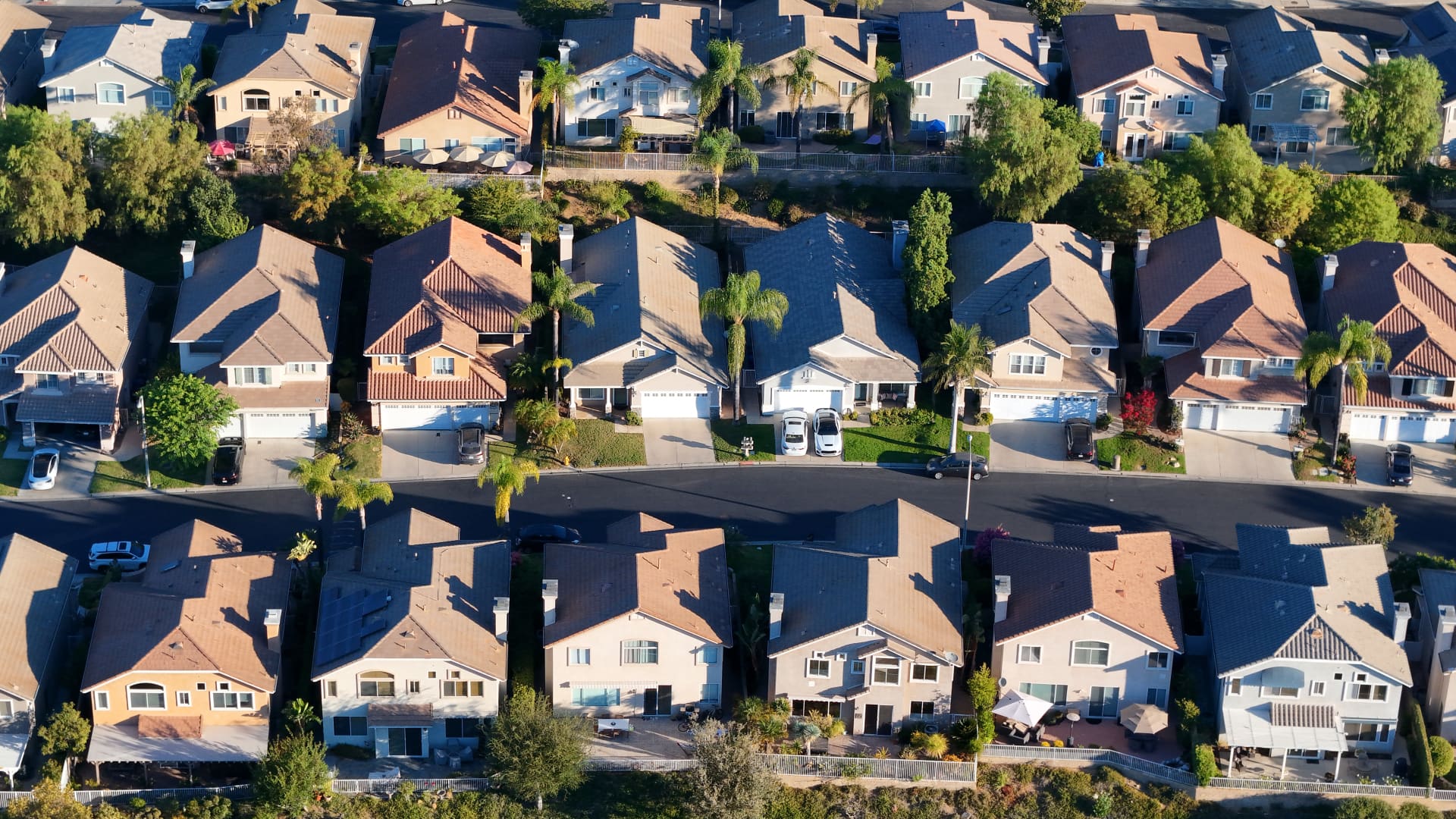
American homebuyers are facing another setback as mortgage rates move closer to 7%, reversing earlier hopes that borrowing costs would gradually decline this year.
The average rate on a 30-year fixed mortgage climbed six basis points Monday to 6.87%, according to Mortgage News Daily, reaching its highest level since June 2025.
The increase extends a rapid shift that has developed over the past several days. The average 30-year rate is now 12 basis points higher than it was Thursday and has increased by more than 30 basis points during the past two months.
One basis point represents one-hundredth of a percentage point, meaning even relatively small moves can materially change borrowing costs when applied to a mortgage lasting several decades.
Renewed fighting involving the United States and Iran has added another source of pressure.
Oil prices jumped after military hostilities intensified again in the Middle East, reviving concerns that disruptions involving the region could keep energy costs elevated. Those worries have contributed to higher bond yields, which in turn have helped push mortgage rates upward.
Mortgage rates do not directly follow the Federal Reserve’s benchmark interest rate. Instead, they tend to move more closely with longer-term bond yields, particularly the 10-year U.S. Treasury yield, because lenders and investors use those markets when determining the cost and risk of long-term borrowing.
When investors become more concerned about inflation, they often demand higher yields from government bonds. Mortgage rates typically move higher alongside them.
The connection has become particularly important because expensive oil can feed inflation through gasoline, transportation, shipping, manufacturing and other costs throughout the economy.
Earlier in the year, many housing-market forecasts had anticipated mortgage rates would decline.
That outlook changed substantially after the war with Iran began near the end of February and oil prices moved higher.
Immediately before the conflict started, the average 30-year fixed mortgage rate stood at approximately 5.99%.
The difference between that level and today’s 6.87% rate has major consequences for prospective homeowners.
Consider a buyer purchasing a $450,000 home, a price roughly in line with the national median, while making a 20% down payment.
That would leave the buyer financing approximately $360,000 with a 30-year fixed mortgage.
At today’s borrowing costs, the monthly principal and interest payment would be approximately $2,363.
That is about $207 more every month than the same buyer would have paid when mortgage rates were around 5.99% near the end of February.
Over the course of one year, the difference amounts to nearly $2,500 in additional principal-and-interest payments.
And the impact extends beyond the monthly bill.
Higher mortgage rates can prevent some prospective buyers from qualifying for loans altogether.
Mortgage lenders evaluate borrowers partly through their debt-to-income ratios, which compare required monthly debt payments with household income. When mortgage rates rise, the monthly payment associated with the same house becomes larger.
That higher payment can push a borrower beyond a lender’s acceptable debt-to-income threshold, reducing the size of the mortgage the household qualifies for or eliminating its ability to qualify for the desired loan entirely.
Buyers are therefore confronting two affordability problems at the same time.
Borrowing costs are increasing while home prices remain elevated.
After showing signs of cooling earlier in the housing slowdown, national home-price growth has recently begun accelerating modestly again.
The S&P Cotality Case-Shiller U.S. National Home Price Index showed prices increasing 1.5% in June compared with the same month a year earlier.
That was faster than the revised 1.2% annual increase recorded in May.
The improvement may appear relatively modest, but it demonstrates that high mortgage rates have not produced a broad decline in national home prices.
One of the reasons is limited housing inventory.
Many existing homeowners purchased or refinanced their properties when mortgage rates were dramatically lower than today’s levels. Selling would often mean surrendering a mortgage carrying a rate of 3%, 4% or another comparatively inexpensive level and replacing it with a new loan approaching 7%.
That difference creates a strong financial incentive for homeowners to remain where they are.
The phenomenon is commonly described as the mortgage-rate lock-in effect.
When homeowners choose not to sell, fewer existing properties become available for prospective buyers. Restricted supply can help support home prices even when higher borrowing costs are weakening overall demand.
S&P Dow Jones Indices associate director Rebecca Kaufman highlighted that tension in the organization’s latest home-price analysis.
She noted that expensive financing continues to weigh on prospective purchasers while existing homeowners remain hesitant to surrender the low mortgage rates they obtained during earlier years.
That dynamic is creating an unusual housing environment.
Normally, significantly higher mortgage rates would be expected to weaken home prices because buyers can afford less.
Instead, the decline in affordability has been accompanied by a shortage of existing homes for sale in many areas.
With both buyers and sellers reluctant to move, transaction activity has weakened while prices remain surprisingly resilient.
Mortgage News Daily’s daily measure also shows how far rates have moved from expectations earlier this year.
The average 30-year fixed rate reached 6.87% Monday, while the average 15-year fixed mortgage stood at approximately 6.38%.
For comparison, Freddie Mac’s most recent weekly survey, released August 27, placed the average 30-year fixed rate at 6.66% and the 15-year mortgage at 5.98%.
The difference partly reflects timing and methodology. Freddie Mac publishes a weekly average based on loan applications submitted through participating lenders, while Mortgage News Daily tracks changes in lending markets more frequently and can reflect sudden bond-market movements faster.
Monday’s increase therefore provides a more immediate indication of how quickly borrowing conditions have deteriorated following the latest market volatility.
The larger concern for buyers is what happens next.
If oil prices remain elevated and financial markets become increasingly worried about inflation, Treasury yields could remain high, keeping mortgage rates under pressure.
Higher inflation can also make it more difficult for the Federal Reserve to move toward easier monetary policy, further weakening hopes for a substantial near-term decline in borrowing costs.
On the other hand, an easing of geopolitical tensions, declining oil prices or softer economic data could eventually push bond yields downward and provide some relief for mortgage borrowers.
For now, however, the housing market has moved in the opposite direction from what many buyers were hoping to see in 2026.
A 30-year mortgage that was just below 6% immediately before the Iran conflict is now approaching 7%.
For a typical homebuyer, that difference translates into hundreds of dollars in additional monthly costs, reduced purchasing power and a tougher path toward qualifying for a loan.
Meanwhile, homeowners who already secured inexpensive mortgages have even less financial motivation to put their properties on the market.
That combination of higher financing costs and constrained supply is leaving the U.S. housing market caught in a difficult cycle: borrowing is becoming more expensive, fewer homeowners want to sell, and home prices are showing renewed signs of acceleration just as affordability deteriorates again.