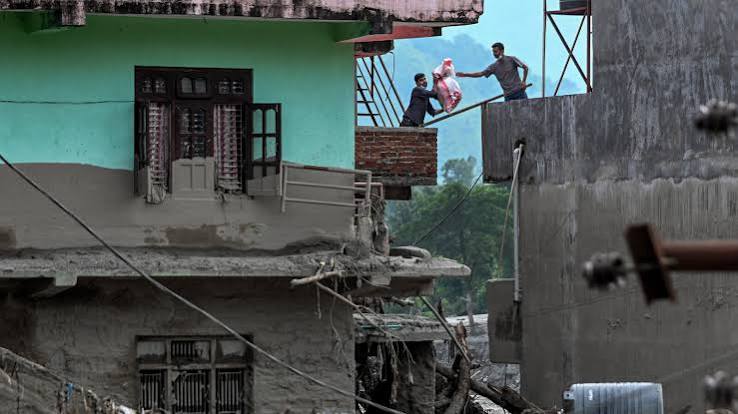
Nepal is confronting one of the most expensive natural disasters in its recent history after a catastrophic Himalayan flood destroyed communities, power plants, roads and a major trade corridor, leaving the developing country with a reconstruction bill potentially equivalent to nearly one-tenth of its entire economy.
The disaster began on August 26 when an enormous collapse of rock and glacial ice high in the Himalayas sent millions of tons of material crashing down the mountainside and into the Bhote Koshi-Trishuli river system.
The collapse generated a torrent of water, mud, rocks and ice that raced through valleys in northern Nepal, wiping out settlements and infrastructure with extraordinary speed.
The event was powerful enough to register as a magnitude-5.2 seismic disturbance, according to scientific analysis, even though it was not a conventional earthquake.
By September 1, Nepal had reported more than 1,000 deaths and thousands of people remained missing. The numbers have continued changing as rescuers reach isolated communities and search through enormous deposits of mud and debris.
The United Nations Development Programme estimated that at least 2.2 million metric tons of debris had been left across the areas analyzed so far.
That estimate includes rock, sediment, vegetation, household belongings and destroyed buildings.
Satellite assessments identified damage involving at least 2,359 structures, producing an estimated 556,200 tons of building debris alone. The figure is expected to increase as additional areas are examined.
More than 10,000 people had been rescued by Tuesday, but the destruction has created an economic emergency that will continue long after the search for survivors ends.
Finance Minister Swarnim Wagle has estimated that rebuilding could require between $4 billion and $5 billion.
Nepal’s economy is worth roughly $45 billion to $50 billion, meaning the recovery could consume close to 10% of annual economic output.
For comparison, Nepal required approximately $9 billion to rebuild following the magnitude-7.8 earthquake that struck the country in 2015.
That disaster killed nearly 9,000 people, destroyed more than half a million homes and caused losses equivalent to roughly one-third of Nepal’s economy at the time.
Although the financial damage from the latest flood is expected to be smaller, the economic disruption is concentrated in several industries that have become increasingly important to Nepal’s development.
Hydropower is among the most severely affected.
Nearly all of Nepal’s electricity comes from hydroelectric generation, and the country had spent years turning its rivers into both a source of domestic electricity and a growing export industry.
The floods knocked approximately 431 megawatts of operating generation capacity offline.
That represents roughly 10% of Nepal’s total electricity-generating capacity.
UNDP reported that 11 operating hydropower plants and one solar facility totaling 431.1 megawatts had stopped operating.
Another 15 energy projects under construction, representing a planned 470 megawatts of future generating capacity, were also damaged.
The destruction has forced Nepal to reverse its recent role in the regional electricity market.
The country had become an increasingly important exporter of hydropower, particularly to neighboring India.
Following the flood, Nepal halted electricity exports and began preparing to import power from India to cover domestic shortages.
Officials have warned that it could take months to restore some of the damaged infrastructure.
The setback comes at an especially difficult moment because Nepal has been planning a dramatic expansion of its hydroelectric industry.
The country intends to more than triple generating capacity over roughly the next decade, in part to export additional electricity to India.
Major companies including India’s Adani Group, NHPC and GMR have been involved in plans to finance or develop projects connected with that expansion.
India is attempting to increase its access to cleaner electricity as it gradually reduces its dependence on coal, giving Nepal a potentially enormous export market.
Electricity exports had already become an increasingly important source of foreign revenue.
Over the past decade, Nepal’s hydropower export earnings increased at an average annual rate of approximately 75%.
Electricity represented nearly one-tenth of the country’s merchandise exports during the year ending in July.
The latest disaster has raised questions about whether that growth model is sufficiently protected against the rapidly changing environmental conditions of the Himalayas.
Many hydroelectric facilities are necessarily constructed along rivers and inside steep valleys.
Those locations give developers access to the enormous elevation changes and water flows necessary for generating electricity, but they simultaneously place critical infrastructure directly in areas vulnerable to floods, landslides and glacial hazards.
The problem is becoming increasingly important as scientists warn that historical weather and river patterns may no longer provide reliable guidance for designing infrastructure expected to operate for decades.
Rising global temperatures are accelerating glacier retreat and destabilizing frozen mountain terrain throughout the Himalayan region.
Researchers are still examining precisely what triggered the August 26 collapse, but scientists have warned that climate change is increasing the likelihood and potential severity of glacial failures, landslides and other cascading disasters.
Nepal has contributed less than 0.1% of historical global carbon emissions, yet its mountainous geography makes the country particularly vulnerable to a warming climate.
Prime Minister Balendra Shah has argued that the flood demonstrates the need for greater international assistance for countries facing climate-related disasters despite contributing relatively little to the emissions driving them.
Nepal has requested urgent support from international climate financing mechanisms and has placed the expected cost of recovery at approximately $5 billion.
The economic damage reaches far beyond electricity generation.
One of Nepal’s most important land connections with China has effectively been destroyed.
The Rasuwagadhi border crossing in Rasuwa district serves as a major route for goods moving between Nepal and Tibet.
Approximately 40 kilometers of road on the Nepalese side of the corridor are believed to have been completely washed away.
More than two dozen bridges between the border and Galchhi were also destroyed.
The flood wiped out the customs facilities and infrastructure surrounding the crossing.
Fifteen customs employees remained missing as of Tuesday.
Rasuwagadhi has become increasingly important to Nepal-China commerce because it is relatively close to Kathmandu and is considered one of the country’s most dependable overland routes into China.
The crossing accounted for approximately 2.18% of Nepal’s total imports during the most recent fiscal year.
Its share would likely have been larger without another flood in July 2025 that forced the crossing to remain closed for six months.
China installed a temporary Bailey bridge that allowed commerce to resume on January 1, 2026.
During the following six months, approximately 45.73 billion Nepalese rupees worth of imports entered Nepal through Rasuwagadhi.
Exports through the crossing totaled approximately 894.6 million rupees.
Only a year earlier, during the 2024-25 fiscal period, the crossing had processed 85.23 billion rupees of imports and 2.04 billion rupees of exports.
Nepal imports a wide range of products through the corridor, including electronics, clothing, footwear, construction materials, agricultural goods, telecommunications equipment, automobiles and industrial machinery.
Exports traveling in the opposite direction have included carpets, handicrafts, wool products, herbs, noodles, copper utensils and agricultural products.
The August disaster destroyed infrastructure that had already required significant public investment.
A new dry port at Timure had been constructed as part of an approximately 3 billion-rupee project.
Roughly 2 billion rupees had already been invested before the latest disaster.
Much of the facility had been completed and was approaching final finishing work.
The 2025 flood had already damaged parts of the customs complex and dry port.
This time, local reporting indicates that virtually none of the major structures survived.
Hundreds of freight containers are also believed to have been buried or swept away.
Traders, truck drivers, customs workers and other employees connected with border commerce remain among those missing.
That creates losses not only for the government and large businesses but also for communities that depended on the border economy.
Hotels, restaurants, drivers, freight handlers, customs agents and other local businesses relied on the constant movement of cargo and travelers through Rasuwagadhi.
Tourism is facing another potentially serious setback.
Nepal’s mountains are the foundation of its international tourism industry, attracting trekkers, climbers and religious pilgrims from around the world.
The flood struck the Rasuwa region just as parts of the industry were hoping for a stronger recovery following years of repeated disruption.
Tourism collapsed during the Covid-19 pandemic.
The sector then faced deadly aviation accidents, destructive flooding in 2024 and political unrest that interrupted the beginning of a peak tourism season in 2025.
The latest disaster occurred along one of the most important routes used by pilgrims traveling through Nepal toward Mount Kailash and Lake Mansarovar in Tibet.
Mount Kailash is considered sacred by Hindus, Buddhists, Jains and followers of the Bon religion.
Demand for the pilgrimage had surged this year.
The journey became particularly popular among Indian travelers after the route reopened following a multiyear disruption linked partly to tensions between India and China.
Nepalese travel companies benefited because many Indian pilgrims traveled through Nepal rather than using the more restricted official routes directly from India.
A typical 10-day Rasuwagadhi-Kerung pilgrimage package costs approximately $1,700 per traveler.
The business generates revenue throughout Nepal’s economy, benefiting hotels, airlines, restaurants, guides, transportation providers and porters while producing tax revenue for the government.
Hundreds of foreign travelers were reported missing following the flood.
Tourism industry officials have warned that the psychological impact could last months even in destinations that suffered no physical damage.
That presents Nepal with a familiar challenge.
After a major disaster, international visitors may view the entire country as dangerous even if destruction is concentrated in one geographic region.
Tourism officials are therefore considering how to reassure travelers that many major destinations remain accessible.
The effects could be particularly serious because tourism is one of Nepal’s important sources of foreign currency.
Agricultural communities have also been hit.
UNDP estimates that 84,270 people across 17 municipalities in six districts were directly affected in the areas covered by its initial assessment.
Approximately three-quarters were already living in communities considered particularly vulnerable because of income, access to services or living conditions.
Many of the hardest-hit municipalities are rural.
About 67.4% of people in those locations work in agriculture.
Floodwaters damaged farmland, livestock and crops during Nepal’s main monsoon planting period, which runs from June through September.
That means the consequences could persist well beyond the immediate destruction.
Families that lose a seasonal crop may have reduced income and food supplies for months even if their homes survive.
Nepal’s financial system could also eventually feel the effects.
Hydropower projects are frequently financed with significant bank borrowing.
Destroyed generating facilities can therefore create problems not only for their owners but also for lenders holding loans tied to the projects.
Insurance companies may face substantial claims involving power plants, vehicles, commercial property, houses and other damaged assets.
The disaster has renewed discussion about whether developing countries vulnerable to extreme climate events need more sophisticated insurance systems.
Traditional disaster insurance remains limited across much of South Asia.
One increasingly discussed alternative is parametric insurance, in which payments are automatically triggered when specific measurable conditions are reached rather than requiring an insurer to calculate each individual loss.
Nepal’s Upper Trishuli-1 hydropower development reportedly carries parametric protection, making the damaged project a closely watched test of whether such financial tools can provide faster recovery funding after catastrophic events.
The enormous reconstruction requirement arrives while Nepal’s broader economy is already facing pressure.
The country depends heavily on money sent home by Nepalese workers living abroad.
Remittances provide critical household income and foreign currency and have historically helped stabilize the economy when domestic industries struggle.
Tourism and electricity exports have become increasingly important alongside those flows.
A disaster simultaneously damaging tourism, hydropower and a major international trade corridor therefore strikes several of the economy’s most important sources of activity at once.
Reconstruction itself can generate economic growth by creating demand for construction workers, materials and infrastructure spending.
But Nepal must first find the money.
A $4 billion to $5 billion rebuilding requirement would be extremely difficult for a relatively small developing economy to finance without international assistance.
The country will need to replace bridges, roads, electricity facilities, transmission infrastructure, government buildings, homes, schools and commercial properties.
Some communities may not be rebuilt in their original locations at all.
Scientists and disaster specialists increasingly argue that replacing destroyed infrastructure exactly where it previously stood could expose Nepal to repeated losses.
The same debate applies to hydropower.
Nepal has few realistic large-scale alternatives to its rivers for producing electricity.
The country has little coal or natural gas generation and limited development of wind and solar power compared with hydroelectric capacity.
Its rivers therefore represent both a major vulnerability and one of its most valuable economic resources.
That leaves policymakers with a difficult decision.
Abandoning Himalayan hydropower development would undermine energy security and an increasingly valuable export business.
Continuing to build in the same locations using historical assumptions about floods and glaciers could leave billions of dollars in new infrastructure exposed to disasters that are becoming harder to predict.
The August 26 flood has demonstrated just how rapidly those risks can materialize.
The torrent arrived with such speed that existing flood-warning systems offered little protection.
Nepal’s conventional warning network is primarily designed to detect rising rivers associated with monsoon rainfall or glacial lakes that gradually become unstable.
It was not built to provide meaningful warning when an enormous section of rock and ice suddenly collapses from thousands of feet above a valley.
The government must therefore rebuild while simultaneously reconsidering how roads, bridges, communities and energy projects are designed throughout the Himalayas.
That will make the recovery more expensive and complicated than simply replacing what was destroyed.
Nepal has rebuilt before.
The country recovered from civil conflict, prolonged electricity shortages, earthquakes, political crises, a pandemic and repeated natural disasters.
Its tourism sector recovered after the devastating 2015 earthquake even after international arrivals collapsed.
Its electricity industry transformed the country from one plagued by daily power cuts into a regional energy exporter.
The latest catastrophe threatens parts of that progress but does not erase it.
The larger challenge is that Nepal may no longer be able to rebuild using the assumptions that shaped earlier development.
Glaciers are retreating, mountain slopes are changing, rivers are behaving in ways historical records may not adequately predict and enormous amounts of infrastructure are being constructed in valleys where those changes have the greatest consequences.
For a country with limited financial resources, repeatedly rebuilding the same roads, bridges, border facilities and hydropower projects is not sustainable.
The flood therefore represents more than a humanitarian disaster or a temporary economic shock.
It has become a test of whether Nepal can protect the industries it relies upon most while adapting its infrastructure to a Himalayan environment that is becoming increasingly unstable.
The immediate task remains finding the missing, caring for survivors and restoring essential services.
After that comes an economic recovery that could cost as much as $5 billion and take years.
For Nepal, the crucial question will not simply be how quickly it can rebuild what disappeared on August 26.
It will be whether the country can rebuild in a way that prevents the next Himalayan catastrophe from destroying those investments all over again.