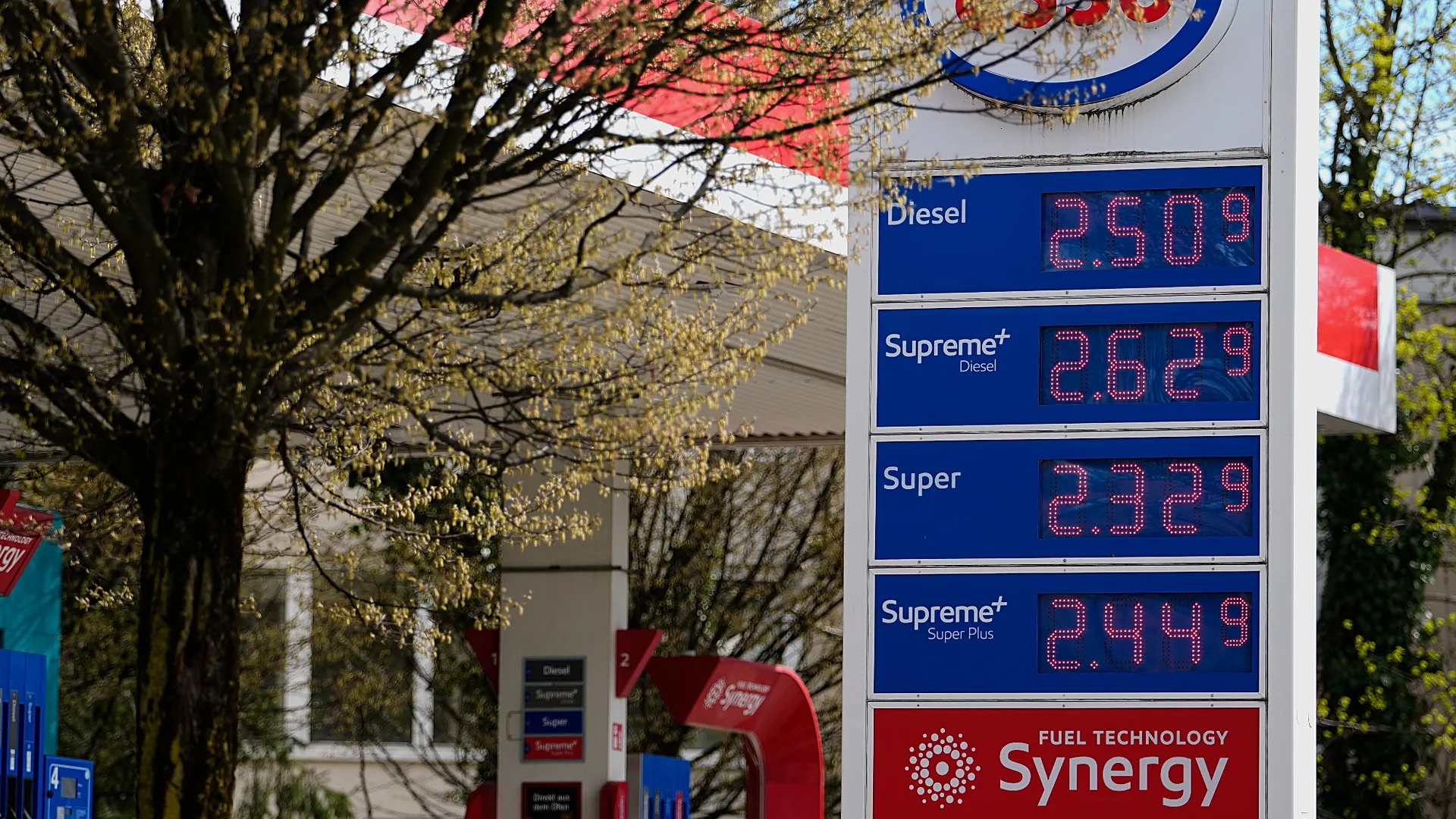
Inflation across the eurozone accelerated sharply in August as surging energy costs pushed consumer prices further above the European Central Bank’s target and strengthened expectations that policymakers will raise interest rates again in September.
Consumer prices across the 21 countries that use the euro were an estimated 3.3% higher in August than they were one year earlier, according to Eurostat’s preliminary inflation report.
That represented a substantial acceleration from the 2.9% annual inflation rate recorded in July.
Prices also increased 0.4% between July and August alone.
The biggest source of the latest inflation increase was energy.
Energy prices were 14.3% higher than they were in August 2025, accelerating dramatically from an already elevated 10.3% annual increase in July.
Energy prices rose another 2.9% on a monthly basis.
The surge reflects the economic consequences of higher global oil and gas prices following the war involving Iran and repeated disruptions affecting energy shipments through the Strait of Hormuz.
The waterway represents one of the most important energy transportation corridors in the world. Interruptions to normal shipping have placed upward pressure on oil and gas markets, creating particularly significant consequences for Europe because the region depends heavily on imported energy.
Renewed disruptions surrounding the strait contributed to another increase in fuel prices during August.
For European households, those changes can appear relatively quickly in gasoline, diesel, heating and electricity costs.
Businesses face higher expenses as well.
More expensive fuel increases transportation and shipping costs, while energy-intensive manufacturers must pay more to operate factories and equipment.
Whether businesses eventually pass those expenses on to customers is becoming one of the most important questions facing the European Central Bank.
So far, the latest inflation figures provide some reassurance that the energy shock has not spread deeply throughout the rest of the economy.
Core inflation, which removes volatile energy, food, alcohol and tobacco prices, declined slightly to 2.4% in August from 2.5% in July.
Core prices increased 0.2% from the previous month.
The decline is significant because policymakers use underlying inflation measures to determine whether a temporary increase in commodities is becoming a broader and more persistent price problem.
Services inflation also moved in the right direction.
Prices for services increased 3.0% from a year earlier, slowing from 3.3% in July.
Services prices rose just 0.1% during August.
Services inflation has been particularly important for the ECB because it is often influenced by wages and domestic economic conditions rather than global commodity prices.
Persistent services inflation can therefore be more difficult to reverse than a temporary increase in oil.
The August slowdown suggests that underlying domestic inflation pressures remain relatively contained even as the headline inflation number moves substantially higher.
Prices for food, alcohol and tobacco increased 1.2% from the previous year, unchanged from July.
There was essentially no overall monthly increase in that category.
Within food, unprocessed products were 2.7% more expensive than one year earlier, accelerating from 2.4% in July.
Processed food, alcohol and tobacco inflation, however, slowed to 0.6% from 0.7%.
Prices for non-energy industrial goods increased 1.2% from a year earlier, compared with 0.9% in July.
Those prices rose 0.6% during August.
Taken together, the numbers show an increasingly unusual inflation environment.
Headline inflation is moving sharply higher because of energy, but several underlying measurements are either stable or declining.
That distinction will be central when ECB policymakers meet September 10.
The European Central Bank officially targets inflation of 2% over the medium term.
At 3.3%, eurozone inflation is now substantially above that objective.
The ECB has already begun responding to the latest inflation resurgence.
Policymakers increased the deposit facility rate by a quarter percentage point in June, moving it to 2.25%.
The central bank then left rates unchanged during its July meeting while making clear that future decisions would depend on incoming inflation and economic data.
The main refinancing rate currently stands at 2.40%, while the marginal lending facility rate is 2.65%.
August’s inflation report has strengthened expectations that the ECB will resume tightening at its September meeting.
Financial markets broadly expect policymakers to raise the deposit rate by another quarter percentage point, which would bring it to 2.50%.
The larger uncertainty concerns what happens after September.
Leo Barincou, senior economist at Oxford Economics, said the latest inflation acceleration largely reflected higher fuel costs following renewed disruption around the Strait of Hormuz rather than a broad deterioration in underlying price pressures.
His outlook is that headline inflation could remain significantly above the ECB’s target into 2027 because expensive natural gas and food may continue affecting the index.
But the decline in services inflation and modest decrease in core inflation could make policymakers more cautious about committing to a long series of additional increases.
Barincou expects an ECB rate increase at the September meeting but believes it is too early to assume another hike will automatically follow.
That puts him somewhat at odds with financial markets, where investors have been preparing for the possibility of further tightening over the coming year.
The ECB faces a difficult policy calculation.
Raising interest rates can reduce inflation by making loans more expensive, discouraging borrowing and cooling demand throughout the economy.
But higher borrowing costs can also weaken business investment, housing activity and consumer spending.
Europe’s economic growth has remained relatively modest, meaning policymakers need to avoid tightening aggressively enough to cause an unnecessary downturn.
The source of the current inflation increase complicates the decision further.
Higher interest rates cannot directly create more oil or reopen shipping routes through the Middle East.
Monetary policy can, however, prevent an energy shock from spreading into wages, services and expectations of permanently higher inflation.
That is one reason policymakers may still choose to raise rates even though core inflation declined.
Inflation conditions also vary substantially across the eurozone.
Lithuania reported the highest estimated annual inflation rate among the euro-area countries in August, at 5.8%.
That was up from 5.4% in July.
Cyprus followed closely at 5.2%, while Bulgaria recorded inflation of 5.1%.
Bulgaria became the eurozone’s 21st member at the beginning of 2026.
Spain also continued experiencing particularly strong inflation.
Spanish consumer prices were 4.5% higher than a year earlier in August, accelerating from 3.9% in July.
That placed Spain well above the overall eurozone inflation rate.
Belgium recorded inflation of 4.2%, while Luxembourg stood at 4.0%.
Greece and Croatia each reported 3.7%.
Portugal registered 3.6%.
Ireland and Slovenia each recorded 3.4%.
Italy’s annual inflation rate increased to 3.2% from 2.9% in July.
Slovakia recorded 3.1%.
Inflation in several of the eurozone’s largest economies remained below the overall regional average.
Germany’s annual inflation rate increased modestly to 2.9% from 2.8%.
France recorded a more noticeable increase, rising to 2.7% from 2.4%.
The Netherlands reported inflation of 2.8%.
Austria was also at 2.9%.
Finland recorded inflation of 2.4%, while Malta stood at 1.9%.
Estonia reported the eurozone’s lowest inflation rate, at 1.3%.
That represented a decline from 2.0% in July and a dramatic change from August 2025, when Estonian inflation was running above 6%.
The wide variation demonstrates why setting one interest rate for the entire eurozone can be difficult.
Countries such as Lithuania, Cyprus, Bulgaria and Spain are dealing with inflation well above the ECB’s target, while Estonia is already below it.
Yet every country shares the same ECB monetary policy.
The latest numbers are preliminary.
Eurostat is scheduled to publish the complete August inflation data on September 17, when the initial estimates can be revised and additional detail will become available.
The flash report nevertheless arrives at a crucial moment for the ECB.
Inflation had already been moving upward before August.
Eurozone inflation stood at 2.8% in June before increasing to 2.9% in July and then accelerating to 3.3% in August.
Energy has been responsible for much of that deterioration.
A year ago, eurozone energy prices were falling.
By March 2026, annual energy inflation had risen to 5.1%.
It accelerated to 10.8% in both April and May, eased somewhat to 8.5% in June and then returned to 10.3% in July.
August’s 14.3% increase marks another significant deterioration.
That trajectory illustrates how dramatically the geopolitical environment has altered Europe’s inflation outlook.
The eurozone experienced a major energy shock after Russia’s invasion of Ukraine in 2022.
Policymakers subsequently spent years bringing inflation back toward target.
The latest Middle Eastern conflict has introduced a new energy disruption before that process was fully secure.
There is an important difference, however.
The earlier inflation wave became deeply embedded throughout the economy, affecting goods, services, wages and expectations.
The latest shock remains much more concentrated in energy.
ECB research has similarly suggested that the 2026 inflation increase is being driven primarily by adverse energy-supply developments rather than the unusually powerful combination of fiscal stimulus, monetary stimulus and supply shortages that contributed to the earlier inflation surge.
That could allow policymakers to respond more cautiously.
Financial markets are nevertheless preparing for tighter policy.
European government bond yields have risen as investors reassess how long borrowing costs may need to stay elevated.
Higher bond yields can increase financing costs for governments, companies and households while also putting pressure on stock valuations.
European equities declined Tuesday as investors absorbed both the inflation report and a broader global bond-market selloff.
The region is therefore entering September with two competing economic signals.
Manufacturing activity has recently improved, with eurozone factory growth reaching its fastest pace in more than four years during August.
At the same time, inflation has moved decisively above the ECB’s target.
Stronger economic activity gives policymakers greater freedom to fight inflation because the economy may be better positioned to absorb higher rates.
But the continuing decline in core and services inflation suggests the ECB may not need to respond to every increase in headline prices with aggressive tightening.
Much will depend on energy markets.
If oil and natural gas prices continue climbing, eurozone inflation could remain above 3% and eventually begin appearing more clearly in transportation, manufacturing, food and services.
If the conflict eases and energy prices retreat, headline inflation could fall again without requiring a prolonged series of rate increases.
For now, the August numbers have made the ECB’s immediate decision considerably clearer.
Headline inflation has risen from 2.9% to 3.3%, energy costs are increasing at a 14.3% annual pace and the central bank remains committed to returning inflation sustainably to 2%.
Markets therefore see another quarter-point increase on September 10 as increasingly likely.
What comes afterward is far less certain.
The continuing decline in underlying inflation gives the ECB reason to proceed carefully, while the energy shock gives it reason not to declare victory.
Europe’s inflation problem has changed again, and this time the outcome may depend as much on oil tankers and geopolitical developments in the Middle East as on wages, consumer demand or decisions made inside the ECB’s headquarters in Frankfurt.