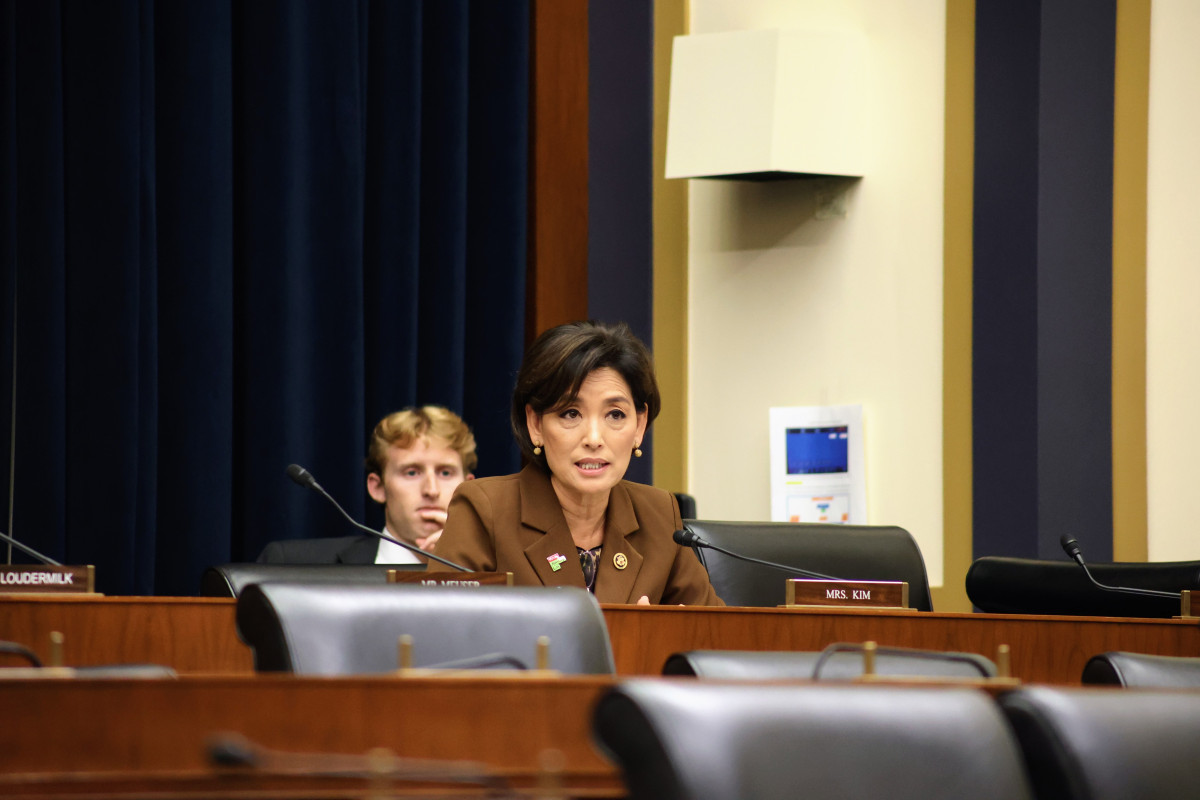
Rep. Young Kim used a House Financial Services Committee hearing Wednesday to focus on three areas she says could strengthen the U.S. economy: protecting consumers from payment fraud, expanding private investment in affordable housing and encouraging financial technologies that could make business payments faster and more efficient.
Kim, a Republican representing California’s 40th Congressional District, questioned witnesses during the September 2 hearing, formally titled “Strengthening the American Economy: Promoting Growth, Opportunity, and Prosperity.”
The full committee hearing was held at 10 a.m. in the Rayburn House Office Building in Washington.
Witnesses included Circle President Heath Tarbert, Florida Bankers Association President and CEO Kathleen Kraninger, New York Stock Exchange President Lynn Martin, Mises Institute Senior Fellow Alex Pollock and Darrick Hamilton, an economics professor and founding director of the Institute on Race, Power and Political Economy at The New School.
Kim’s questioning centered first on the growing problem of check and wire-transfer fraud.
She pointed to a recent California case involving roughly 150 residents whose property-tax checks were stolen.
The incident became an example of a broader problem Kim has sought to address through legislation introduced earlier this year.
In June, Kim introduced the Strengthening Transaction Oversight and Preventing Payments Fraud Act, known as the STOP Payments Fraud Act.
The legislation would give banks and other covered financial institutions additional time to hold checks and wire transfers when a transaction appears suspicious and requires further investigation.
Existing banking rules generally require institutions to make deposited funds available within established periods.
Kim argues that those requirements can become a weakness when a bank recognizes warning signs associated with a potentially fraudulent transaction but does not have enough time to investigate before the money must be released.
Her proposal would provide financial institutions with greater flexibility to delay suspicious transactions while investigators determine whether fraud is occurring.
The objective is to prevent stolen money from reaching criminals rather than forcing consumers and banks to attempt to recover funds after a fraudulent transfer has already been completed.
The legislation has already advanced beyond its introductory stage.
The House Financial Services Committee approved the STOP Payments Fraud Act on June 30.
Kim’s office has cited industry estimates showing that more than $1.3 billion was stolen from consumers and financial institutions through check fraud during 2023 and 2024.
Check fraud has remained particularly challenging because criminals can steal physical checks, alter information on them and use the account and routing numbers contained on legitimate payments to carry out additional fraud.
Wire transfers can create another problem because they can move large amounts of money quickly and are often difficult to reverse after funds reach the recipient.
Kim argued that financial institutions should have enough time to investigate warning signs before questionable transactions are completed.
The issue has particular relevance in cases involving payments such as property taxes, where consumers may mail checks containing both personal banking information and significant dollar amounts.
Kim also used the hearing to discuss affordable housing and community development.
She highlighted the Community Investment and Prosperity Act, bipartisan legislation she helped introduce in the House with Reps. Mike Lawler of New York and Joyce Beatty of Ohio.
The proposal was designed to increase the amount of capital banks are permitted to invest in projects serving a public-welfare purpose.
Before the change, national banks and state member banks generally could invest up to 15% of their capital and surplus in qualifying public-welfare investments.
Those projects can include affordable housing, community revitalization and economic-development initiatives.
The Community Investment and Prosperity Act raises that limit to 20%.
The goal is to make a larger pool of private bank capital available for projects that can support affordable housing and local economic development.
Supporters have argued that banks play an important role in financing affordable housing through equity investments connected with programs such as the Low-Income Housing Tax Credit and New Markets Tax Credit.
By increasing the statutory investment cap, banks potentially have greater room to finance qualifying housing and community-development projects without requiring a separate expansion of direct federal spending.
The legislation attracted bipartisan support.
The House version was introduced by Kim, Lawler and Beatty, while senators from both parties pursued a companion proposal.
The measure ultimately became part of the broader 21st Century ROAD to Housing Act and became law earlier this summer.
The housing package contained a number of provisions intended to increase housing construction and make it easier for private institutions, local governments and developers to finance or approve new projects.
For Kim, the Community Investment and Prosperity provision represented a way to address housing affordability by encouraging more private investment rather than relying solely on government funding.
Housing costs remain one of the most significant economic pressures facing households in California and many other parts of the country.
Increasing the supply of affordable housing generally requires large amounts of long-term capital, making banks an important source of financing.
Kim has argued that increasing the public-welfare investment limit can give financial institutions more flexibility to participate in those projects.
Her third major focus during Wednesday’s hearing was financial technology.
Kim questioned witnesses about stablecoins and other emerging payment systems and how those technologies could affect American businesses.
Stablecoins are digital assets generally designed to maintain a fixed value relative to another asset, most commonly the U.S. dollar.
Dollar-backed stablecoins can allow value to be transferred electronically using blockchain networks without the price swings normally associated with cryptocurrencies such as Bitcoin.
Advocates say that structure could make stablecoins useful for payments, particularly transactions that currently rely on slower banking processes or involve businesses operating across national borders.
Kim examined whether stablecoins and other new payment technologies could allow businesses to settle transactions more efficiently.
Settlement refers to the point at which money actually moves between parties and a financial transaction becomes final.
Traditional financial transactions can involve multiple banks, payment processors, clearing systems and settlement windows.
Depending on the transaction, moving funds internationally can take considerably longer than transferring digital assets through a blockchain network.
Supporters of stablecoin-based payments argue that properly regulated digital dollars could allow some transactions to settle more quickly and operate outside conventional banking hours.
The technology has received increasing attention from payment companies, banks, cryptocurrency firms and policymakers as blockchain-based financial products become more closely connected with the traditional financial system.
Kim also connected the stablecoin debate with the international role of the U.S. dollar.
Most major stablecoins are denominated in dollars.
Supporters of U.S. stablecoin legislation have argued that broader international use of regulated dollar-backed stablecoins could increase demand for dollar-denominated assets and help preserve the dollar’s importance in global commerce.
That argument has become increasingly prominent as the United States competes with other countries over the future structure of digital payments.
China, Europe and other major economies have been developing their own approaches to digital currencies, instant-payment systems and blockchain-based financial services.
American policymakers therefore face two related questions.
The first is how to regulate emerging payment technologies without creating unacceptable financial, consumer-protection or money-laundering risks.
The second is whether excessive restrictions could cause new financial technologies and businesses to develop outside the United States instead.
Kim’s comments Wednesday reflected the latter concern.
Her office said she wants the United States to remain at the forefront of financial innovation while maintaining the dollar’s central position in the international financial system.
The discussion also came as Congress continues debating broader cryptocurrency and digital-asset rules.
Lawmakers have increasingly focused on the regulatory treatment of stablecoins, cryptocurrency exchanges, token issuers and payment platforms.
The central policy challenge is establishing rules that allow legitimate financial innovation while protecting consumers and preserving the stability of the banking system.
Wednesday’s broader committee hearing was not limited to Kim’s priorities.
The Financial Services Committee brought together witnesses representing banking, digital payments, capital markets and economic policy to examine policies lawmakers believe could affect growth, investment and economic opportunity.
The presence of Circle President Heath Tarbert was particularly relevant to the stablecoin discussion.
Circle is the company behind USDC, one of the largest dollar-backed stablecoins in circulation.
NYSE President Lynn Martin represented another major part of the financial system, providing the perspective of U.S. public capital markets.
Kathleen Kraninger represented the banking industry through her role leading the Florida Bankers Association.
The hearing also included contrasting economic-policy perspectives from Pollock and Hamilton.
The discussion took place against a complicated economic backdrop.
American households continue dealing with affordability pressures involving housing, borrowing and other everyday expenses, while financial institutions are adapting to increasingly sophisticated fraud schemes.
At the same time, blockchain technology and digital payments are creating new ways for companies to transfer and settle money.
Kim’s policy agenda connects those issues through a broader argument that economic policy needs to protect existing financial activity while adapting to technological change.
On fraud, her proposal would give banks more time to stop suspicious payments.
On housing, the legislation she helped advance increases the amount banks can invest in qualifying community-development projects.
And on digital payments, she is pushing policymakers to consider how stablecoins could improve transaction settlement while supporting continued international use of the dollar.
The three issues involve different parts of the financial system, but each ultimately affects how money moves through the economy.
Fraud determines whether consumers can safely use existing payment networks.
Housing-investment rules influence how much private capital banks can direct toward community projects.
Stablecoins and new payment technologies could determine how businesses move money in an increasingly digital financial system.
Kim used Wednesday’s hearing to argue that federal policy should evolve in all three areas.
Some of that agenda has already progressed through Congress.
The Community Investment and Prosperity Act’s central provision has become law through the broader housing package.
The STOP Payments Fraud Act has passed the House Financial Services Committee but still must complete the legislative process before becoming law.
The debate surrounding stablecoins and next-generation payment systems is continuing as lawmakers, regulators, banks and cryptocurrency companies determine how those technologies should fit into the U.S. financial system.
For Kim, the issues share a common objective: protecting consumers while giving businesses and financial institutions more flexibility to invest, innovate and move money efficiently.
Whether each proposal ultimately delivers those economic benefits will depend on implementation and, in the case of the fraud legislation, whether Congress completes the remaining steps required to enact it.