Miami’s transformation from a tourism and Latin America-focused business center into one of the most closely watched financial and technology hubs in the United States has accelerated dramatically since the pandemic, drawing billionaires, investment firms, technology companies and enormous amounts of private capital to South Florida.
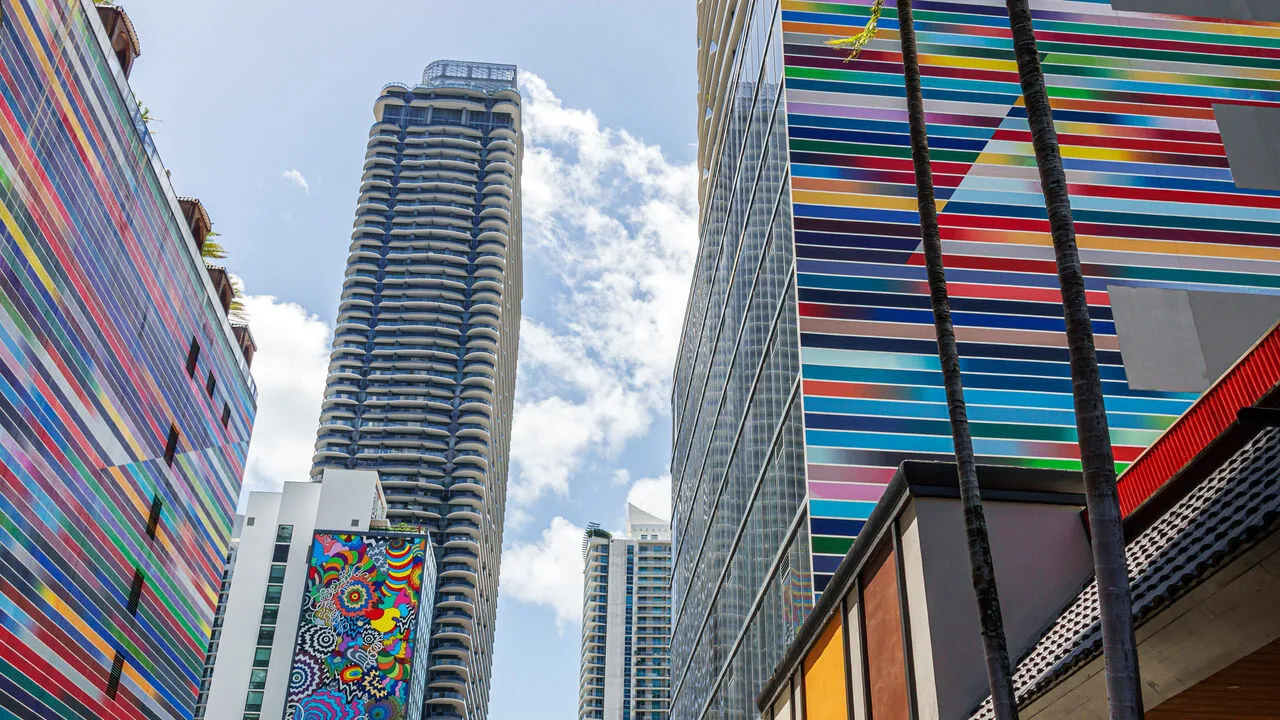
The shift is visible throughout Miami’s skyline.
Brickell, long the center of the region’s banking industry, has become an increasingly expensive destination for hedge funds, private-equity firms, law firms and technology companies. New office towers are filling with businesses that might once have automatically chosen Manhattan, Chicago or San Francisco.
At the same time, South Florida’s luxury residential market has moved into territory that would have seemed extraordinary only several years ago.
Miami Realtors data show that Miami-Dade, Broward and Palm Beach counties recorded 17 residential transactions worth more than $50 million in 2025, a new record for the region. There had been no such transactions in 2020.
The average price of those 17 properties was approximately $78.5 million.
That surge at the very top of the housing market reflects a larger migration of wealth.
A growing collection of prominent executives and investors have established residences, offices or corporate headquarters in South Florida. Among the most consequential was Citadel founder Ken Griffin, who moved his investment firm’s headquarters from Chicago to Miami.
Other prominent financial companies and executives have also expanded their presence in the region, including businesses associated with Carl Icahn, Paul Singer and Barry Sternlicht.
The trend has become substantial enough that Miami increasingly appears on the list of American cities competing for financial talent.
New York remains overwhelmingly larger as a financial center, but Miami is no longer simply attracting wealthy people who want second homes.
Companies are bringing employees, leasing offices and building permanent operations.
Several factors are driving the migration.
Florida has no state individual income tax, creating a significant financial advantage for high earners relocating from states such as New York and California.
The difference can become enormous for hedge-fund managers, business owners and executives earning millions of dollars annually.
Remote and hybrid work also changed the calculation.
Before the pandemic, executives often needed to live near a company’s traditional headquarters. The widespread adoption of remote work made it easier for business leaders to reconsider where they wanted to live, and some eventually brought portions of their companies with them.
Miami’s local and state governments have also promoted Florida as a business-friendly alternative to higher-tax states.
The result has been a broader expansion of the region’s financial ecosystem.
Investment companies require lawyers, accountants, consultants, technology specialists, wealth managers, recruiters and other professional services.
As more firms establish operations in Miami, those supporting industries gain an incentive to expand there as well.
That dynamic is critical because successful business centers tend to become self-reinforcing.
A financial company considering Miami today can find considerably more specialized talent, customers, service providers and potential employees than it could have found in the city a decade ago.
Technology companies are becoming part of the same story.
Palantir Technologies, the data analytics and artificial-intelligence company founded with the involvement of billionaire investor Peter Thiel, shifted its principal executive office from Denver to the Miami area in February 2026.
The company listed a new address in Aventura, north of central Miami.
Palantir joined other technology businesses and investors that have increased their South Florida presence during the past several years.
For Miami’s supporters, such relocations are evidence that the region is beginning to move beyond tourism, hospitality and real estate and toward industries capable of producing highly paid professional jobs.
The technology transition is not yet complete.
South Florida still lacks the enormous research ecosystem surrounding Silicon Valley, Boston, Seattle and other established innovation centers.
Those regions have spent decades building relationships among universities, venture-capital firms, engineers, laboratories and major technology companies.
Miami cannot reproduce that infrastructure simply by attracting wealthy investors.
Much of the venture capital managed from South Florida continues to be invested in companies headquartered elsewhere, particularly in established technology centers.
That distinction matters.
A city becomes a true technology hub when companies are being created, financed, staffed and expanded locally rather than merely having investors who live nearby.
Finance faces a similar challenge.
The arrival of major firms has increased Miami’s profile considerably, but New York remains in a different category when measured by financial employment, assets under management and the number of professionals directly involved in investing.
Recent analysis of the industry’s migration has placed Miami among the largest U.S. centers for financial employment, but still well behind Manhattan.
Some of the positions created by firms relocating to South Florida have also involved operations and administrative functions rather than portfolio management, trading or senior investment decisions.
That does not make those jobs economically unimportant.
It does mean that Miami still has significant distance to cover before it can credibly claim to have replaced Wall Street as America’s financial capital.
There is nevertheless clear momentum.
The region’s office market illustrates how demand has changed.
Prestigious Brickell buildings have attracted major banks, investment firms, law practices and technology businesses even as office markets in several other American cities continue struggling with vacancies caused by remote work.
JPMorgan Chase, for example, has pursued additional expansion in Miami as part of a broader increase in its Florida operations.
The combination of new businesses and wealthy residents has also supported Miami’s traditional industries.
Hospitality remains a major employer.
Luxury hotels, restaurants, nightclubs and entertainment businesses benefit directly when wealthy residents, investors and corporate executives spend more time in the region.
Miami has also developed a powerful calendar of international events.
Professional sports, Formula One racing, the Miami Open tennis tournament, major art events and finance and technology conferences bring affluent visitors into the area throughout the year.
That ability to combine work and recreation is one of Miami’s competitive advantages.
Executives can conduct business in Brickell, attend a conference in Miami Beach and entertain clients at luxury restaurants or sporting events without leaving the metropolitan area.
South Florida has also become increasingly important politically.
President Donald Trump’s Mar-a-Lago property in Palm Beach has helped turn the northern portion of the region into a gathering place for political officials, corporate leaders and foreign visitors.
Major financial and technology executives have attended events there, while lobbying organizations and businesses have increased their South Florida presence.
Trump also selected his Doral resort near Miami as the location for the United States’ 2026 Group of 20 leaders summit, further increasing the region’s international political visibility.
That intersection between money and politics adds another dimension to Miami’s economic expansion.
Companies frequently cluster near customers and decision-makers.
If financial executives, wealthy investors, government officials and foreign representatives are all spending more time in South Florida, businesses serving those groups have stronger reasons to establish permanent offices nearby.
International capital represents another longstanding strength.
Miami has historically functioned as one of the primary financial and commercial gateways between the United States and Latin America.
Families and businesses throughout Latin America have used South Florida for banking, investment, real estate and corporate operations for decades.
That foundation gave Miami an international financial network before the more recent migration from New York, Chicago, California and other parts of the United States began.
Middle Eastern investment has become increasingly visible as well, adding another pool of international capital to the region.
Taken together, these trends have created a dramatically richer Miami.
But the boom is producing consequences that could eventually undermine some of the city’s advantages.
Housing affordability is among the biggest problems.
Property values and rents increased rapidly following the pandemic as wealthy residents competed for limited housing.
People earning ordinary salaries have experienced a very different version of Miami’s economic boom than the investors purchasing multimillion-dollar waterfront properties.
Restaurant workers, hotel employees, teachers, nurses, construction workers and other middle- and lower-income residents must contend with housing expenses that consume an increasingly large share of their earnings.
Inflation has added to the burden.
Federal labor data showed consumer prices in the Miami-Fort Lauderdale-West Palm Beach area were still rising 3.4% annually as of June 2026.
Energy prices were up substantially more.
Miami experienced especially strong increases in living costs during the years immediately following the pandemic, widening the gap between what high-income newcomers can afford and what many longtime residents can pay.
The population data provide a warning.
Miami-Dade County had an estimated population of approximately 2.812 million in July 2024.
By July 2025, that figure had fallen to about 2.802 million.
The decline of 10,115 residents was the third-largest numerical population decrease among U.S. counties during that period, according to Census Bureau estimates.
That creates a paradox.
Miami can simultaneously attract billionaires and lose residents.
A relatively small number of extremely wealthy newcomers can bring enormous income and wealth into a region even while thousands of lower- and middle-income households leave because they can no longer afford to live there.
Over time, that could become a serious economic weakness.
Luxury hotels still need housekeepers.
Restaurants need cooks and servers.
Hospitals require support employees.
Construction companies need tradespeople.
Office buildings require security, maintenance and administrative workers.
A city cannot function exclusively for millionaires and billionaires.
If essential workers must live farther away, employers may eventually need to increase wages substantially or struggle to fill positions.
Long commuting distances can also place additional pressure on transportation infrastructure.
Housing therefore represents more than a social problem for Miami.
It is an economic competitiveness problem.
The second major challenge involves human capital.
Miami has successfully imported wealth faster than it has developed a deep pool of locally produced technical and professional talent.
Florida has major universities and a large economy, but its research ecosystem remains smaller than those found in several competing technology centers.
Universities in places such as Boston and California produce enormous numbers of engineers, researchers and entrepreneurs while receiving billions of dollars for scientific research.
Companies then locate nearby because those workers are available.
That creates another self-reinforcing cycle.
Miami needs to develop a similar pipeline if it wants technology and finance companies to build their most important operations there rather than merely establishing satellite offices.
The third major threat comes from geography.
Few large American cities face Miami’s combination of hurricane exposure, sea-level rise and coastal flooding risk.
A peer-reviewed study published in Scientific Reports in August examined what would happen if a hurricane comparable to 2017’s Hurricane Irma struck Miami under future sea-level conditions.
Researchers found that coastal flood exposure could increase nonlinearly as global temperatures rise.
One particularly important threshold appeared around 1.5 degrees Celsius of warming above preindustrial levels, when higher seas could allow storm surge to penetrate farther inland and expose substantially more people.
That risk has financial consequences today.
Florida already has some of the highest homeowners-insurance costs in the United States.
One 2026 analysis estimated an average annual premium of more than $8,400 for a standardized $300,000 homeowners policy in Florida, nearly three times the national average.
Coastal properties can cost considerably more to insure.
Insurance premiums therefore act as another form of housing expense, potentially offsetting part of Florida’s tax advantage.
A wealthy household moving from New York may save substantially on state income taxes, but it can simultaneously face extraordinary property, insurance and maintenance costs in South Florida.
Businesses face similar calculations.
Climate adaptation will require enormous investment in drainage systems, flood protection, resilient infrastructure and building improvements.
The question surrounding Miami’s rise is therefore no longer whether the boom is real.
It clearly is.
The more important issue is whether Miami can convert a period of extraordinary wealth migration into a durable, diversified metropolitan economy.
That would require building institutions and talent capable of surviving even if the forces driving today’s migration weaken.
Tax advantages could change.
Political influence could shift.
Executives could eventually decide another city offers a better deal.
Financial markets could experience downturns that reduce luxury property demand.
Climate costs could continue increasing.
Cities that become enduring global economic centers generally succeed because businesses eventually need to be there, not merely because executives prefer being there.
New York possesses enormous financial networks.
San Francisco and Silicon Valley possess unmatched technology networks.
Washington possesses the federal government.
Miami is attempting to build its own combination of finance, technology, international capital, politics, tourism and lifestyle.
The evidence suggests that effort has advanced much further than skeptics might have expected five or ten years ago.
South Florida is attracting major companies, record luxury-home transactions and increasingly powerful residents.
Yet some of the same forces fueling that transformation are creating the city’s most serious risks.
The influx of wealth is making housing harder to afford.
Rapid growth is increasing the importance of infrastructure.
The city still needs a deeper pool of highly skilled workers and research institutions.
And its coastal location ensures that climate and insurance costs cannot be separated from its economic future.
Miami has already demonstrated that it can attract capital.
Its next challenge is proving that capital can build an economy capable of lasting long after the current migration boom ends.