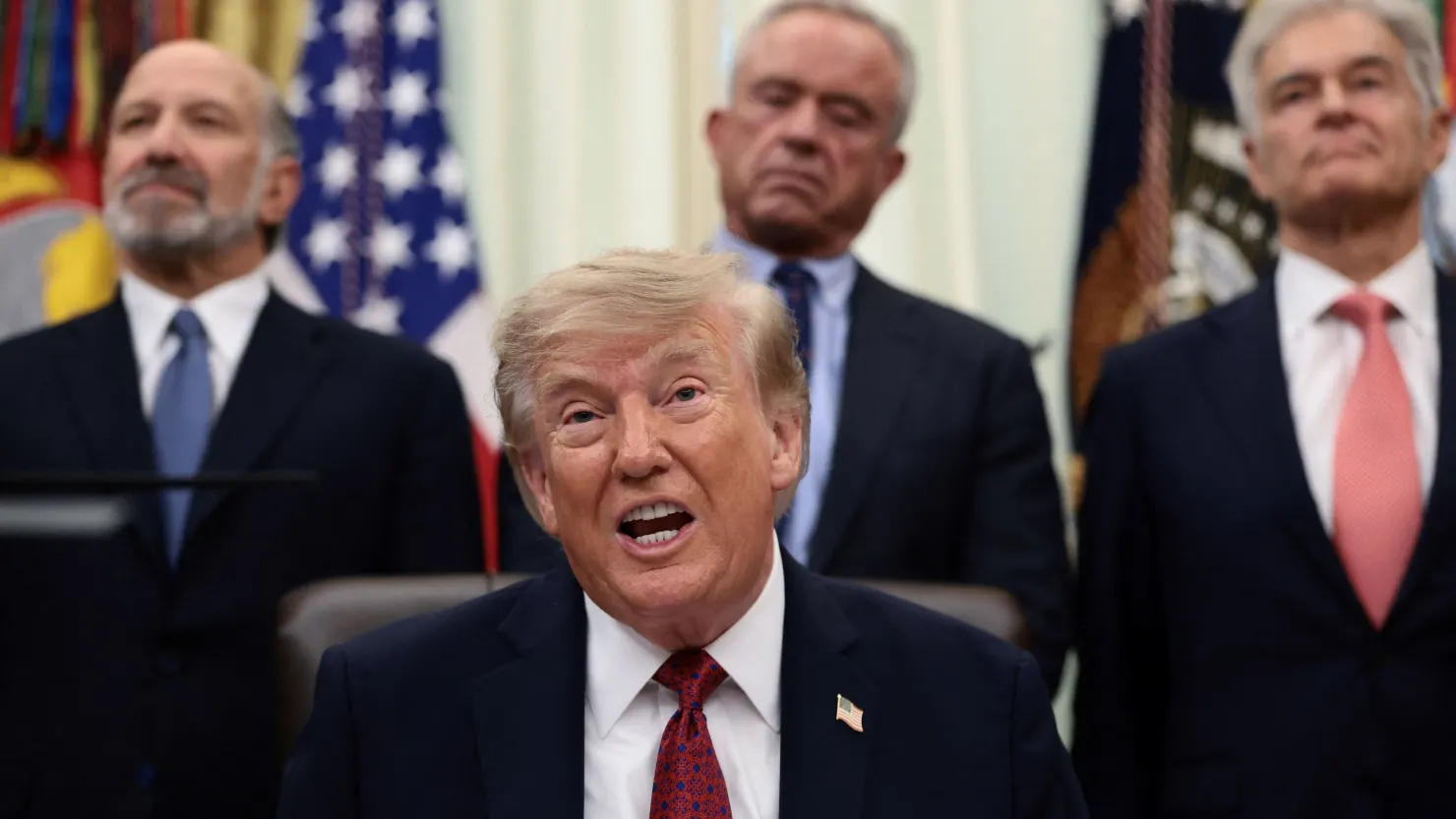
President Donald Trump says the United States could eventually produce economic growth rates as high as 20%, an extraordinarily ambitious projection that would represent a level of expansion almost never seen in modern American history.
Trump made the remarks Monday during an Oval Office event where his administration announced new agreements aimed at reducing prescription drug prices.
While discussing interest rates and the Federal Reserve, Trump argued that the American economy should be allowed to expand much more rapidly without policymakers responding by increasing borrowing costs.
“We could have a GDP of 14, 15, 16 and 20,” Trump said.
Trump’s argument centered on his longstanding belief that strong economic performance should not automatically cause the Federal Reserve to tighten monetary policy.
He maintained that faster economic growth itself does not necessarily create inflation and criticized the idea that strong economic reports should result in higher interest rates.
His comments come at an important moment for monetary policy.
The Federal Reserve has kept its benchmark federal funds rate in a range of 3.5% to 3.75% throughout 2026 as policymakers attempt to balance relatively resilient economic activity against inflation that remains substantially above the central bank’s target.
Trump wants borrowing costs considerably lower.
During Monday’s remarks, he said the United States should have lower interest rates than any other country in the world.
He contrasted today’s monetary-policy environment with what he described as an earlier period when favorable economic reports could be accompanied by declining interest rates.
Trump argued that the current approach effectively limits how quickly the economy is allowed to expand because policymakers become concerned about inflation whenever growth accelerates.
The president has repeatedly expressed frustration with that relationship.
Just weeks earlier, during an August 19 White House event involving technology leaders, Trump made a similar argument, saying policymakers should allow interest rates to decline when strong economic numbers are released rather than assuming that faster growth will inevitably generate additional inflation.
His latest comments take that argument considerably further by suggesting that annualized GDP growth could potentially move into the mid-teens or even reach 20%.
Such an expansion would be virtually unprecedented in the modern American economy.
Bureau of Economic Analysis historical data extending back to 1947 show only one quarter in which inflation-adjusted GDP growth reached or exceeded 20% at a seasonally adjusted annual rate.
That occurred during the third quarter of 2020, when real GDP surged 34.9%.
But that quarter was anything but a normal economic expansion.
The United States was rebounding from the unprecedented shutdowns associated with the COVID-19 pandemic.
During the previous quarter, real GDP had collapsed at an annualized rate of approximately 28%.
Businesses were reopening, consumers were resuming activities that had been suspended, and economic output was recovering from an extraordinary artificial contraction.
The 34.9% rebound therefore did not represent the type of sustainable economic boom Trump is proposing.
Outside that pandemic-driven recovery, the closest the modern U.S. economy has come to the rates Trump described occurred in 1950.
Real GDP expanded at an annualized rate of 16.7% during the first quarter of that year.
Growth remained exceptionally strong during portions of 1950 as the postwar economy expanded, but even that period failed to reach 20%.
Modern American economic growth generally occurs at dramatically lower rates.
That makes Trump’s prediction particularly striking when compared with current conditions.
The U.S. economy expanded at an annualized rate of 1.5% during the second quarter of 2026, according to the Commerce Department’s Bureau of Economic Analysis.
That was slower than the 2.1% annualized expansion recorded during the first quarter.
Consumer activity nevertheless remained relatively strong.
Real consumer spending accelerated during the second quarter, while business investment continued receiving support from enormous expenditures related to artificial intelligence, computer equipment and other technology.
Imports increased sharply, however, subtracting significantly from the headline GDP calculation.
The 1.5% growth rate means the economy would need to accelerate enormously to reach even the bottom end of the 14% to 20% range mentioned by Trump.
The Federal Reserve’s immediate concern is not that the economy is growing anywhere near those levels.
It is inflation.
The central bank has maintained an official target of 2% inflation over the longer term, but recent price increases remain substantially above that goal.
Federal Reserve Chairman Kevin Warsh said during his August 28 address at the Jackson Hole Economic Policy Symposium that the 12-month increase in the Fed’s preferred personal consumption expenditures price index stood at 3.7%.
Over six months, the measure was running at approximately a 4.1% pace.
Warsh described inflation as the Federal Reserve’s predominant concern and emphasized that the central bank’s 2% objective remains a firm target.
He also said policymakers need to see clear evidence that underlying inflation is moving toward that objective at a sufficient speed.
If that evidence does not emerge, Warsh indicated that the Fed still has work to do.
The chairman’s assessment differs significantly from Trump’s preferred approach to interest rates.
Trump believes faster growth should be encouraged with cheaper borrowing costs.
The Fed must consider whether stronger demand could make its inflation problem more difficult.
Economically, growth itself does not automatically produce inflation.
An economy can expand rapidly without a major rise in prices if productivity and the supply of goods and services increase quickly enough to accommodate additional demand.
Technological advances, improved worker productivity, larger labor supply and increased business investment can all allow an economy to produce substantially more without generating equivalent inflationary pressure.
The difficulty arises when demand expands faster than the economy’s ability to produce.
When households, businesses and governments collectively attempt to purchase more goods and services than the economy can efficiently supply, companies can respond by raising prices.
That is one reason central banks frequently increase interest rates when they believe an economy is becoming overheated.
Higher rates make mortgages, credit cards, business loans and other forms of financing more expensive, discouraging some spending and investment and reducing pressure on prices.
Trump’s economic vision essentially argues that America could increase its productive capacity dramatically enough to support much faster growth without generating destabilizing inflation.
His administration has promoted tax reductions, deregulation, domestic energy production, tariffs, manufacturing investment and artificial intelligence as mechanisms capable of raising the country’s long-term economic potential.
However, sustaining annualized real GDP growth approaching 14% to 20% would require an economic acceleration far beyond the pace normally associated with a mature economy such as the United States.
The disagreement between Trump and the Fed has become especially relevant because investors increasingly expect another interest-rate decision in September.
At its July meeting, the Federal Open Market Committee voted 9-3 to leave rates unchanged at 3.5% to 3.75%.
The three dissenting policymakers — Beth Hammack, Neel Kashkari and Lorie Logan — wanted to increase rates by a quarter percentage point.
That was notable because dissents favoring tighter monetary policy reflected growing concern about inflation.
The Fed said economic activity continued expanding at a solid pace, productivity growth and capital investment remained strong, and the unemployment rate had changed little.
But policymakers also emphasized that inflation remained elevated, partly because supply shocks had increased prices in areas including energy.
Warsh reinforced that concern at Jackson Hole.
The chairman said the unemployment rate remained low at approximately 4.1% and characterized the labor market as broadly consistent with full employment.
Consumer spending was also healthy, while private domestic demand remained strong.
Those conditions give the central bank less incentive to stimulate the economy aggressively with substantially lower interest rates.
Trump nevertheless continues to argue that borrowing costs are unnecessarily high.
During Monday’s Oval Office appearance, he pointed to countries with extremely low interest rates and argued that America’s economic strength should allow the United States to borrow more cheaply than other nations.
He also connected interest rates with international trade, arguing that the United States’ enormous economic leverage should strengthen its ability to achieve more favorable financial conditions.
The Fed operates independently from the White House, however, meaning the president cannot directly order policymakers to lower rates.
Trump said Monday that he respects Warsh and believes the Fed chairman will ultimately take whatever action is necessary.
The two men nevertheless appear to approach the current economic situation from different directions.
Trump is focused heavily on maximizing economic expansion and reducing borrowing costs.
Warsh is emphasizing the danger of allowing inflation to remain above target.
That difference will become increasingly important if economic data strengthen.
Normally, a sharp acceleration in growth would be welcomed by investors, businesses and political leaders.
But if rapid expansion occurs while inflation remains around 3% to 4%, markets could conclude that the Federal Reserve needs to keep rates high or raise them further.
Trump rejects that logic.
His position is that America should be capable of experiencing tremendous economic success without having that success restrained by monetary tightening.
Historical data demonstrate the scale of what he is proposing.
Since quarterly records began in 1947, the United States has experienced everything from postwar expansions and technological revolutions to massive government spending programs, financial booms and recoveries from severe recessions.
Yet inflation-adjusted quarterly growth has reached 20% only during the extraordinary reopening from the COVID-19 shutdowns.
Today’s economy is expanding at 1.5%.
Closing the enormous distance between those figures would require a transformation in American economic output with almost no precedent in the postwar era.
Whether Trump’s policies can produce even a portion of that acceleration remains to be seen.
For the immediate future, the more consequential battle may concern interest rates rather than 20% GDP growth.
The Federal Reserve meets again September 15 and 16.
With inflation still well above its target, three policymakers already favoring higher rates and Warsh signaling that restoring price stability remains the central bank’s priority, another rate increase remains a possibility.
Trump, meanwhile, is pushing in precisely the opposite direction.
His message is that the United States should not have to choose between extraordinary economic growth and low interest rates.
The Federal Reserve’s challenge will be determining whether the economy can actually deliver stronger growth without creating the inflationary pressures that monetary policy is designed to prevent.