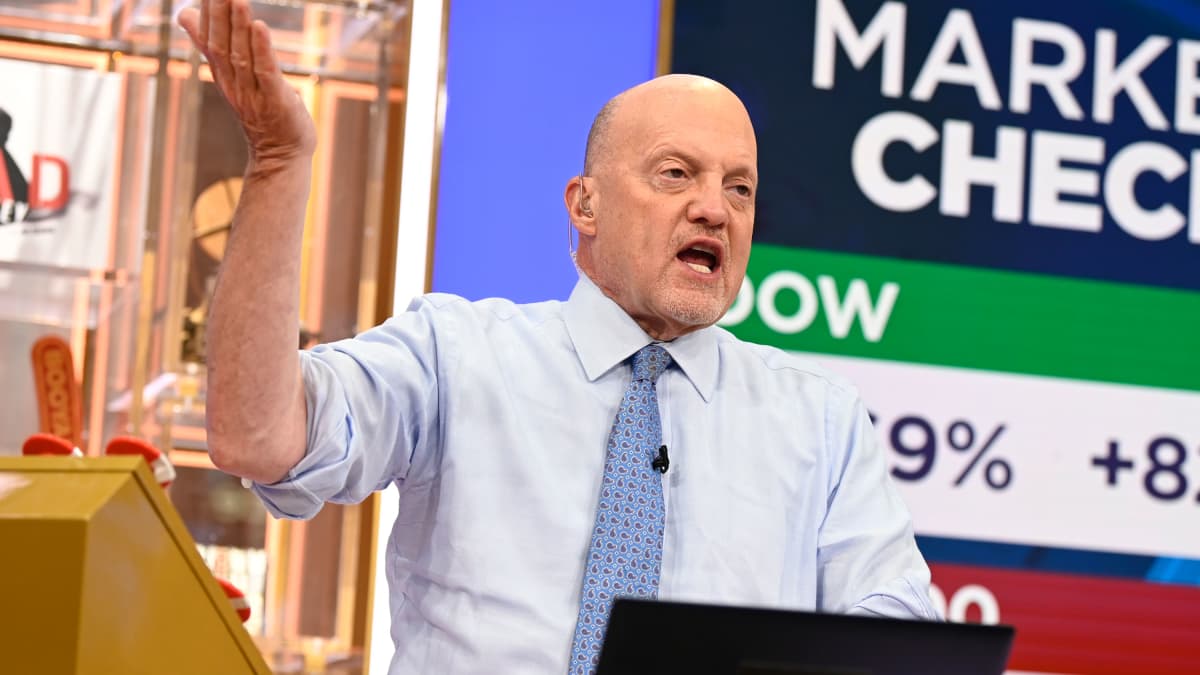
Jim Cramer is taking a more defensive approach to the stock market as surging oil prices, rising Treasury yields and renewed geopolitical tensions create a tougher environment for investors entering September.
The market commentator said his charitable trust has made three notable changes in response: increasing its cash position to roughly 15%, reducing exposure to some stocks tied heavily to the data-center boom while adding to health care, and becoming more patient about buying stocks during market declines.
The strategy comes as Wall Street faces renewed pressure from several directions at once.
U.S. stocks started September on a weak note Tuesday. The S&P 500 fell about 0.7%, the Dow Jones Industrial Average lost roughly 0.8%, and the Nasdaq Composite declined around 1%.
Energy markets were an important reason for the weakness.
West Texas Intermediate crude jumped 5.2% to settle at $90.22 per barrel, while Brent crude rose 4.6% to $94.65.
Oil prices climbed as fighting involving the United States and Iran intensified again, increasing concerns about potential disruptions to energy supplies moving through the Middle East.
Particular attention remains focused on the Strait of Hormuz, one of the world’s most important transportation routes for crude oil and other petroleum products.
Any prolonged disruption there could reduce available supplies, increase shipping costs and push oil prices even higher.
For investors, expensive oil creates problems that extend beyond the energy market.
Higher fuel prices can raise costs for transportation companies, manufacturers and consumers. Businesses may eventually pass some of those expenses along through higher prices, adding another source of inflation throughout the economy.
That is particularly important because inflation is already running above the Federal Reserve’s 2% target.
If higher energy costs keep inflation elevated, the central bank could be forced to maintain restrictive monetary policy longer than investors previously expected or potentially increase interest rates again.
Treasury yields have already responded to those concerns.
The benchmark 10-year Treasury yield moved to roughly 4.79% Tuesday.
Higher bond yields can create pressure on stocks because investors suddenly have more attractive alternatives to equities.
Government securities provide income with considerably less risk than stocks, making expensive equities less appealing as bond yields rise.
Technology and other high-growth companies can be particularly vulnerable.
Many of those businesses trade at elevated valuations based largely on profits investors expect them to generate years in the future. Higher interest rates reduce the present value of those future earnings, making investors less willing to pay extremely high multiples.
That backdrop has pushed Cramer toward a more cautious strategy.
The first major change involves cash.
Cramer’s charitable trust has increased its cash position to approximately 15% of the portfolio.
That is an unusually high level for the trust.
Holding more cash reduces the amount of money exposed to falling stocks while also creating an opportunity to buy companies at lower prices if the market experiences a deeper decline.
The move does not mean Cramer expects an imminent market crash.
Instead, it reflects his belief that investors should preserve flexibility while oil, inflation, interest rates and geopolitical developments remain unpredictable.
Another major military escalation involving Iran or a serious interruption to shipping through the Strait of Hormuz could cause energy prices to move substantially higher in a short period.
That could quickly pressure Treasury yields and stocks again.
Rather than attempting to predict when those developments will occur, Cramer is keeping more cash available.
His second defensive move involves changing the composition of the portfolio.
Cramer’s trust has reduced some exposure to companies closely connected with the massive expansion of artificial intelligence data centers while increasing investments in health care.
One of the most significant moves was selling the portfolio’s remaining position in Corning.
Corning has become a beneficiary of the enormous data-center construction boom because its optical fiber and connectivity technologies are used to move information between servers and other computing equipment.
The trust had already reduced the Corning position before eliminating what remained.
Cramer also trimmed the portfolio’s position in Broadcom.
Broadcom is another major beneficiary of artificial intelligence infrastructure spending through networking technology and custom AI processors.
Rather than leaving all of that money in cash, the trust moved some capital into Cardinal Health.
Cardinal Health represents a considerably more defensive type of business.
The company distributes pharmaceuticals and other medical products, giving it exposure to an industry where demand tends to remain relatively stable even when economic conditions weaken.
Health care stocks can therefore provide investors with some protection when markets become more volatile.
Medical needs generally do not disappear simply because interest rates increase or the economy slows.
Cramer’s decision to reduce some data-center exposure does not mean he believes the artificial intelligence investment boom is ending.
The underlying demand remains extremely strong.
Dell Technologies provided fresh evidence of that this week.
Dell reported roughly $47 billion in second-quarter revenue, representing an increase of approximately 58% from the previous year.
The company has experienced extraordinary demand for artificial intelligence servers as technology companies and other businesses continue expanding computing infrastructure.
Dell also raised its full-year revenue forecast to approximately $192 billion from $167 billion.
Its adjusted earnings outlook increased to roughly $25.50 per share from $17.90.
Those numbers provide powerful evidence that corporations continue spending heavily on artificial intelligence.
The issue for Cramer is the difference between a strong business and an attractive stock price.
Companies involved in data centers can continue generating excellent revenue and earnings while their stocks fall because of rising Treasury yields or excessive valuations.
The same problem can affect semiconductor companies and other major beneficiaries of AI spending.
That is why Cramer has reduced exposure rather than abandoning the theme entirely.
His portfolio continues to own Nvidia.
The trust also continues holding Apple.
Nvidia remains one of the most important companies supporting the artificial intelligence boom because its graphics processors are used extensively in AI training and inference.
Demand for Nvidia’s technology remains strong, but the stock can still decline when investors rotate away from expensive technology shares.
Another concern surrounding data centers comes from politics and infrastructure.
Communities around the country have increasingly scrutinized major data-center projects because of their enormous electricity requirements, water consumption and potential effects on utility costs.
Those issues could become another obstacle for companies benefiting from the data-center construction boom.
Cramer’s third defensive strategy is perhaps the simplest: stop automatically buying every market decline.
Buying the dip has been an extremely successful strategy throughout much of the recent bull market.
Technology and AI stocks repeatedly experienced short-term pullbacks before recovering and moving higher.
That pattern conditioned investors to view nearly every decline as an immediate buying opportunity.
Cramer believes investors should now be more selective.
A stock becoming 5% or 10% cheaper does not necessarily make it attractive if oil prices continue rising, Treasury yields keep climbing and Federal Reserve expectations continue becoming more hawkish.
Prices could fall substantially further.
Cramer wants to see greater pessimism among investors before aggressively using the trust’s cash reserves.
The idea is to wait until the market becomes significantly more fearful rather than chasing every short-term decline.
That does not mean attempting to identify the exact market bottom.
Instead, it means demanding better prices before committing additional capital when several major economic risks remain unresolved.
September’s reputation also contributes to the caution.
Historically, September has been the weakest month of the year for the S&P 500.
Going back to 1928, the index has averaged a decline of roughly 1.1% during the month.
Historical averages do not determine what will happen in any individual year, but September’s record provides another reason for investors to avoid becoming overly aggressive.
The current environment is especially complicated because strong corporate earnings are colliding with difficult macroeconomic conditions.
Artificial intelligence spending remains robust.
Major technology companies continue investing enormous amounts of money into computing infrastructure.
Semiconductor demand remains strong.
Companies such as Dell are producing exceptional growth.
At the same time, oil has climbed above $90 per barrel.
Treasury yields are approaching 5%.
Inflation remains elevated.
And investors are becoming more concerned that the Federal Reserve may need to raise interest rates again.
That creates a difficult combination for the market.
Normally, an economic slowdown can eventually produce lower interest rates, giving stocks support.
But an economy experiencing inflation from higher energy prices may not receive that same relief.
The Federal Reserve cannot easily cut rates if inflation remains too high.
That leaves investors facing the possibility of slowing economic growth while borrowing costs remain elevated.
Higher interest rates can also place pressure on businesses themselves.
Companies must pay more to borrow money or refinance existing debt.
Consumers face higher mortgage, auto loan and credit-card costs.
Eventually, those expenses can reduce spending and weaken corporate demand.
For Cramer, those risks justify holding more protection than usual.
His trust remains heavily invested in stocks despite its approximately 15% cash position.
The strategy therefore does not amount to abandoning equities.
Instead, the portfolio is attempting to become more balanced.
It has additional cash available if stocks become substantially cheaper.
It has shifted some money away from highly valued data-center beneficiaries toward more defensive health care companies.
And it is refusing to treat every market decline as an automatic buying opportunity.
Cramer’s approach also highlights an important distinction for investors.
A strong long-term investment theme does not guarantee strong short-term stock performance.
Artificial intelligence could continue transforming the economy for years while AI stocks still experience significant corrections.
Nvidia can continue selling enormous quantities of processors while its shares temporarily decline.
Broadcom can benefit from strong networking and custom-chip demand while higher interest rates pressure its valuation.
Corning can benefit from data-center connectivity spending while investors rotate toward more defensive industries.
That is why Cramer has not abandoned his longer-term technology outlook.
He is instead adjusting how much risk he wants to take while the broader environment becomes less predictable.
For now, his three-part strategy is straightforward.
The trust has raised cash to approximately 15%, an unusually defensive position.
It has reduced some exposure to data-center beneficiaries, including selling Corning and trimming Broadcom, while adding to health care through Cardinal Health.
And it plans to wait for significantly greater market pessimism before aggressively buying stocks during declines.
Those moves reflect a market where company fundamentals remain strong but outside pressures are becoming more difficult to ignore.
Oil near or above $90 increases inflation risks.
The 10-year Treasury yield approaching 5% creates a serious competitor to equities.
The conflict involving Iran introduces another unpredictable variable.
And September’s historically weak market performance adds another reason for caution.
Cramer still believes major long-term investment opportunities remain in artificial intelligence and technology.
What has changed is his willingness to chase them at current prices.
Until oil prices, interest rates and geopolitical conditions become more predictable, preserving cash and waiting for better opportunities has become the priority.