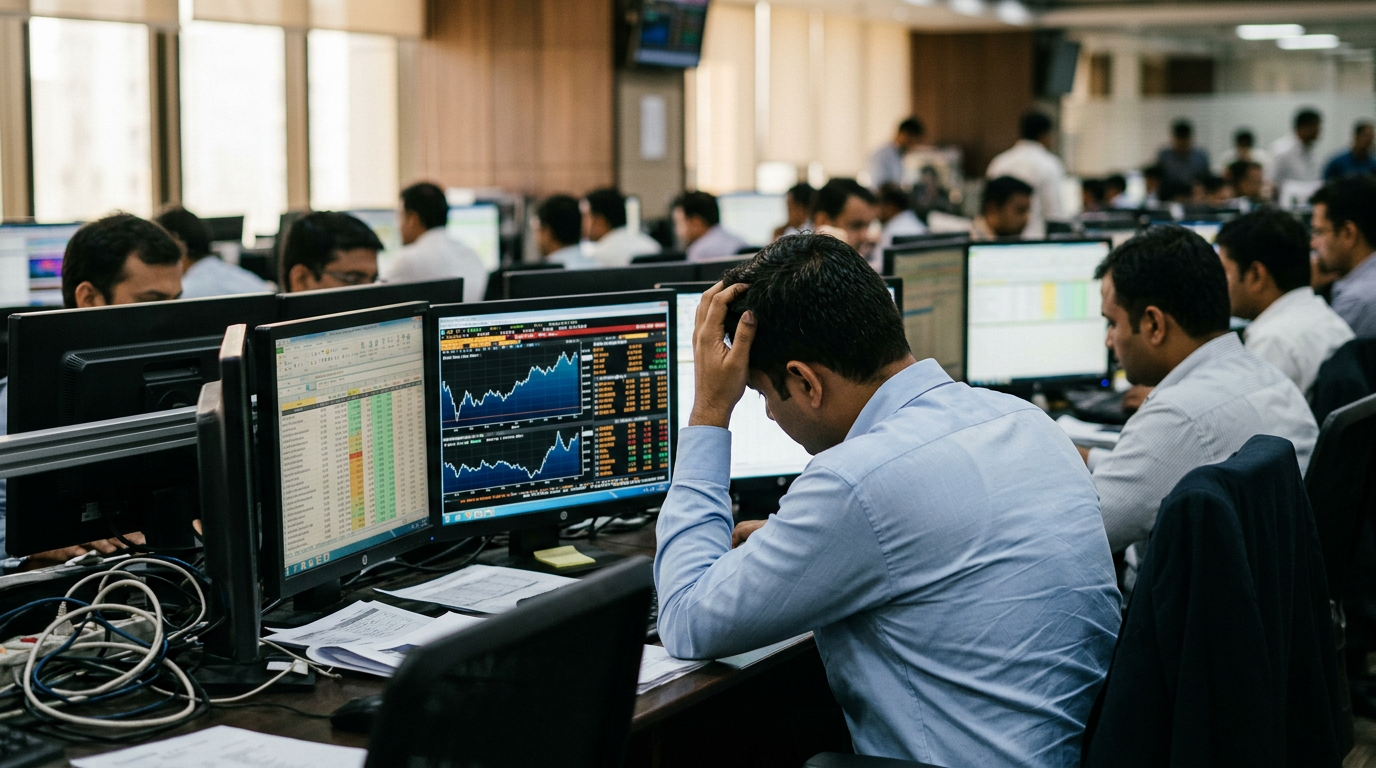
India’s recently introduced system for determining stock closing prices handled its largest volume test yet on Monday, but unusually sharp price swings continued to affect the market, raising questions about whether more professional liquidity providers are needed for the mechanism to operate smoothly.
Approximately $4.2 billion worth of trading connected to MSCI index rebalancing passed through the new closing-auction process, marking a record since India introduced the system in early August.
The surge in trading was enormous compared with activity during the auction’s first month.
Turnover during the 20-minute closing window on the National Stock Exchange of India was approximately 33 times the average daily volume recorded since the system launched on August 3.
Despite the flood of institutional orders, volatility remained significant.
Around 60 stocks finished the closing auction at the maximum 3% price boundaries allowed under the system. Eternal, Adani Enterprises and Reliance Industries were among the prominent companies experiencing major movements as the auction determined their official closing prices.
That performance is drawing additional attention to one of the biggest concerns surrounding India’s new approach: whether there is enough liquidity on both sides of the market to absorb large buy and sell orders without producing dramatic price changes.
Low liquidity had already been identified as a potential explanation for the unusual movements seen during the first several weeks of the closing auction.
Monday presented a different kind of test.
MSCI’s index reshuffling generated a large amount of institutional trading, dramatically increasing the amount of money passing through the closing session. Even with that added volume, several stocks still experienced substantial price dislocations.
Independent data put the value of Monday’s closing-auction trades at roughly $4.1 billion to $4.2 billion, depending on the calculation, confirming that the MSCI rebalance represented by far the largest stress test the new system had faced.
The continuing volatility has shifted some attention toward proprietary trading companies and professional market makers.
Market makers regularly provide buy and sell quotes, helping connect investors who want to purchase shares with those attempting to sell them. Their presence can deepen liquidity and reduce the size of price movements that occur when one side of the market suddenly overwhelms the other.
Mayank Sachan, chief executive of proprietary trading firm Zanskar Research, believes greater participation from those firms could be an important step in improving the closing auction.
Sachan’s assessment is that simply increasing the amount of trading flowing through the system may not eliminate the problem. Without market makers willing and able to provide liquidity on both sides of the auction, significant closing-price movements could continue even on days when overall volume is extremely high.
However, several features of the current framework make that participation difficult.
Proprietary firms have generally remained on the sidelines during the closing auction because restrictions make it difficult for traders to short shares.
That creates a problem for firms attempting to function as traditional market makers.
To consistently quote both buying and selling prices, a market maker needs the flexibility to manage its inventory. If the firm receives substantial demand from buyers, for example, it may need to sell shares short temporarily before balancing that position elsewhere.
Restrictions that make short selling difficult therefore reduce the ability of these firms to provide two-way liquidity during the closing process.
The absence is significant because proprietary traders account for approximately one-third of overall turnover on the National Stock Exchange.
Monday’s movements demonstrated how substantial the consequences can become when major institutional orders arrive during a relatively short auction period.
The Nifty Bank Index offered one of the most dramatic examples.
The 14-company banking index entered the closing auction down approximately 0.2% and appeared headed toward its third consecutive losing session.
Within the closing-auction window, however, the situation reversed.
By the time the final closing prices had been established, the banking index had jumped enough to finish the session approximately 0.9% higher.
That represented a swing of more than one percentage point in only a short period and highlighted the influence that concentrated closing orders can have under the new system.
Individual stocks experienced similar reversals.
Eternal, the quick-commerce company formerly associated primarily with its Zomato business, had been down approximately 3% shortly before the closing auction began.
By the end of the auction, those losses had disappeared and Eternal finished the trading session essentially unchanged.
The movement was notable because Eternal is already considered one of India’s most liquid publicly traded companies when measured using freely tradable shares.
Reliance Industries, one of the most heavily weighted companies in India’s major stock indexes, moved sharply in the opposite direction.
Reliance was trading approximately 0.8% higher before the closing auction.
Once the auction was completed, the company instead finished approximately 0.8% lower.
The shift amounted to an intraday reversal of roughly 1.6 percentage points around the closing process.
MSCI’s scheduled index rebalancing was a major reason Monday produced such large order flows.
Passive investment funds and other institutions that track MSCI benchmarks must adjust their portfolios when companies are added, removed or given different weightings inside the indexes.
Those adjustments can create enormous buy and sell orders that often need to be completed close to the end of the trading session so that fund portfolios remain aligned with the indexes they track.
India’s new system concentrates much of that activity into a separate closing-auction process.
The Closing Auction Session applies initially to cash-market stocks that also have derivative contracts available.
Continuous trading for those securities ends before the auction begins. The exchange then uses a multi-stage process lasting roughly 20 minutes in which investors submit market and limit orders.
A reference price is established, and prices during the auction generally cannot move more than 3% above or below that reference level.
After orders have been collected, the exchange determines an equilibrium price based on available buying and selling interest.
That price becomes the stock’s official closing price.
The approach represents a major departure from the system India previously used.
Before August 3, the official closing price was calculated using the volume-weighted average price of transactions completed during the final 30 minutes of normal trading.
Under that method, the close reflected an average of actual transactions occurring over a relatively extended period.
The new auction instead concentrates orders together and establishes a single equilibrium closing price.
India adopted the approach in part to bring its market structure closer to practices already used by many large international exchanges, where closing auctions are an important tool for price discovery and institutional order execution.
The concept can be particularly useful on days involving index rebalances because massive institutional orders can interact inside one designated auction instead of being forced through the continuous market immediately before trading ends.
Monday demonstrated that the Indian system is capable of processing extremely large orders.
Handling approximately $4.2 billion in trades during one 20-minute window without a breakdown represented an important operational test for the new framework.
The more difficult question is whether those orders can be processed without causing closing prices to move dramatically.
The fact that approximately 60 stocks reached their 3% auction boundaries even while turnover increased to 33 times its recent average suggests that sheer volume alone may not solve the problem.
Instead, the market may need deeper two-sided liquidity.
Greater participation from professional market makers could potentially provide that depth by placing competing buy and sell orders around the equilibrium price, making it more difficult for a relatively concentrated institutional order to move an individual stock sharply in one direction.
For now, however, restrictions affecting how those traders manage short positions continue to limit their incentive to participate.
That leaves India’s new closing auction with a mixed early record.
The mechanism successfully absorbed an extraordinary amount of institutional trading during the MSCI rebalance, demonstrating that it can handle large volumes.
At the same time, the swings in Nifty Bank, Eternal, Reliance Industries and dozens of other securities show that improving liquidity and stabilizing price discovery remain major challenges only a month after the system’s introduction.
As India continues adapting to the closing-auction model, the debate is increasingly moving beyond whether the system can handle large trading volumes.
The larger question is whether the market structure surrounding the auction can attract enough liquidity providers to ensure that billions of dollars in closing orders can be matched without producing outsized movements in the prices investors see at the end of the trading day.