

Unemployment figures can vary noticeably depending on a person’s marital and household status because the decision to search for work does not carry the same incentives for every family situation.
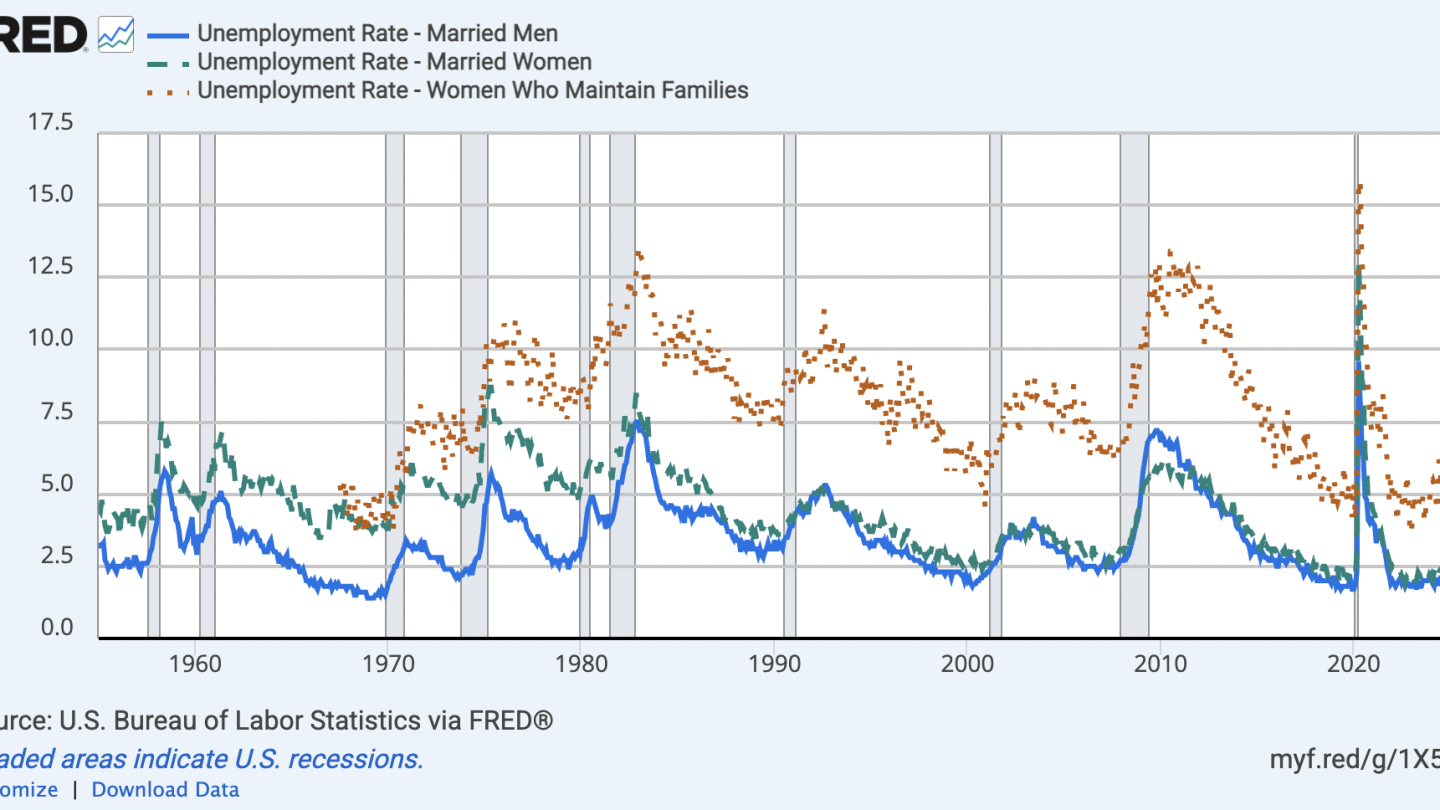
A Federal Reserve Bank of St. Louis analysis compared unemployment rates for three groups: married men, married women and women who maintain families. In the accompanying FRED chart, married men were represented by a solid blue line, married women by a dashed green line and women maintaining families by a dotted orange line.
The data revealed that unemployment among married men and married women generally moved together throughout expansions, recessions and other business-cycle changes. During the earlier years covered by the chart, however, the unemployment rates for married men and women were separated by roughly 2 percentage points. That gap gradually narrowed before the two series converged during the 1990s.
The chart also showed a considerably higher unemployment rate among women who maintain families. That category includes women leading single-parent households as well as women serving as their household’s primary breadwinner.
Understanding the differences requires distinguishing unemployment from simply not having a job. The unemployment rate does not measure the percentage of the entire population that is not working. Instead, it measures the share of the labor force that is without work but remains available for employment and is actively searching for a job. The labor force includes those people along with individuals who are currently employed.
Marriage can affect both employment decisions and labor-force participation. A married person may be more willing than a single person to remain outside the workforce, particularly when another member of the household is already earning income. At the same time, married women have progressively increased their labor-force participation over the years, adding another layer of complexity to comparisons involving marital status.
When one spouse already has a job, the other spouse may face less financial pressure to work than someone supporting a household alone. That person may voluntarily stop working and stop searching for employment, removing themselves from the labor force entirely.
Reducing the size of the labor force can place upward pressure on the unemployment rate under certain circumstances. However, the result can move in the opposite direction when a nonworking spouse searches only when a particularly attractive opportunity becomes available. Such a person may appear in labor-force statistics primarily when already employed, which can lower the measured unemployment rate.
The circumstances are different for women who maintain families. Because they may have a greater financial need for employment than married women living in households with another source of income, they may search for work more consistently and intensely.
They may also be less likely to abandon their search when a job is difficult to find. Remaining in the labor force while unemployed keeps them included in the unemployment calculation, helping explain why their measured unemployment rate is substantially higher.
The FRED chart was created using information from Table A-10 of the Current Population Survey. Users can reproduce it by searching FRED for the table, selecting the three relevant unemployment series and choosing the option to add them to a graph. The comparison was suggested by Christian Zimmermann.
Source: FRED Blog