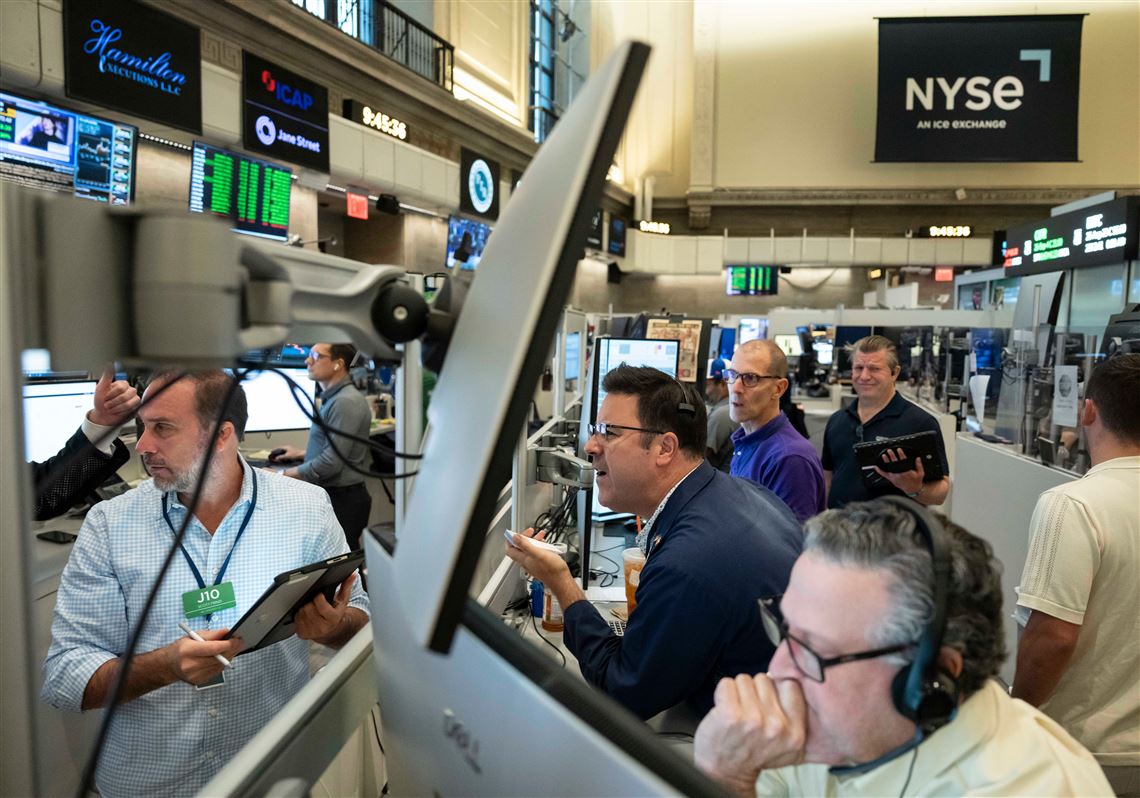
U.S. stocks rebounded Wednesday, breaking a three-session losing streak as strength in major technology companies and a relatively calm day for oil and Treasury yields gave investors some relief after a difficult start to September.
The S&P 500 rose 35.13 points, or 0.5%, to close at 7,666.60.
The Dow Jones Industrial Average climbed 295.07 points, or 0.6%, finishing at 53,061.95.
The Nasdaq Composite gained 118.05 points, or 0.5%, to end the session at 26,217.83.
The Russell 2000, which tracks smaller U.S. companies, performed even better, rising 1.1% to 2,953.17.
The advance helped Wall Street recover part of the losses accumulated during a rocky opening to September.
Stocks had entered Wednesday under pressure from rising oil prices, higher government bond yields and renewed concerns that persistent inflation could keep borrowing costs elevated.
The weak start to the month followed a generally positive August, when each of the major U.S. stock indexes finished higher.
Even after Wednesday’s rebound, investors remained cautious about inflation, the rapidly growing federal debt burden and geopolitical conflicts that continue affecting energy markets and the global economy.
One of the biggest sources of relief Wednesday came from the bond market.
Treasury yields had climbed sharply during the previous several sessions, increasing pressure on stocks and raising concerns about how high borrowing costs could ultimately rise.
Michael Antonelli, a market strategist at Baird, said investors had become nervous after the recent jump in yields because markets were trying to determine what level would begin causing more serious economic and financial damage.
Wednesday brought a temporary break from that pressure.
The benchmark 10-year Treasury yield slipped to approximately 4.78% from 4.79% late Tuesday.
Although the move was small, the absence of another sharp increase gave equity investors room to return to riskier assets.
The 10-year yield remains considerably higher than it was earlier this year.
It had fallen as low as approximately 4.20% near the beginning of 2026.
The two-year Treasury yield, which tends to respond more directly to expectations surrounding Federal Reserve interest-rate policy, also edged lower.
It slipped to approximately 4.37% from 4.39%.
The two-year yield has risen substantially during the year as well, after reaching levels near 3.50% early in 2026.
Higher bond yields can create several challenges for stocks.
They raise borrowing costs for consumers and companies, increase mortgage rates and make relatively safe government debt more attractive compared with equities.
Growth-oriented technology companies can be particularly vulnerable because investors value many of those businesses based on earnings expected far into the future.
Wednesday, however, technology companies became a major source of strength for the market.
Investors received fresh evidence that spending connected with artificial intelligence remains strong, reinforcing one of the most important themes supporting stocks during 2026.
Dell Technologies delivered the largest gain in the S&P 500.
Shares surged 15.8% after the computer hardware company released strong second-quarter results and raised its revenue outlook for the fiscal year.
Dell said demand for computing infrastructure used in artificial intelligence continued accelerating.
The results strengthened confidence that major businesses and technology companies are continuing to spend heavily on the servers and computing equipment required to operate increasingly powerful AI models.
That helped revive enthusiasm for the broader artificial intelligence trade after several difficult market sessions.
Palo Alto Networks also released better-than-expected quarterly results.
The cybersecurity company pointed to strong demand for security products connected with artificial intelligence.
Despite the strong financial performance, Palo Alto shares fell 9.3% Wednesday.
The contrasting reactions to Dell and Palo Alto demonstrated that investors are becoming increasingly selective even when companies report strong AI-related demand.
Other major technology stocks performed better.
Nvidia rose 3.2%.
Because Nvidia has one of the largest market values of any U.S. company, changes in its stock price can have an unusually large effect on major indexes.
The chipmaker has remained at the center of the artificial intelligence investment boom because its processors are widely used to train and operate AI systems.
Micron Technology gained 2.4%.
The memory-chip manufacturer has also benefited from growing demand created by artificial intelligence data centers and advanced computing systems.
Antonelli said the market remains caught between competing forces.
When interest rates rise, investors become concerned that more expensive borrowing will eventually weaken economic growth.
At the same time, corporate spending on artificial intelligence continues producing strong financial results for several major technology companies.
A report such as Dell’s can therefore quickly remind investors that the AI investment cycle remains a powerful source of corporate growth even when broader economic conditions create uncertainty.
The artificial intelligence boom has been one of the primary forces driving the S&P 500 higher during 2026.
The strength spread beyond technology Wednesday.
Banks and credit-card companies also helped support the market during portions of the session.
Broader market participation improved, with small-cap stocks outperforming the largest indexes.
Reuters market data showed advancing stocks outnumbering declining stocks by roughly 1.8 to 1 on both the New York Stock Exchange and Nasdaq.
Materials companies were among the strongest sectors, while real estate was the only major S&P 500 sector to finish lower.
Outside the United States, the market picture remained weaker.
European stock markets declined after Asian markets had also finished lower.
Investors around the world continue dealing with many of the same pressures confronting Wall Street, including rising government borrowing costs, inflation and geopolitical instability.
Energy prices remained one of the most important risks.
Oil prices held relatively steady Wednesday despite another escalation in the six-month conflict between the United States and Iran.
The United States carried out strikes against targets in Iran over the weekend, ending a period in which major hostilities had temporarily eased.
Iran subsequently retaliated against targets around the Gulf region.
The fighting renewed concerns about energy supplies and transportation through the Middle East.
Brent crude, the international oil benchmark, rose 1% Wednesday and settled at $95.63 per barrel.
U.S. benchmark crude increased 0.9% to $91.01 per barrel.
Those prices remain elevated enough to keep inflation risks near the center of investors’ attention.
The war has already caused substantial disruption in the energy market.
The Strait of Hormuz, one of the world’s most important oil transportation routes, has been disrupted by the conflict.
Under normal circumstances, roughly 20% of the world’s petroleum moves through the waterway.
Disruptions have helped push oil prices, gasoline costs and global shipping expenses higher.
Those increases create inflation pressure because energy affects virtually every part of the economy.
Higher fuel prices increase household expenses.
Businesses face more expensive transportation and manufacturing costs.
Airlines, delivery companies and other fuel-intensive industries can experience significant increases in operating expenses.
Some of those costs may eventually be passed to consumers through higher prices.
The energy shock has complicated an inflation problem that was already troubling policymakers.
U.S. inflation remains above 3%, considerably higher than the Federal Reserve’s long-term 2% objective.
The increase in prices is occurring while the labor market is beginning to display more signs of weakness.
That creates a difficult situation for the Federal Reserve because its two major responsibilities can begin pulling policy in opposite directions.
Higher interest rates can reduce inflation by making borrowing more expensive and slowing demand.
But raising rates when employment is already weakening can increase the risk of a sharper slowdown in hiring or a rise in unemployment.
New labor-market data released Wednesday added to those concerns.
Payroll-processing company ADP reported that private-sector employment declined during August.
The report represents only one measure of the labor market, but it reinforced evidence that employers have become increasingly cautious about adding workers.
A government report released Tuesday showed that U.S. job openings increased during July.
Even so, hiring remained subdued and worker turnover remained relatively weak.
The previous government’s employment report for July had been particularly disappointing.
Employers cut jobs during the month, contributing to concerns that what had previously been described as a low-hire, low-fire labor market could be deteriorating further.
Investors are therefore looking closely toward Friday’s government employment report for August.
The report will provide a much broader picture of payroll growth, unemployment, labor-force participation and wage increases.
That data could strongly influence expectations for the Federal Reserve’s September policy meeting.
Inflation figures scheduled for next week could be even more important.
Angelo Kourkafas, senior global strategist at Edward Jones, said both Friday’s employment report and the upcoming inflation data will help determine whether policymakers decide to increase interest rates during September.
Financial markets currently consider another rate increase increasingly possible.
CME FedWatch data showed investors pricing approximately a 64% probability that the Federal Reserve will raise rates at its September meeting.
Expectations have shifted considerably as oil prices and inflation concerns have intensified.
The central bank faces a difficult tradeoff.
If policymakers leave rates unchanged while inflation remains substantially above target, they risk allowing higher prices to become more persistent.
If they increase rates too aggressively, they could weaken a labor market that already appears to be losing momentum.
The recent selloff in the bond market reflects that uncertainty.
Investors have demanded higher yields as they prepare for the possibility that borrowing costs will stay elevated or rise further.
Government debt has added another layer of concern.
Large federal deficits require the Treasury to issue substantial amounts of debt.
As investors absorb that supply, they may demand higher yields, particularly when inflation remains elevated.
That combination of inflation, monetary policy and government borrowing has pushed Treasury yields upward during much of 2026.
Wednesday’s stabilization therefore provided an important temporary boost for stocks.
Energy companies produced mixed results despite higher crude prices.
Chevron rose 0.3% after confirming plans to expand its operations in Venezuela.
The move highlights how high oil prices and geopolitical disruptions are creating opportunities for some energy producers even while they create challenges for the broader economy.
The market’s rebound was also supported by several company-specific developments outside the largest technology names.
Dell remained the standout performer after raising its forecasts.
Brown-Forman, the company behind Jack Daniel’s, rose 3.9% after reporting quarterly profit that exceeded expectations.
Uber gained 1.6% after announcing plans to eliminate approximately 10% of its workforce.
Those gains helped broaden the recovery.
Still, the market has not completely escaped the pressures that produced the three-day losing streak.
The global bond selloff continues to worry investors.
Government yields remain high.
The U.S.-Iran conflict continues creating uncertainty around oil supplies.
Inflation remains above the Federal Reserve’s target.
And labor-market data increasingly suggest that hiring momentum is weakening.
The result is a market balancing strong corporate earnings and continued artificial intelligence investment against a more difficult economic backdrop.
For the week through Wednesday, the major indexes were still lower despite the rebound.
The S&P 500 remained down approximately 0.6% for the week.
The Dow was down around 0.9%.
The Nasdaq had lost roughly 0.7%.
The Russell 2000 remained down approximately 0.6%.
Performance for the full year remained much stronger.
The S&P 500 was up approximately 12% for 2026.
The Dow had gained about 10.4%.
The Nasdaq was up roughly 12.8%.
Smaller companies had performed even better, with the Russell 2000 up approximately 19%.
That year-to-date strength explains why investors remain willing to return to stocks when pressure in oil and bond markets temporarily eases.
Corporate earnings remain strong in several industries, particularly businesses connected with artificial intelligence.
At the same time, Wednesday’s rally did not eliminate the economic risks confronting Wall Street.
Investors are still watching Treasury yields closely.
They are still monitoring oil prices and the conflict with Iran.
They are still trying to determine whether inflation will force the Federal Reserve to raise rates.
And they are waiting to see whether the labor market can remain stable as borrowing costs climb.
For one session, those concerns became less dominant.
Treasury yields stopped surging, oil avoided another dramatic spike and strong technology earnings reminded investors why artificial intelligence has remained such an important driver of the market.
That combination was enough to end Wall Street’s three-day slide.
Whether the rebound can continue will depend heavily on the next round of economic data and whether inflation, interest rates and geopolitical tensions allow investors to keep focusing on corporate growth rather than the risks surrounding it.